On 28th April 1984, ITV broadcast the first episode of Robin Of Sherwood, a new Saturday afternoon family adventure serial with surprisingly elevated and ambitious production values for its timeslot and audience. On 12th July, the Video Recordings Act (1984) received Royal Assent, requiring any home video release of any material with a handful of exemptions to possess a legally mandated certificate from the British Board Of Film Classification before it could be made available for sale or rental. Following a lengthy and enormously successful if never exactly uncontroversial stint at London Weekend Television, and a shorter and less successful if decidedly lucrative spell at floundering American production company Embassy Television, Michael Grade was essentially headhunted as the new Controller of BBC1, taking up the post from 1st September; one of his earliest moves was, contentiously, to intervene in plans for the channel’s intended Christmas ‘Globe’ (which incidentally you can find out more about here). In one of his boldest shake-ups to the schedules – well, apart from his facing off against ITV over a bid to snatch away the rights to Dallas and winning by refusing to run a purchased but unaired series if they persisted, although you can find out more about that here – the first of two weekly instalments of EastEnders arrived on 19th February 1985. On 27th April, perhaps at least partly informed by her relatively reduced profile across the previous couple of years, a reinvigorated Mary Whitehouse caused renewed press excitement with a speech to the twenty first annual convention of the National Viewers And Listeners Association in which she denounced, amongst many other targets and for many different reasons, ‘Video Nasties’, Robin Of Sherwood and EastEnders. Meanwhile, on 27th February, a never identified industry source placed a call to Patrick Hill of the Evening Standard repeating a rumour that they had heard concerning the long-term prospects of a certain long-running BBC programme. All of these seemingly unrelated and unremarkable incidences would play their part, both individually and collectively and directly and indirectly, in determining what would become of Doctor Who in the second half of the eighties. Ultimately, however, nothing would bear more and more substantial responsibility for Doctor Who‘s fate than Doctor Who itself.
Produced by HTV in association with Goldcrest Films – who it’s worth noting at that point were riding high on the critical and commercial success of no loftier a triumvirate than Chariots Of Fire, Gandhi and Local Hero, thereby entering into proceedings with an effective guarantee that anything they touched would at the very least turn to crest – and written by Richard Carpenter, Robin Of Sherwood brought an element of both grimy historical reality and unsettling sword and sorcery into the well-worn legend of merrie outlaws in Sherwood Forest with high yet cost-effective production values and an atmospheric soundtrack commissioned from avant-folk outfit Clannad which, crucially, was capable of withstanding continual reuse across and even within episodes. ITV’s effective in-house publicity machine and self-styled ‘Junior TV Times‘ Look-In thoroughly threw their weight behind the series, particularly when it came to featuring the highly photogenic leads Michael Praed and Judi Trott, while Clannad’s main theme Robin (The Hooded Man) and the accompanying album Legend both vaulted up the charts, and magazines and magazine shows alike scrambled to secure behind-the-scenes features. Atmospheric and action-packed in equal measure, Robin Of Sherwood was an instant and massive hit and in many senses set new and higher standards for family-orientated adventure series, and more importantly did so in a timeslot that ITV had neglected for several years by that point, preferring instead to leave the Doctor Who-rivalling to imported American series that were generally cancelled in short order anyway. Their most recent Saturday afternoon success of any note, way back in 1979, had been Richard Carpenter’s not entirely dissimilar Dick Turpin.
Home Video had also essentially arrived in the UK in 1979, but the major distributors, wary of risking a loss of revenue from selling film rights to the television networks, were slow to realise its potential or even to acknowledge it existed. Instead, and with a wryly ironic element of robbing from the rich to give to the poor, it fell to independent startup distributors, many of which were essentially run out of industry professionals’ bedrooms in their spare time, to ensure that the sudden proliferation of video rental stores actually had enough titles in stock for home viewers eager to roadtest the freedom afforded by their expensive new toy to shove into the toploading cassette caddy – and this was where the problems began. Forced by circumstance to favour international markets and what can only be described as the less Gandhi-adjacent end of the film industry, many of them had little idea of what they were actually buying until the prints arrived, and scant awareness of the fact that many titles had either only been released in the UK with hefty cuts or even in many cases refused a cinematic certificate outright, and often not surprisingly so; home video, at that point was not subject to any such regulation. Suddenly ordinary living rooms were flooded with movies that had been considered too horrific, too explicit, too violent, too esoteric, too cheap or in the overwhelming majority of cases just plain too boring for the sensitivities of audiences more used to the tamer fare at their local ABC on a Saturday night, and they found a surprisingly eager and receptive audience – and the calls for something to be done would inevitably shortly follow. Some point to Vipco’s acquisition of Abel Ferrara’s 1979 art movie The Driller Killer and subsequent promotion of it with a title-emphasising still from the movie’s one genuine albeit abstractly rendered actual moment of extreme violence, unintentionally sparking a craze for lurid cover art that often bore little to no relation to the film’s actual contents. Others would point to an incident a couple of months later when Go Video took out full page magazine adverts for the notably less artistically challenging Cannibal Holocaust and SS Experiment Camp featuring wild artwork that whilst again not strictly accurately reflecting the admitted on-screen depravity, nonetheless left even the most casual of observers in little doubt of what to expect from them. Others still to World Of Video 2000 launching the fairly humdrum 1981 slasher film Nightmare – they took it upon themselves to add the s In A Damaged Brain – at a video trade fair with a series of attention-seeking stunts that understandably unnerved one journalist to the extent that he came up with the phrase ‘Video Nasties’ to underline his unease. Whatever its genesis was, there soon followed a wave of panic fuelled in debatable faith by tabloids desperate to sell papers, anti-sex and violence campaigners desperate to maintain relevance and MPs desperate to hang on to their seats, and what started as an in all honesty fairly reasonable and pressing concern, particularly with regard to the potential unrestricted ease of availability of such titles of children, soon spiralled out of control, pulling all manner of relatively innocent films into the furore and giving rise to a series of raids on video shops and distributors with licence to seize and destroy dozens upon dozens of often arbitrarily proscribed titles under the terms of Section Two of the Obscene Publications Act (1959). When those confiscated tapes were just replaced by twice as many copies again and as public curiosity just kept on growing in tandem with public outrage, the authorities attempted instead to prosecute distributors and retailers out of business again under the Obscene Publications Act, but found that this only complicated matters still further with different juries arriving at different verdicts in different judiciaries. Eventually, what was essentially the first instance of enforced state censorship of the arts since the Theatres Act (1968) finally abolished the legal requirement for stage performances to be vetted ahead of production by the Lord Chamberlain’s Office was instituted in the form of the Video Recordings Act (1984). It was a rushed item of legislation assembled by politicians to placate tabloid outcry, prop up prospects for an impending general election and essentially to all intents and purposes make an extraneous problem that they had not anticipated go away whilst presenting the illusion that they had ‘solved’ it and by association saved the moral fabric of the nation from being rent asunder, with minimal to no input from industry professionals or even the British Board Of Film Classification themselves, resulting in a confused and confusing set of vague and unclear yet non-negotiable legal addenda to the long established process of film classification which most notoriously prevented any home media release of The Exorcist for over fifteen years whilst many of the erstwhile ‘nasties’ subsequently sailed through more or less uncut. With no small irony, under the terms of a vaguely worded clause about instructional criminal behaviour, one of the earliest innocent victims of this – as we have already seen here – was a scene in The Talons Of Weng-Chiang in which The Doctor breaks into a room by pushing a key through a keyhole from the other side of a door and sliding it underneath on a sheet of paper. Putting it bluntly, this was not a moment to be testing anyone’s patience.
Never a man afraid to make difficult decisions, Michael Grade had been brought in as Controller of BBC1 with an unofficial brief to bolster and define the channel’s at that point fairly haphazard identity. This he took to with considerable enthusiasm and indeed considerable skill, with his earliest decisions including updating the on-screen branding with the introduction of computer-generated imagery, permitting Children’s BBC to take control of their own previously disinterestedly-linked continuity and moving Tenko to a Sunday night slot on the basis of personal viewing instinct upon which its viewing figures almost doubled, while his insistence that if The Black Adder returned for a second series it would have to be repositioned as a cheaper studio-set traditional sitcom – a change of direction that it transpired Rowan Atkinson had himself already been privately considering – helped to shape it into one of the BBC’s most iconic creations. A longtime admirer of Dennis Potter, he had not only resolved to defend the upcoming The Singing Detective against any ensuing controversy no matter how intense and targeted the furore might prove, but also cleared his notorious Play For Today entry Brimstone And Treacle, shelved by a cautious BBC back in 1976, for broadcast. Other decisions, whilst unquestionably made for sound reasons, would prove more contentious with the viewing audience. A determination that the often shapeless scheduling was restricted to programmes rigidly starting on the hour or half hour saw Top Of The Pops shorn of an entire quarter of its running time, whilst the underperforming The Tripods was cancelled outright and it was far from alone. In a career characterised by such uproar-provoking moves that would ultimately prove to be a correct if challenging decision – and yes this does include Brass Eye, which was postponed out of concerns that some of the setups actually contravened legal guidelines on political media representation and could in theory have resulted in Channel 4 being closed down if it had gone out unchecked (and added to that Chris Morris had caution-inviting form in that area, although you can find more about that in Fun At One here); although it does not include his recent bleating about how unfair it is that people won’t watch GB News even though he thinks they should, to which the only reasonable response is that he can fuck right off, and fuck off while he’s doing it, and then continue fucking off for good measure – it is safe to say that he was never averse to abruptly curtailing any programme that did not measure up to a not unreasonable quality threshold. It would be a very foolhardy producer indeed who did not pay attention to what was extremely visibly happening around them.
In one form or another, the vague concept that would eventually evolve into EastEnders had been around since early 1983, but it was Michael Grade, who knew a hit when he saw one, who understood the full potential of BBC1 launching a downbeat ongoing soap opera to counteract ITV’s generally lighter offerings, to the extent of pushing back the intended launch from Autumn 1984 to Spring 1985, where it sat alongside Terry Wogan’s astutely rescheduled chat show as a cornerstone of a revitalised weekday evening lineup. Critical and press reaction was initially gleefully negative if not downright hostile, with the tabloids in particular using the fact that it had lost ‘a million’ viewers since the first episode as a very big stick to beat the BBC with, but those half-spectacular viewing figures just kept building and by the end of the year it was the biggest programme on UK television bar none. With the tabloids now embracing it as a reliable route to shifting papers, and thanks to its insistence on handling daring storylines in a sensitive yet unapologetic manner with headline-grabbing controversy never far away, EastEnders represented the bold new face of a BBC that, unrelenting repeats of Fawlty Towers aside, suddenly had scant regard for the good old days or indeed The Good Old Days.
By his own admission, veteran taste and decency campaigner Mary Whitehouse had been at the forefront of Michael Grade’s thoughts whilst determining to push ahead with the more contentious aspects of both EastEnders and The Singing Detective, but in all honesty she had hardly been at the forefront of anyone else’s thoughts for quite some time. Never seeming to quite understand where to draw the line, many of her recent campaigns had left her looking somewhat foolish in public and invited entirely warranted accusations of making a great deal of fuss over very little. Sustained opposition to Life Of Brian had drawn little bar bafflement from anyone who was not a member of a religious right that did not need converting to the cause, a successful prosecution of Gay News under an archaic blasphemy law had provoked deep suspicion even amongst those who might have felt a tacit alignment to her views, and a similar further attempt to prosecute the National Theatre over a production of The Romans In Britain, founded on what in several cases can only be described as outright lies from defence witnesses, ensured that more or less the entire arts industry stood vehemently against her en masse. It was perhaps with all of this in mind that in a speech to the twenty first annual National Viewers And Listeners Association convention on 27th April 1985, in a markedly different and less assured yet more combative tone, Mary Whitehouse denounced Robin Of Sherwood, ‘Video Nasties’, EastEnders and the recently concluded new series of Doctor Who in measured and markedly non-hysterical terms. This was not – as you can find out here – the first occasion on which Mary Whitehouse had attacked Doctor Who and Robin Hood in the same speech, but this time around it seemed to strike a very different note. In this context, it was difficult even for those who saw her as a time-wasting self-important irritant driven by attention and distinctly dubious and worryingly opaque political leanings to dispute that even if they didn’t agree with it, she at least had an argument. All of this is, with depressing inevitability, retrospectively surrounded by ideologically loaded disinformation of the sort that helps nobody -as strikingly dissonant as it may be to find yourself having to speak up in Mary Whitehouse’s defence, in what is frankly something of a recurring theme for any discussion of her at any point during her inveterate crusading, there is no reliable record anywhere of any evidence to suggest that around the same time she also tried to have Pob’s Programme ‘banned’; in fact it would be genuinely surprising if they had not at least considered her as a jumper-following guest – but to assume that nobody within a rapidly evolving BBC would be responding to her or indeed anyone’s comments about on-screen violence with anything other than the traditional bullish dismissal would have been a misjudgement to say the least.
By the time that Mary Whitehouse’s views were registered in public, however, it was too late for them to have any substantive effect. On 27th February 1985, under the headline ‘Dr Who Fails To Make The Grade’, the Evening Standard repeated a report from their unnamed BBC source that the BBC intended to cancel Doctor Who. Within days, it had become more than abundantly clear that this was anything but press conjecture. It matters had proceeded as intended on paper and in paperwork, this would have been the last that anyone saw of anything even approaching a seemingly endless multicoloured scarf.
By this point, anyone reading this will probably be wondering why there has thus far been so little mention of Doctor Who itself. This is on account of one simple and blunt reason – when it comes to series twenty two, it is frankly more enjoyable to talk about anything but Doctor Who. There will of course be more to say about the at times frankly unpleasant run of episodes in due course, but the primary causes of the show’s cancellation can essentially be broken down as follows. Increasingly apparently labouring under a delusion that all of his decisions were right and everything was fine, John Nathan-Turner – who would later reflect with something weirdly approaching pride verging on pining for ‘real boy’ status that he often asked in his prayers at night for Mary Whitehouse to watch and object to Doctor Who on no other basis than that it sometimes occasioned a moderate increase in viewing figures – had lobbied for a return to the ‘traditional’ Saturday afternoon slot with big bold grown-up fifty minute episodes like Hardcastle And McCormick to boot, seemingly envisaging some form of celebratory triumph but in actuality exposing the programme that had only recently considered Warriors Of The Deep suitable for broadcast to the attentions of those who would rightly point out where and how it was lacking in comparison to Robin Of Sherwood. Meanwhile, Eric Saward had taken an ill-advised decision to introduce a harsher and more violent tone to proceedings, in depressing pursuit – and in a misapprehension that continues to dog Doctor Who to this day – of a delusion that a long-running family entertainment show somehow desperately needed to be ‘toughened’ up to appeal to a more ‘sophisticated’ audience that have never actually existed outside of the imagination of people who, ironically, need to grow up themselves, thereby exposing the programme to the attentions not just of traditional antagonists like Mary Whitehouse but anyone who had found themselves disturbed at the thought that something called Zombie Flesh Eaters was sitting on that sort of carousel of VHS tapes in their local off licence as if it was the most casual occurrence in the world. Both of the above brought Doctor Who firmly into Michael Grade’s firing line, and he was far from alone; numerous other executives, notably that inexhaustible laugh-a-minute gag machine Jonathan Powell, shared his opinion that the ailing and ageing series was looking increasingly out of place as the eighties rolled on and rolled its sleeves up like Don Johnson in Miami Vice. Doctor Who had few friends within the BBC by this point, and it would be astonishing if even JNT at his most blithely cloud-headed had expected to find any.
It’s at this point that I have to come out of character slightly. Some will doubtless challenge aspects of my conclusions, which provided it is not just knee-jerk nitpicking based on repeating tired handed-down observations such as, say, claiming that Mary Whitehouse tried to ‘ban’ Pob’s Programme, is both understandable and reasonable and indeed in some cases and to a strictly limited degree welcome, although I would counter that I do actually have some semblance of an idea of what I am talking about here. Back in that extended nineties-straddling hinterland when it really did look like JNT’s miscalculations had eventually and ultimately probably put paid to Doctor Who for good, I did my dissertation on the Video Recordings Act (1984). In the interests of academic rigour, I eventually saw all seventy two titles – although I think it’s seventy four, but let’s not get into that right now – on the Director Of Public Prosecutions’ list of video cassette titles liable for forfeiture, seizure and destruction under Section Two of the Obscene Publications Act, courtesy of methods as varied as walking into HMV and walking out with The Evil Dead on VHS, getting a big scary letter authorising me to view the University library’s restricted access copy of Possession, and covertly handing over cash at the local covered market to a man who insisted on only being known as – I kid you not – ‘Sharaz Jek’ for a fairly ropey umpteenth generation two-to-a-tape dub of The Werewolf And The Yeti and Blood Rites. My informal conclusion, in case you were interested, was that while one or two of them despite having been passed uncut for home entertainment decades ago should still be liable for forfeiture, seizure and destruction even now, the overwhelming majority were ridiculous throwaway horror runarounds with deliberate gratuitous shock moments that were largely deprived of any capacity to deprave and corrupt on account of their often hilariously cheap realisation, made for a very different audience than the one who were suddenly so alarmed at their availability and which it would honestly have proved more effective to ignore than to draw so much hysterical attention to. It was just that those expressing concerns about those two or three deeply unpleasant titles didn’t seem to have the capacity to focus on them or to know where to draw a sensible and manageable line, but that’s what happens with moral panics.
Of course, I didn’t see any of the ‘Video Nasties’ at the time. What I did see, however, was the 1985 run of Doctor Who, and I am not in any way exaggerating when I say I would far rather talk about Don’t Go In The Woods… Alone! – which I am not even especially interested in talking about to the limited extent of namechecking it here – than I would Attack Of The Cybermen, Vengeance On Varos, Revelation Of The Daleks or especially The Two Doctors. They simultaneously bored and nauseated me as a younger viewer and they bore and nauseate me now. Conversely, despite their many, many faults and flaws, I enjoyed and still enjoy The Mark Of The Rani and Timelash, which appear to at least represent some semblance of a notion of someone somewhere realising they had taken a very wrong turn and were supposed to be making fun family entertainment after all. Conventional wisdom tells me that I am wrong to express any appreciation for either of the above. Conventional wisdom also attempts to apportion blame to poor old Colin Baker and Nicola Bryant, who were probably every inch as uncertain and baffled as anyone else. Everyone who was actually responsible, and who should have known better, went into this with their eyes open and knew exactly what they were doing, and the surprise that certain of them would later feign in relation to the attempted cancellation of Doctor Who was quite something to behold. As for the actual fans, they seem to have been the least of anyone’s considerations, but they did their best by dressing up as Krynoids or something.
Meanwhile, speaking of walking into situations with your eyes open, this isn’t They’re Still The Woods, Why Are You Going In Them… Alone?, so it’s time to indulge in some serious teeth-grittage and try and find something entertaining and amusing to say about the stories that didn’t have The Rani in them. Pass me that Krynoid costume…
It’s Still A P… Oh
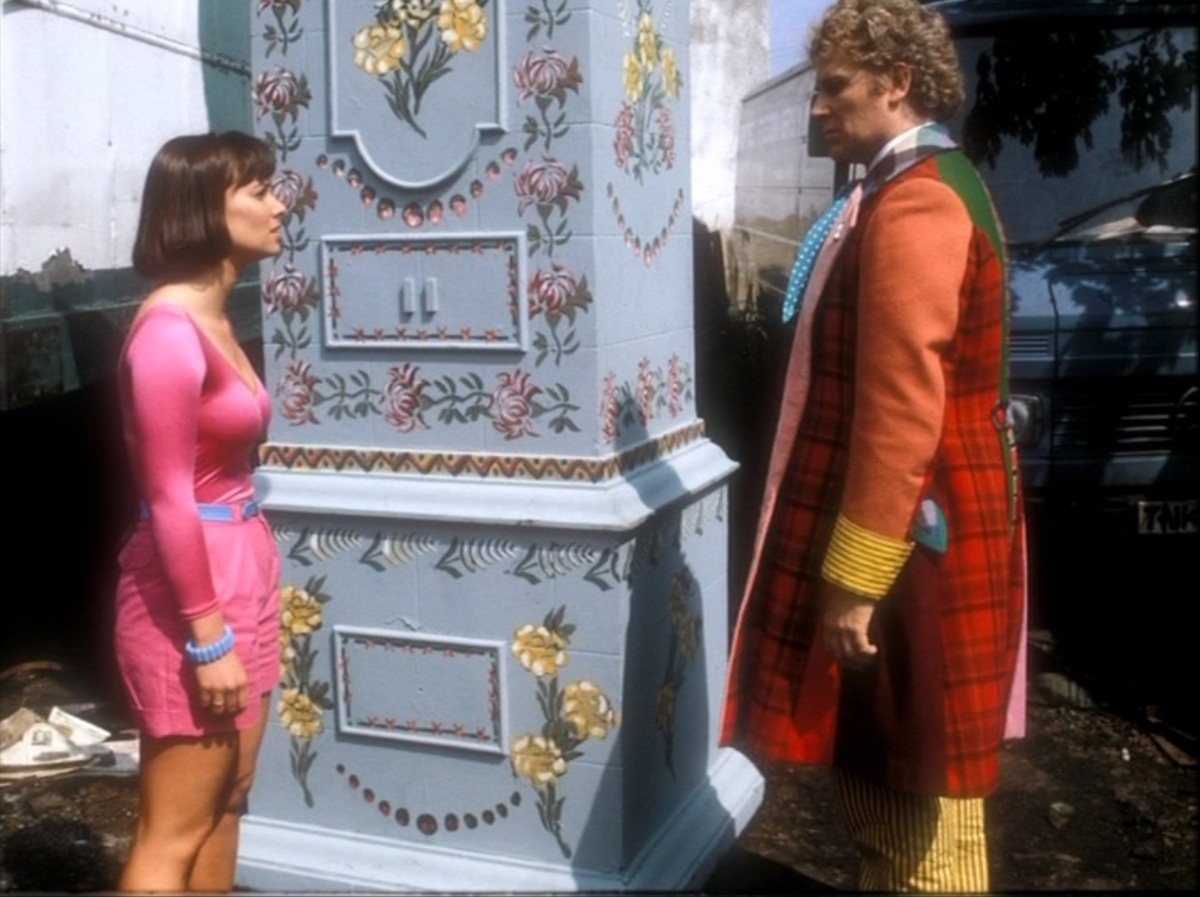
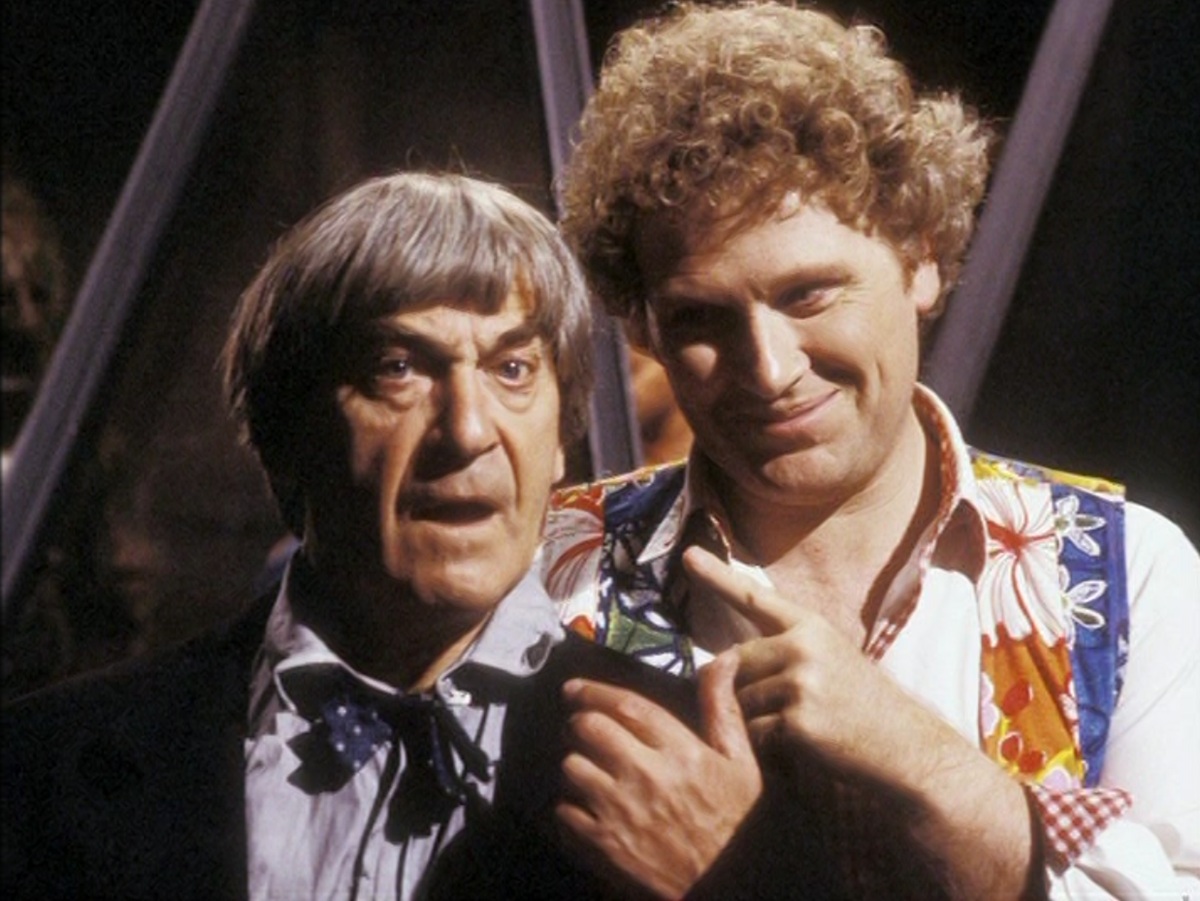
Attack Of The Cybermen, essentially Colin Baker’s debut story from the perspective of a wider viewing audience who would doubtless have forgotten by then that The Twin Dilemma even happened, was credited on-screen to one ‘Paula Moore’ – it is still not entirely clear whether this apparent pseudonym ever actually strictly referred to an actual individual or not – and to be frank it is surprising that there are still so many clamouring to establish full or partial credit for themselves for this overly violent and unnecessarily noisy mess revolving around uncharacteristic displays of Cyber-thuggery almost entirely reliant on acute familiarity with both a story from the previous series and at that point partially and wholly lost respectively stories from 1966 and 1967 without ever really bothering to explain itself rather than trying their hardest to comprehensively distance themselves from it. Across two interminable instalments that somehow feel overlong despite technically being the length of a traditional four part story, viewers are treated to additional and conspicuously never revisited lore relating to both Telos and Mondas, the CyberController returning after his lone appearance almost two decades ago and played by the same actor who it has to be said did not display the same lithe menace he had demonstrated in abundance back in 1967, a redemptive arc for a villain they knew little about on his first appearance and essentially found out even less about now, a Cyberman painted black to effect that camouflage they were evidently in such desperate strategic need of, a ‘moving’ musical motif that bears a jarring resemblance to Send In The Clowns, hefty doses of unnecessary brutality including a LOT of blows conducted with pipes, and of course rigid adherence to the ludicrous notion that viewers were clamouring to see an ‘abrasive’ Doctor still having issues with a regeneration ‘gone wrong’, who at one point appears to take some sort of dimensional reading of Peri’s inevitably impractically attired breasts. Somewhere underneath all of this, however, there is an additional subplot that frankly it is something of a stretch to consider it a subplot, as it goes absolutely nowhere and should have been not just crossed out after its first appearance in a draft script but torn up, set on fire and mailed to Mary Whitehouse with a note reading ‘we give up, you win, just let us keep The Dangerous Brothers – deal?’. Perhaps fuelled by the press hysteria that had greeted his announcements of intent to dispense with the services of the Sonic Screwdriver and K9 and indeed his possibly not as off the cuff and mischievous as it may have appeared suggestion that he might consider casting a female Doctor, John Nathan-Turner had grown increasingly prone to dropping ludicrous unfeasible hints of changes that could and should not possibly happen and crossing his fingers that the associated degree of attention might ensue. One sabre that he had begun to rattle with the frequency of the repetitively rattled pipes in Attack Of The Cybermen was the possibility of that pesky Chameleon Circuit finally being repaired and, well, that Police Box finally changing. It was an act of sheer hubris – or madness – to even vaguely allude to the idea that one of two immediately recognisable visual signifiers of the Doctor Who ‘brand’ that did not change with the lead actor, the other of which of course the BBC famously did not own the rights to, might be so casually dispensed with in the service of nothing in particular, but astonishingly, he went one further with this and actually contrived to attempt to fool the audience into thinking that they had indeed seen the last of the trusty Police Public Call Box. Over the course of Attack Of The Cybermen the TARDIS handily disguises itself as a procession of doors, a pipe organ on which The Doctor promptly dashes out the most predictable musical motif imaginable to a distinct lack of comic effect, and what appears to be some distant relative of Lord Belborough’s Dutch Organ from Chigley before – oh no!!! – it just stopped working again for no readily stated reason. Unfortunately for JNT, nobody really much cared let alone understood what was happening and why, and within weeks he would find himself – well, we can only hope; this was JNT we are talking about here – possibly slightly regretting that desperation for press interest. Speaking of which…
“Are They Very Disturbing, These Videos You Sell?”
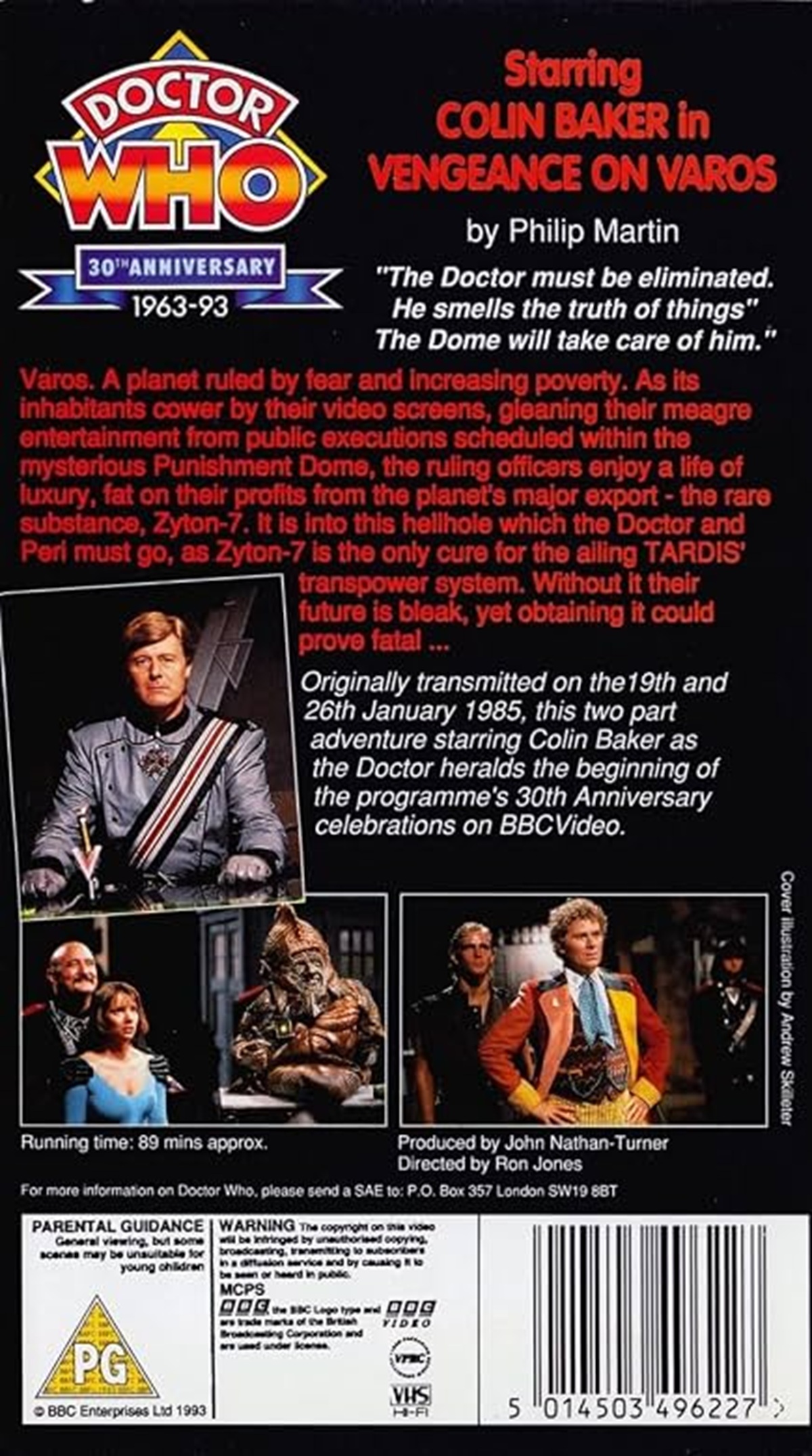
On paper, Vengeance On Varos should be the ideal Doctor Who story for anyone whose political, personal, artistic and just plain wanting everyone to be nice to each other sympathies fall somewhere to the left of the Tonton Macoute. It represented a bold attempt to take Doctor Who in a more modern direction, and had a genuine and indeed timely and topical – if not in many regards decades ahead of its time – point to make about the potential to frame individuals’ suffering and misery as ‘entertainment’. It also introduced one of the few genuinely memorable original antagonists of Doctor Who‘s floundering later series in the form of Sil, a sort of gabbling capitalist slug which surely at least partially inspired Spitting Image‘s subsequent lettuce-fixated puppet of Kenneth Baker, as splendidly portrayed by Nabil Shaban, a disabled actor who had not only been one of the first performers seen on the recently-launched Channel 4 – which considering its early unfairly tabloid-designated reputation for ‘shockers’ there is a case for arguing may well have informed part of Vengeance On Varos‘ narrative standpoint – but also relentlessly used any and every platform he was afforded to politely but firmly campaign for equal as opposed to special treatment within his industry. It also gave rise to an absolutely textbook incomprehensible JNT anecdote that went absolutely nowhere in the form of his frequently breathlessly excitably related claim that Marsh Minnows, the reportedly citrus-hewn swampily-dyed delicacies relentlessly scoffed by the in-character Nabil Shaban, were ‘nearly marketed’. To whom and why was a question that he never quite seemed prepared to address. It remains, however, almost the dictionary definition of divisive, frequently to be found hovering unnoticed around the mid-rankings of any given ‘BEST STORY EVER’ poll and the reasons for this are both not difficult to see and very difficult to unsee – however you may attempt to frame it, Vengeance On Varos visibly revels in and celebrates the very presentation of violence and brutality as entertainment that it purports to critique and condemn. The problem, expressed in wordplay that it is apparently a legal requirement to use in any discussion of Vengance On Varos, is literally, well, with the execution. Hangings, immersion in corrosive substances, grotesque enforced body modifications and more are presented somehow both casually and voyeuristically as Sil and company writhe with delight, the ordinary Varosians moan about all the bloody repeats and everyone’s hero The Doctor essentially regards each and every instance with little more reaction than ‘ha ha, serves you right’. They appear with the frequency and apparent narrative relevance of a list of things that purportedly happen in The Bogey Man in tabloid scare stories about the rise of ‘Video Nasties’, and considering Eric Saward’s disgruntled pursuit of an edgier audience, JNT’s childish desire to be berated by Mary Whitehouse for publicity and the fact that they had hired Philip Martin, well known and widely celebrated for his challenging treatment of screen violence in adult dramas, to write it, it is difficult not to leap to the conclusion that they were hoping for a slice of The Beast In Heat-adjacent outrage action too. There is probably a case for considering that it might have been actually intended as a sort of meta-commentary on the Doctor Who audience’s own complicity in violence as entertainment, but if so, it was pitched at a frequency so acute that even Godfrey Humphrey would have suggested they steady on a bit. From the audience’s perspective, they were having their Marsh Minnow-caked cake and eating it. The grand irony of all of this, of course, is that if Vengeance On Varos is remembered by the wider public for any reason, it’s because Jason Connery appeared in it shortly before taking over in the lead role of Robin Of Sherwood. Still, at least there was something to actually admire in it…
In A Fix With A Fix With A Fix With Sontarans (With Optional ‘The’)
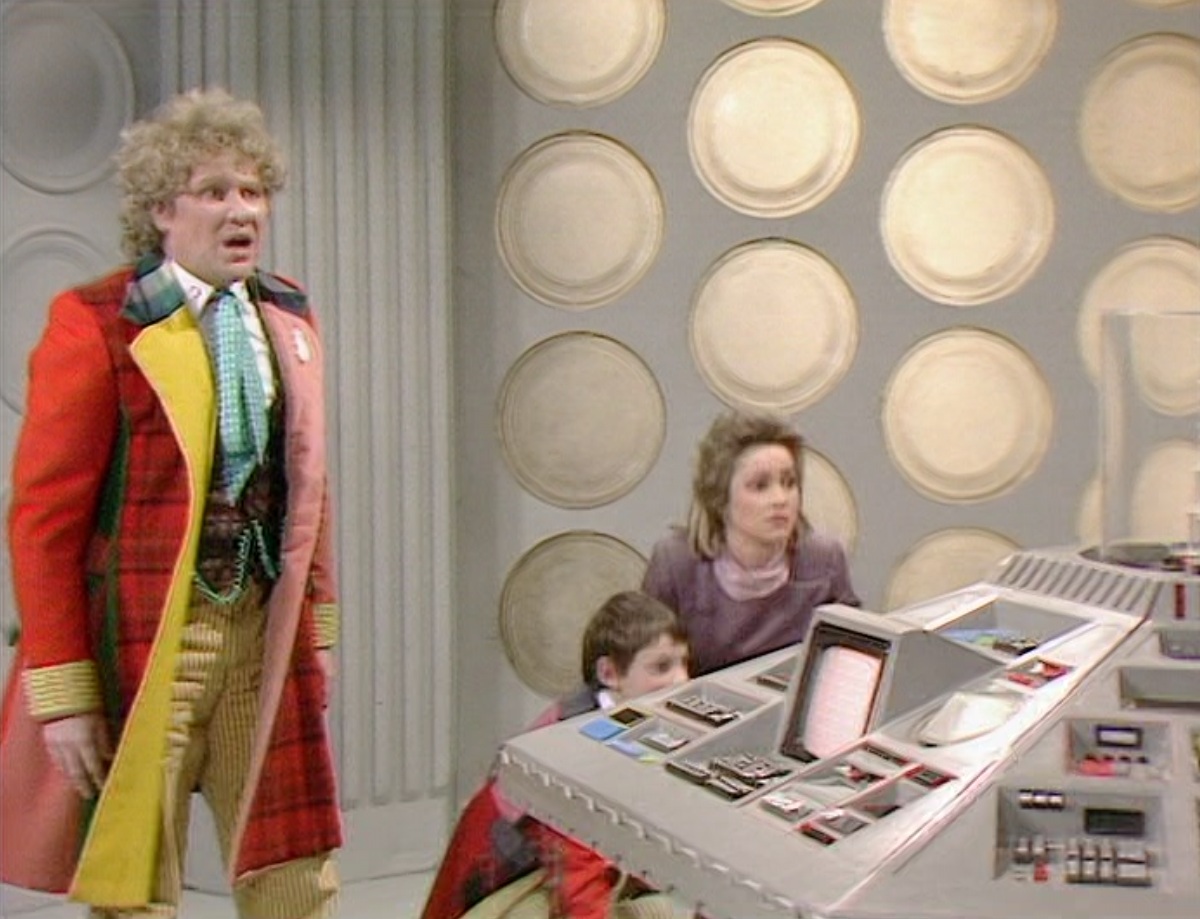
If there is one scene that underlines pretty much everywhere that Doctor Who had taken a wrong turning by the mid-eighties, then it’s a scene that occurs – intentionally chosen in preference to ‘appears’ – around six minutes into the third and final episode of The Two Doctors. In it, slobbering ravenous rat-chomping extra-terrestrial caterer who had not seen V honest Shockeye O’The Quancing Grig, having already remarked upon Peri’s qualities as a ‘fine, fleshy beast’, stuns her and lays her out on his kitchen table whilst sharpening his knives and sizing her up. The implication, in case it had somehow eluded you even in spite of the helpfully illustrative camera angle, is that he is ferociously salivating at the prospect of eating her breasts; fortunately, he is thwarted in his desperation to ‘trim the beast’ by his immediate required participation in somewhat more opaque but nonetheless pressing plans to do with something or other. As well as being a colossally stupid move at a moment when newspaper editorials were essentially uniform in their despairing of the capacity for video shop punters to find themselves unable to choose between renting Cannibal Holocaust, Cannibal Ferox, Cannibal Apocalypse, Cannibal Terror and Cannibal Man – spoiler, he isn’t – it is quite simply repulsive and repugnant to watch. Whatever the intention, there is no getting around the unpleasant fact that it comes across as hideously and lasciviously perverted in a manner that should certainly have ordinarily had the guest-starring second Doctor exclaiming ‘Oh crumbs!’. Perhaps the reason, other than its sheer unpleasantness, that it does not find itself subject to scrutiny more often is that it is simply one of many unpleasant moments in a story that somehow manages to combine spectacle with tedium, profligate production spending with cheapness and nastiness and references to ‘squat’ Sontarans with strikingly tall actors, and all matters considered it is perhaps not remotely surprising that Michael Grade reportedly cited The Two Doctors to JNT as compelling evidence for Doctor Who slinging its hook with immediate effect. It is not quite the most objectionable Doctor Who story ever broadcast – that would come several decades and several Doctors later – but it certainly made a good attempt at vying for that ‘honour’. You would probably understandably assume on this basis that it was not actually possible for The Two Doctors to become even more problematic after it was broadcast, but somehow, it did. On the same day that episode two was transmitted, a certain other Saturday afternoon show on BBC1 with a title not a million miles removed from Stephen Will Do His Level Best To Comply With Your Wishes included amongst its gallery of individuals who had had it fixed for them and them and them and ba-ba-baaaaa was one Gareth Jenkins, who wrote in to ask if he could appear in Doctor Who as The Doctor as his grandmother had made him – surely with some effort – a replica of Colin Baker’s coat. His letter of course was only the start of it, and never one to pass up a you can show a close-up of the ciaaaaar level opportunity for publicity, JNT quickly arranged for a surprisingly entertaining Eric Saward-scripted mini-episode with the aspirant Doctor joined by Colin Baker, a brace of Sontarans and – deputising for a momentarily out of favour Nicola Bryant – Janet Fielding as Tegan, having evidently invested in a significant volume of Studioline from L’Oreal since her most recent trip in the TARDIS, with a certain Scrawny Old Bastard showing up at the end to present Gareth with oh my goodness me what have we here it does appear that what we got is a Jim’ll Fix It Badge. For many years, this seemingly charming additional exercise in extra-curricular whimsy enjoyed a surprisingly warm reputation, and indeed the joke once universally and in all honesty not entirely untruthfully ran that the later DVD release was in fact A Fix With Sontarans with The Two Doctors as an extra. Then of course certain details came to light and suddenly A Fix With Sontarans no longer seemed as charming, even in comparison to The Two Doctors, and indeed for a good while it disappeared from availability altogether, only eventually resurfacing in heavily edited form. As welcome as it always may be to draw a discreet line under The Two Doctors and move on, it really is a shame that it has to be for this particular reason and it is almost enough to make you feel sorry for poor old Shockeye. Almost. We really could do with something a little more light-hearted right now, couldn’t we…?
That’s An Unusual Mark
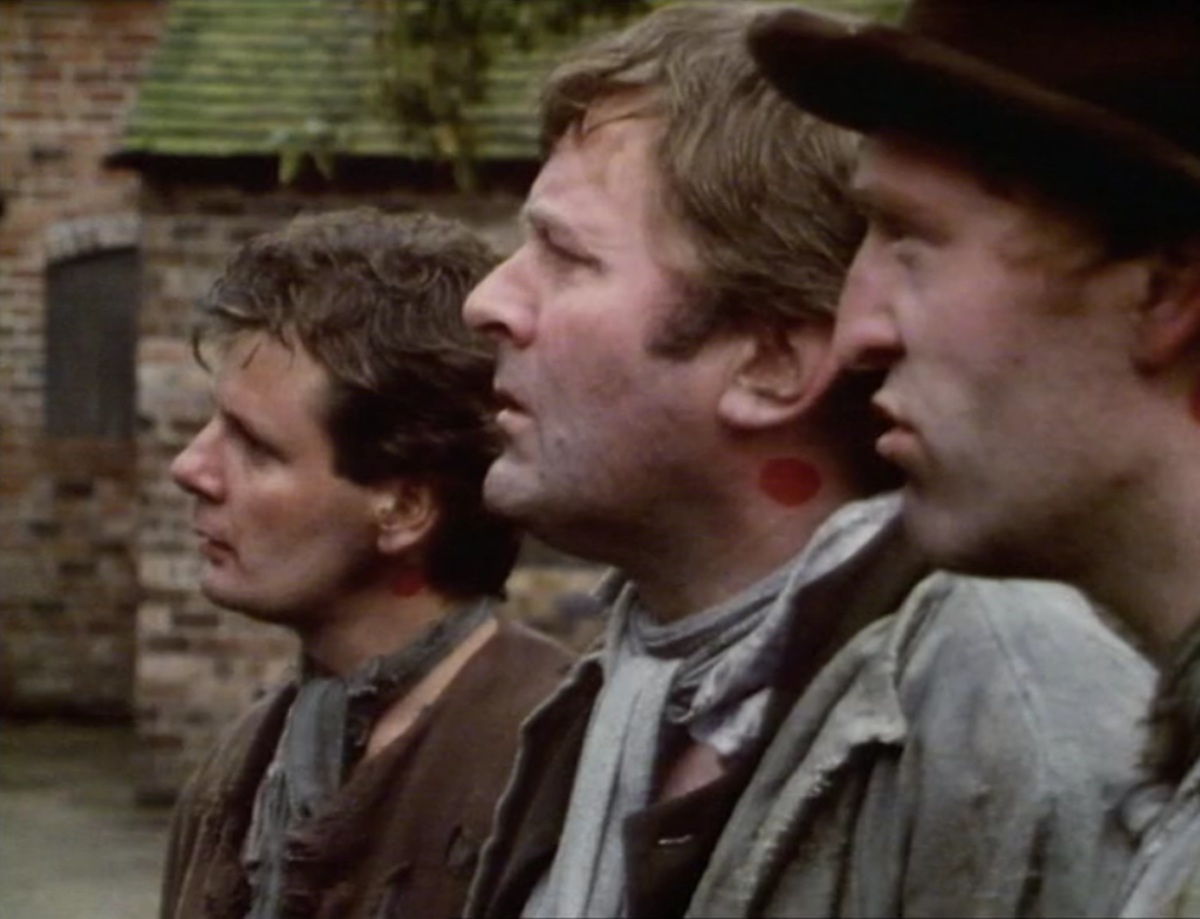
Around fifty places below The Two Doctors in any given ‘best story’ poll, you can usually find poor old The Mark Of The Rani languishing unloved and unwanted, its lowly reputation having apparently been unanimously decreed at a meeting that nobody who watched it and the time and frankly found it something of a relief to see a light-hearted steam age historical runaround amidst an overwhelming barrage of unpleasantness was invited to. Although it is fair to say that The Mark Of The Rani is not exactly Spearhead From Space, it is a decent story which has the misfortune to find itself weighed down by association with writers Pip and Jane Baker’s other less well regarded contributions to Doctor Who, and dogged by an off-the-shelf lazy observation that it is crammed with florid and impenetrable ‘technobabble’, which is presumably more acceptable than the tiresome and unappetising ‘foodbabble’ gobbling up every second line of dialogue in The Two Doctors. What was more, once again it succeeded in introducing one of the few new iconic adversaries of the post-Fourth Doctor era in the form of Kate O’Mara’s outrageous soap-glam bastard The Rani, whose wider public recognition considerably outstripped her actual quantity of on-screen appearances and whom according to Kate O’Mara herself played no small part in reviving her career to the extent that she was offered a not entirely un-Rani-like part in Dynasty only a couple of months later. Most pertinently of all, it doesn’t have The Doctor casually deploying poisonous vines to impede the progress of some guards. In a sense, and with very heavy irony, it was far closer to Tom Baker-era Doctor Who than many affect to believe the more violent stories that surrounded it to be. It would be a bold writer who attempted to suggest that there was anything in The Mark Of The Rani worth holding up as accomplished drama or high art, but if there is to be any genuine fault found with it – other than Anthony Ainley reacting to some puppet dinosaurs sort of going up a bit in the manner of the Rentaghost cast prancing about behind the closing credits – then it is literally there in the title. The ‘mark’ that The Rani bestows on her subjugated industrial revolutionees appears to have been applied with something somewhere between a cheap red magic marker with a partially dried-out tip and whatever it was they used to append a bindi to Eddie Large’s forehead in one of those incredibly tasteful sketches that were remarkably still all over television in the mid-eighties; perhaps Eric Saward might have been better advised redirecting his searing incisive media commentary onto that lingering phenomenon instead. Still, like it, loathe it or just plain forget to mention it in ‘best story’ polls, The Mark Of The Rani at least had its heart in the right place, and thankfully it was not alone…
My Pertwee And I
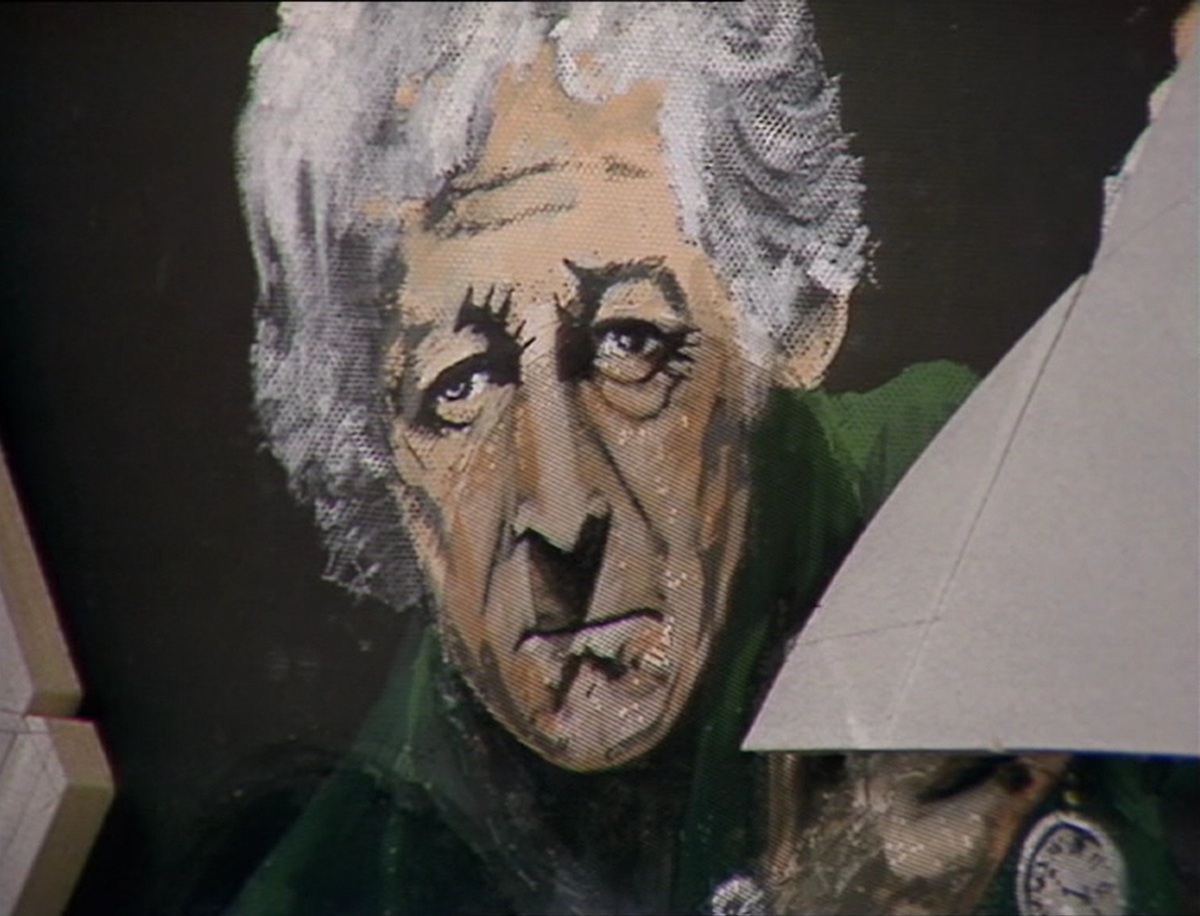
As befits a story that has something to do with H.G. Wells being flung backwards and forwards through a Thomas Salter Science Chemistry Set while the eighteen thousandth iteration of the Loch Ness Monster fell in one-sided obsessive love with Peri, Paul Darrow delivered-his-dialogue-as-distinct-unrelated-words, a blue-faced android spoke to the tune of the theme from Automan or something and the phrase ‘Sezon at the Falchian Rocks’ provoked undue and disproportionate consternation although nobody is quite sure what, Timelash can often be found languishing at the foot of any given ‘best story’ poll, left somewhat unfairly to battle it out with The Twin Dilemma for last place when that honestly ought to be spun off into a separate poll of its own and then cordoned off and set adrift on the Antarctic Ocean. Timelash is ostensibly if confusingly built around legends of an earlier visit by The Doctor to the planet Karfel which has been conveniently hidden from history by literally fish-faced ruler The Borad, which is why it is something of a surprise to discover that Karfel’s Inner Sanctum is in fact housing a boarded-up portrait of Mollie Sugden, at that point starring in ITV’s top-rated early evening sitcom That’s My Boy and soon to appear in semi-canonical sort-of spinoff My Husband And I, a comedy show in which absolutely nothing happened whatsoever; and if you think that might be an exaggeration for comic effect – albeit more comic effect than My Husband And I ever had – you can find out what little there is to find out about its lone Christmas special here. The most recent episode of That’s My Boy at the time of Timelash‘s broadcast was Surprise, Surprise, in which Mollie Sugden’s character got a bit narked that everyone had given her rubbish birthday presents and that was essentially that, and yet it somehow managed to avoid cancellation for an entire year longer than Doctor Who. Thankfully, the greatest creative minds in the industry were on hand to ensure that The Doctor’s disappearance from the airwaves was handled as tantalisingly and seamlessly as possible…
“I’ll Take You To-FT“
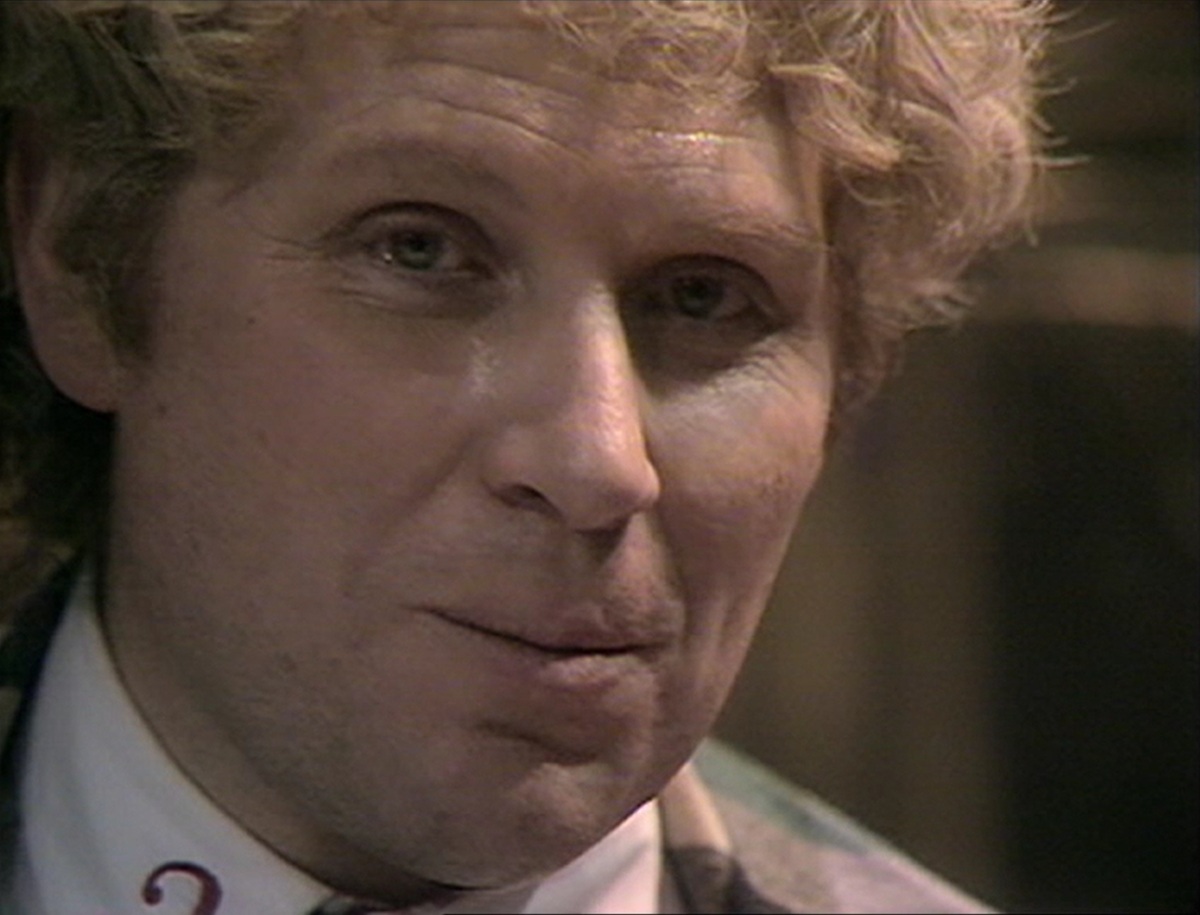
Considering the current average form of this particular run of Doctor Who it should probably come as little surprise to discover that Revelation Of The Daleks is yet another barrage of evil scientists conducting inhumane experiments because reasons and space mercenaries alternately smashing hands and having their hands smashed, only on this occasion it is a little easier to defend on account of also featuring Davros pretending to be Zippy, a sort of transparent Dalek that everyone always adjudges to be ‘really good’ for some reason that nobody has ever quite been sure of and Alexei Sayle apparently auditioning for the Radio Televizioni Shqiptar version of Sounds Of The Sixties. Before Michael Grade had ‘wielded’ what the tabloids always insisted on calling ‘the axe’, it was even supposed to conclude with something of a new departure for Doctor Who – an end-of-series cliffhanger of sorts with the emphasis very much on the ‘of sorts’. Reacting to Peri’s post-Davros-detonation outburst about how The Doctor never took her anywhere fun, the story and indeed the series would originally have ended with him looking directly at the audience and saying “I’ll take you to Blackpool” with the exact same tone as a teacher quietly congratulating themselves on the witty observation they had thought up in relation to you not having done your homework, ostensibly leading ‘directly’ into a Blackpool-set adventure the following year. Another genius idea from the people who brought you plonking the new Doctor’s debut story at the end of the previous run, it was a clunky line clunkily delivered and in general a bad idea all round; never mind the wider audience forgetting that they’d already seen Colin Baker in action, this time around it is doubtful that even fans would have remembered this apparent non-sequitur a whole twelve months later. Fortunately, when it became evident that no such story would ensue they had the perfect solution – even more clunkily edit out the word ‘Blackpool’, drawing proceedings to a close on a weird hamfisted freeze frame and leaving pretty much anyone watching neither knowing nor caring what was going on. To think that this was very nearly the very last that was seen of Doctor Who is frankly staggering and, especially when considered in relation to the fact that technically the best Doctor Who story seen on screen that year was a sketch in The Lenny Henry Show featuring a Cyber Margaret Thatcher, it is little wonder there was such a pronounced and widely perceived need for change. We will of course be finding out what that change actually entailed, and indeed what became of that mooted jaunt to Blackpool, in due course. In the meantime, however, it is safe to say that Doctor Who fandom was not exactly taking the threat of cancellation lying down, and some were more vocal in their opposition than others…
Bring Him Back Now, We Won’t Take Less
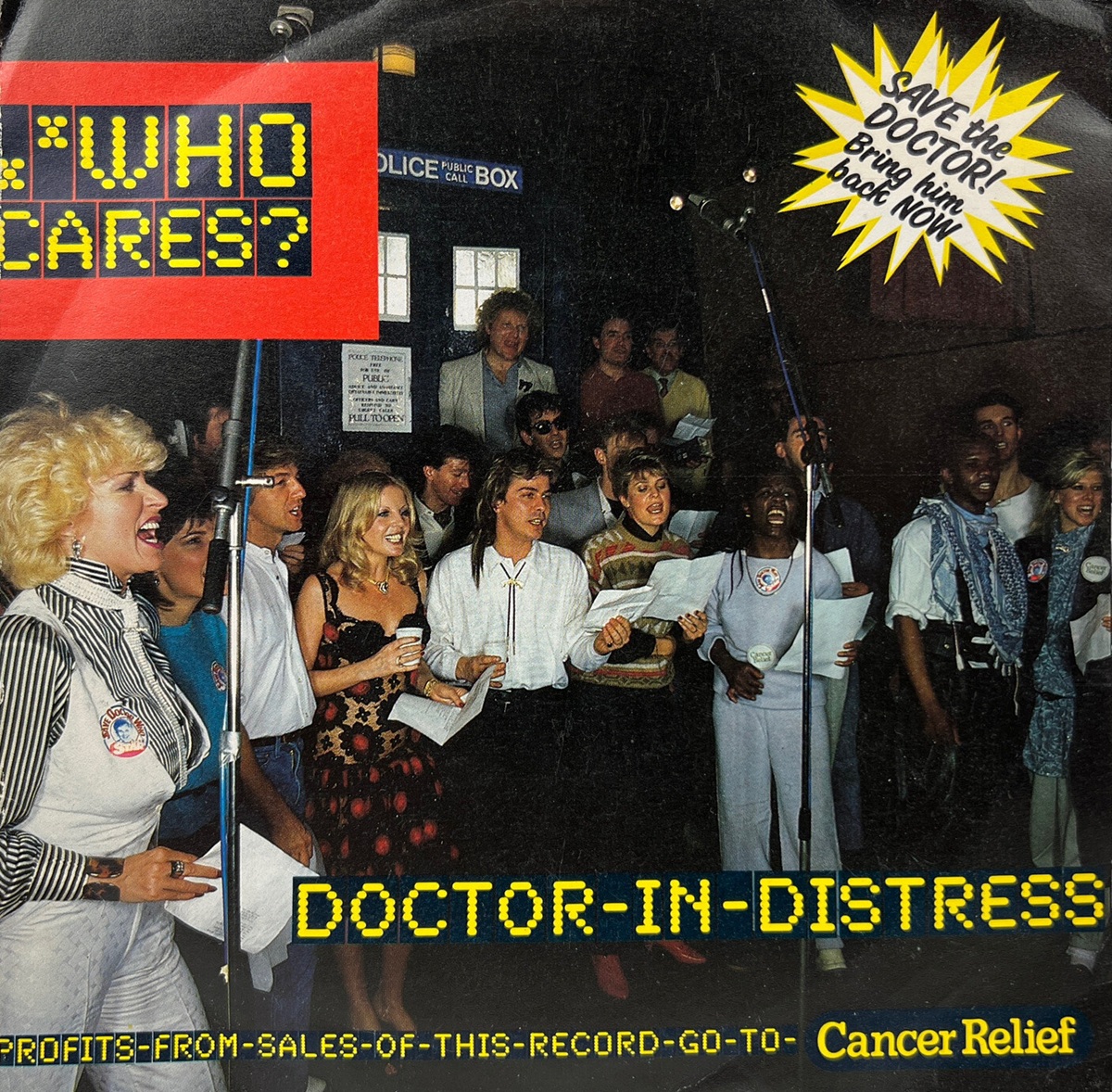
Pretty much the dictionary definition of a ‘superfan’ – and whether that is a positive or negative designation remains very much open to question – it is fair to say Ian Levine has always been a divisive figure amongst Doctor Who fandom. In his actual career as a DJ, songwriter and producer, he has also proved a divisive figure amongst Northern Soul fans, although arguably for entirely different reasons; from the very earliest days of the scene he helped to both found and define, he has consistently pushed for enthusiasts to find and embrace new sounds instead of looking backwards, controversially albeit to great popularity introducing suitably driving disco sounds into the playlist at the legendary Blackpool Mecca to the enduring chagrin of purists, and as recently as the splendid 2026 documentary Northern Soul: Still Burning expressing his ongoing exasperation at dancers demanding to hear The Snake by Al Wilson for the five hundred and ninety six millionth time when the likes of Taylor Swift are churning out decent new records with a solid Northern beat. Perhaps in correlation to how certain of his more TARDIS-adjacent pronouncements are periodically received, there appears to be a widespread misconception amongst Doctor Who fans that his musical output is somewhere between bland and perfunctory and downright dreadful, and as tends to be the case with widespread misconceptions, this is absolutely not remotely true. Exemplifying the Blackpool Mecca sound, his earliest disco-tinged stompers like Evelyn Thomas’ Weak Spot, L.J. Johnson’s Your Magic Put A Spell On Me and Barbara Pennington’s Twenty Four Hours A Day are strong and catchy efforts that actually proved Top Of The Pops-bagging hits in their own right. By the early eighties, when he began a decade-long stint as the resident DJ at pioneering gay club Heaven and by all accounts was one of the earliest DJs in the UK to adopt the soon to be commonplace art of beatmatching, he had moved on to the emergent HI-NRG dance music scene, furnishing dancefloors with a chain of hugely popular releases from his own Record Shack label including Evelyn Thomas’ genre anthem and international top ten smash High Energy and an imaginative reworking of Northern Soul standard Skiing In The Snow by Laura Pallas And The Reputations which actually got the lyrics correct for once. Later in the decade he founded the short-lived but hugely influential Motor City label, specialising in tracking down lesser-known Motown artists and providing them with brand new songs with a studied post-Stock Aitken Waterman sound, giving rise to such genuinely fantastic records as All Over The World by Chuck Jackson and Footsteps Following Me by Frances Nero, and that’s only taking us as far as 1991. There is, however, one huge insurmountable obstacle in the extensiver than extensive Ian Levine discography that has come to define his musical abilities whether he or anyone else likes it or not. Released in March 1985 and actually recorded before even We Are The World hit the shops, let alone the dozens if not hundreds of copycat charity celebrity choir singalongs that would follow in the second half of the eighties, Doctor In Distress was it is not unreasonable to say ‘inspired’ by Band Aid’s 1984 festive famine relief-fundraising chart-topper Do They Know It’s Christmas?; only on this occasion the assembled ‘names’ – essentially the Doctor Who cast and a couple of third-tier celebrities who appeared to have scant idea of what they were actually doing there – were hardly exactly Martin Kemp or Marilyn and the ’cause’, such as it was, was to demand the immediate uncancellation of Doctor Who, albeit with all proceeds donated to Cancer Relief. In its defence, which is possibly not a sentiment that has ever been expressed anywhere else, Doctor In Distress made no pretence at being anything other than it actually was – a hastily thrown together tune with a cursory arrangement and clumsily copyright-skirting lyrics aimed more at drawing attention to an issue than at entertaining listeners. In this regard it is actually objectively a better record than many of the other similar charity efforts aligned to a more reasonable cause, many of which have more than probably not been played on any radio station anywhere from that day to this, and there is a certain amount of amusement to be found in the cautious references to ‘warriors of the ice’, ‘a brigadier’ and ‘a master’, and the world would be a duller place without Anthony Ainley warbling “heh heh heh heh… AND THE CAYNINE COMPYOUTAR” as if he was more interested in some adjacent masonry than the entire concept of singing. Nonetheless, it is both not a good record and pushing it a bit as far as public tolerance for worthy causes go, and indeed the majority of putative purchasers – fans included – seemed to concur with Miquel Brown wailing “NO NO NO NO NO” between verses in an apparent metatextual plea to actually be allowed out of the entire recording. In fairness, Ian Levine would distance himself from Doctor In Distress essentially before it was even released and would later disown it entirely, claiming not implausibly that it was an idea that he had more or less suggested as a joke only to find out before he had even realised what was happening that he was essentially contracted to make it with no get-out clause, and his resentment that this one record continues to define him is entirely understandable and reasonable. Ultimately, and regrettably for everyone involved who at least meant well, Doctor In Distress probably achieved the exact opposite of what it set out to do and by virtue of its all too public and all too visible ludicrousness doubtless played its own small part in ensuring that public indifference verging on contempt continued to dog Doctor Who for much of the decade that followed. What it can safely claim to bear no responsibility for whatsoever, though, is what became of the original intended twenty third series of Doctor Who…
“…Blackpool”
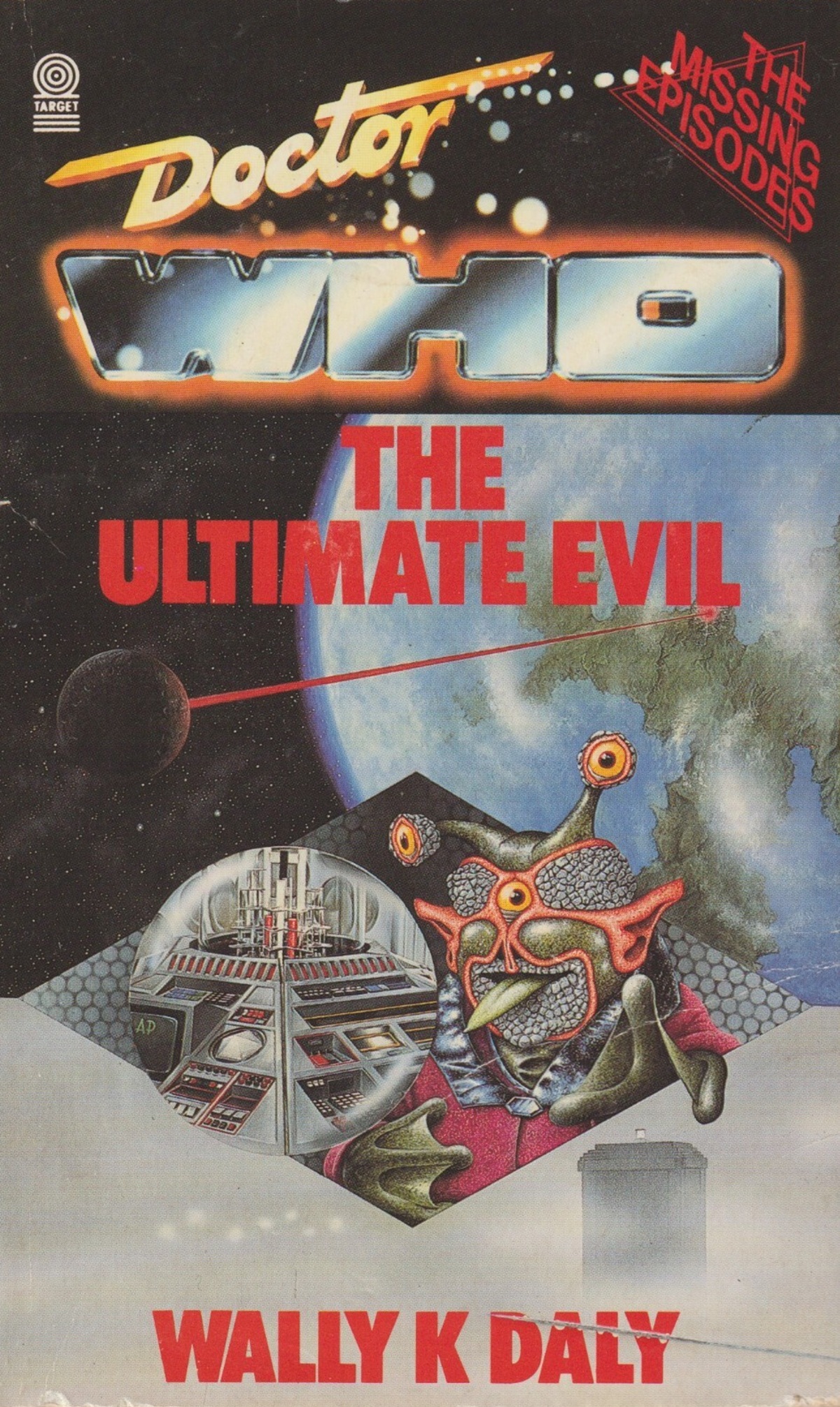
Although it is difficult to credit that even John Nathan-Turner might have at any point believed that matters would proceed as intended, if matters had indeed proceeded as intended then the following year’s run of Doctor Who would indeed have commenced with a trip to Blackpool, although quite how much fun Peri would have found it is open to question, even if they let her go on the River Caves. Written by former Doctor Who producer Graham Williams, The Nightmare Fair somehow simultaneously sounds like both a missed opportunity and evidence that no lessons had been learned at all and production would continue to drift even further away from what casual viewers or indeed viewers full stop might have wanted from Doctor Who. Setting what appears to have been a presumably entirely intentional precedent for this unmade set of adventures, The Nightmare Fair involves surprisingly well-remembered one-shot mid-sixties antagonist The Toymaker up to some evident variety of no good in Blackpool Pleasure Beach, with the character seemingly chosen on the basis of influential fans complaining to the production office that this was an ‘iconic’ villain that had not been revisited yet when we’ve just had the eighty four millionth Cyberman story in three weeks, the setting seemingly chosen because Colin Baker had been invited to open Blackpool Pleasure Beach’s new ride the Space Invader, and The Doctor still in full on bad-tempered feckless miseryguts mode with JNT essentially bragging to all and sundry that once you’ve thought of the important audience-cornering details like that then the story will essentially just write itself with a beam of awestruck optimism somewhere between Wimblich City’s player-manager Bryan Tossman asserting to assembled sports journalists that his decision to spend the club’s transfer money on magic beans will result in a giant beanstalk which he will ascend to discover a treasure trove including the FA Cup, the Anglo-Italian League Shield and the old World Cup and Pigsy and Sandy labouring under the immediately Monkey-shattered delusion that their chancing upon an unattended table full of bread will ensure that from now on they shall live like kings. Philip Martin’s Mission To Magnus would have united Sil, the Ice Warriors – with the script sadly omitting to clarify that they stood over seven feet tall – and, for crying out loud, yet another ‘evil’ Time Lord. The Autons would have met The Rani and The Brigadier in Singapore in Robert Holmes’ Yellow Fever And How To Cure It, a story about which little is known and on the basis of that title we probably ought to be thankful for that. The likeable but uneventful The Ultimate Evil from the otherwise enormously inventive Wally K. Daly at least aspired to introduce a brand new villain in the form of intergalactic arms dealer The Dwarf Mordant, while Christopher H. Bidmead’s The Hollows Of Time involved an encounter in a sedate English coastal town with some sand dune monsters and one ‘Professor Stream’, which we can only assume was a partially apposite anagram of Master’s For Rope, and virtually nothing is known about Michael Feeney Callan’s The Children Of January other than that it presumably did not feature a dance number with ‘Hippy Horse’. Quite what prompted the complete abandonment of all of the above and an entire overhaul once the cancellation was sort of reprieved-ish has never quite been fully clarified, and the possibilities that it was either an astute creative decision prompted by the unanticipated wake-up call and the opportunity for a second chance or that it was an instruction handed down from on high both seem as viable as they do implausible. Whatever the cause, however, and even despite the fact that several of the above later formed the basis of reasonably entertaining novels and audio plays, we can probably consider ourselves fortunate to have been spared the season that never was. While it is doubtful that it would have played host to anything as obnoxious as The Two Doctors, it was nonetheless a continuation of an approach to the lead character that had demonstrably not been working since Colin Baker’s very first – well, technically second, but there’s more about that here – appearance on screen, and an obsession with courting publicity that seldom came and pursuing continuity and ‘legacy’ for the benefit of an unrepresentative audience who just complained about it anyway that had demonstrably not been working for even longer still. What we wound up with instead may have had problems all of its own, but at least it was attempting something different. Well, different-ish. Anyway, more about that in, as ever, due course. Who else is wondering what Turlough’s been up to?
New Trion On Trion
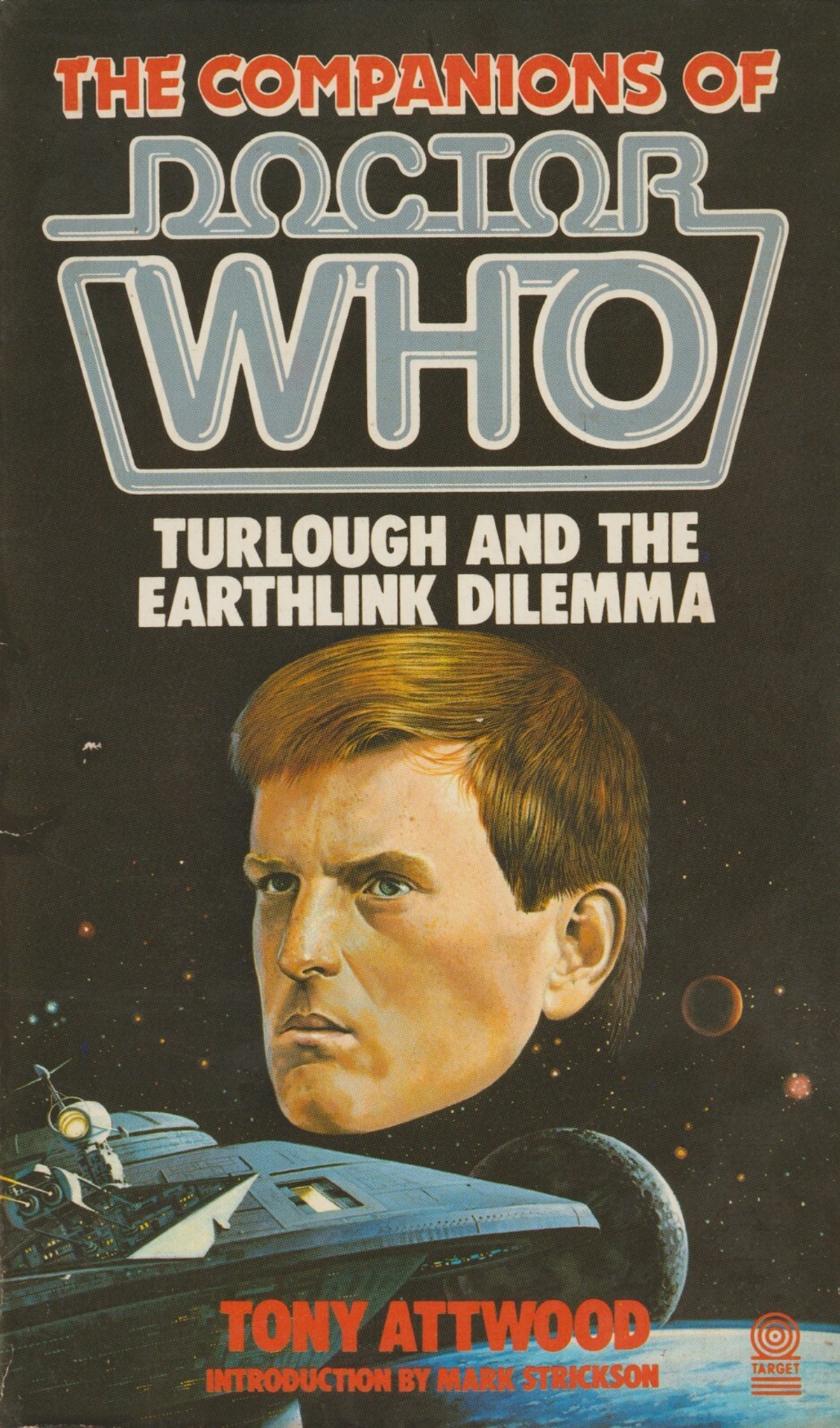
Watching events surround the attempts to cancel Doctor Who possibly with something closer to alarm than interest were Target Books, who despite regularly raking in a decent amount of cash with novels based on the likes of The A-Team and Street Hawk and endless ‘factual’ books postulating that UFOs were in fact the Loch Ness Monster who had accidentally gone whatever the opposite of underwater is or something, had come to rely on their range of Doctor Who paperbacks as a genuine industry-envied moneyspinning phenomenon. Aware that there was a tangible prospect of there being no further new television stories to novelise whilst the back catalogue was increasingly becoming depleted to the point where someone would have to have a go at The Space Pirates eventually, they took a calculated gamble and launched what was, in effect, the very first concerted and semi-officially sanctioned attempt at a full strand of Doctor Who spin-off media. Running to a grand total of three titles, ‘The Companions Of Doctor Who’ made its debut with Turlough And The Earthlink Dilemma, following the further adventures of the world’s oldest schoolboy probably more on account of his recent status and storyline ‘resolution’ that somehow left everything even more unresolved still than any notion of focus group-derived commercial potential or desperate pleas from fans starved of Brendon School For Boys and anecdotes about Ibbotson eating lettuce or something. Written by Tony Attwood, previously responsible for the well-received original Blake’s 7 novel Afterlife – no prizes for guessing who published that – and a heftily fanfared foreword making huge promises of it from Mark Strickson, it surprisingly turned out to be a mediocre adventure story in which the main villain was named, in a satirical gambit that even the writers of the ‘Gagfax’ bits on Three Of A Kind would have considered in need of a second draft or two, ‘Rechtaht’. Considerably greater thrills were to be found in Harry Sullivan’s War, in which Ian Marter brilliantly developed his character into the bumbling reluctant accidental James Bond that would have been rejected from the 1967 Casino Royale he had always intended him to be, complete with a taut low-stakes conspiracy thriller plot which thankfully did not at any point involve a shadowy organisation known as ‘Sdivad Owt Eht’. The third and final instalment was essentially just Terence Dudley’s novelisation of K9 And Company, which was in all honesty always going to stand or fall on whether the reader actually liked K9 And Company or not. After which incoming editor Peter Darvill-Evans abandoned the experiment, noting that none of the titles had sold as well as expected, and thus readers were denied Ian And Barbara Practice Rolling A Joint In Front Of Late Night Line-Up, Dodo And The Shrewsbury Pie Pie and That One About Victoria At The 1969 Isle Of Wight Festival That BBC Books Passed On The Pitch For. Nonetheless, it had clearly provided him with the faintest first stirrings of another idea that as we shall see played no small part in keeping Doctor Who as a viable going concern even when it wasn’t being made any more. Received with bemusement at the time and as good as forgotten about since, whatever their varied merits, the three ‘The Companions Of Doctor Who’ novels deserve greater recognition at the very first attempt at concerted redirection into other media, without which it may never even have been possible for Doctor Who to be cancelled for a second time; and remarkably, it wasn’t even the only attempt during that very first ‘Cancellation Crisis’…
I Think I’d Find It Very Difficult To Be Casual At This Particular Moment
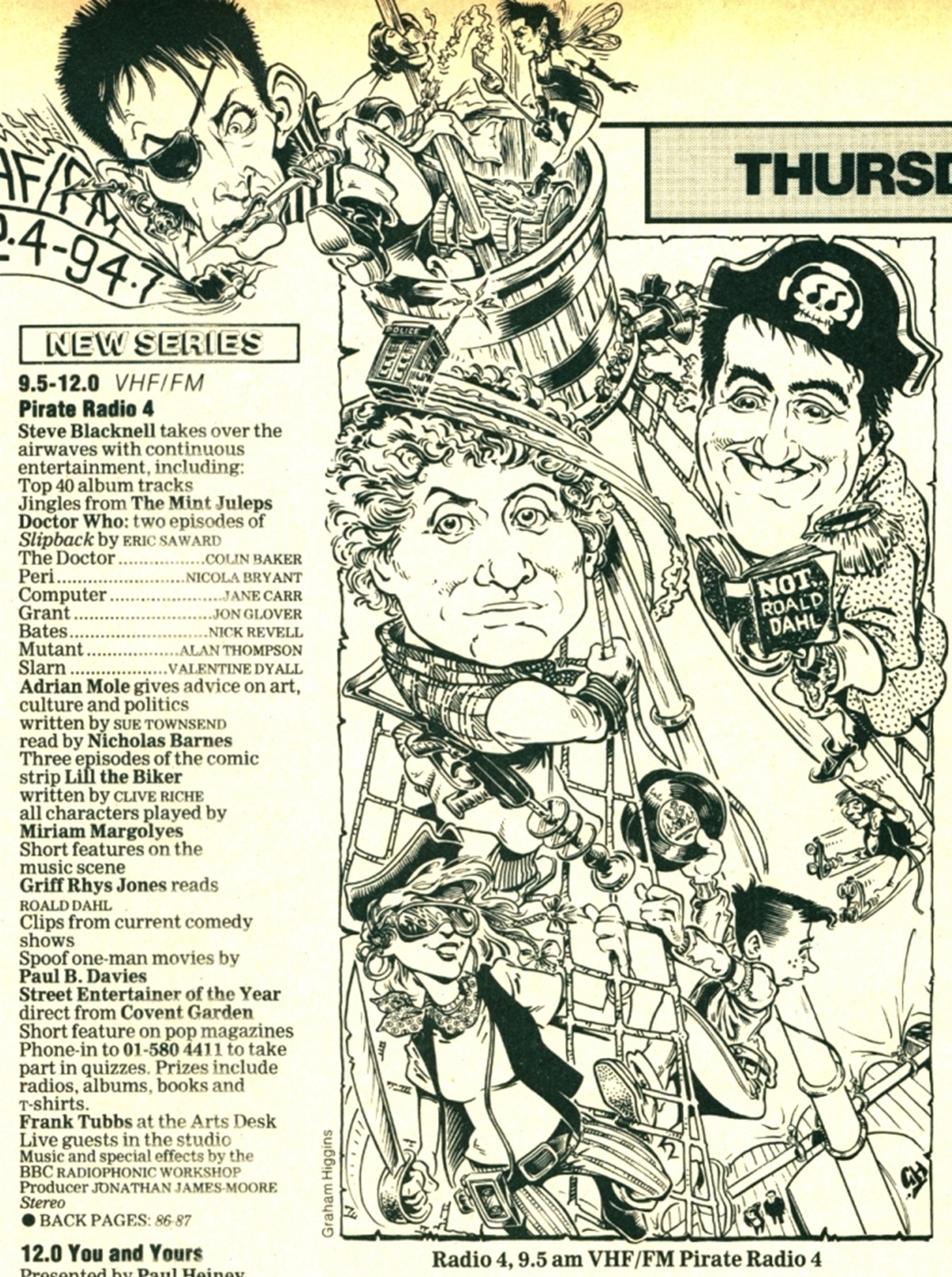
Speaking of unintentionally setting precedents, just as it seemed to all intents and purposes and indeed to all and sundry that Doctor Who might well be gone for good, there it was carrying on seemingly as normal where you would ordinarily least expect to find it. Aimed primarily at children stuck in tailbacks on long car journeys courtesy of parents who had set off early to ‘beat the traffic’ in apparent unawareness that pretty much every holidaymaker in the UK would have thought that they were the only person clever enough to have thought of that too, Pirate Radio 4 was – in an unusual departure for the otherwise dry and serious station mainly given over to men with interchangeable voices asking Lord Hailsham if they could bring him back to his earlier point – a marathon-length morning-straddling children’s show crammed with music, comedy, drama, competitions and interviews, all linked by host of BBC2 youth show Riverside and Radio 1’s In Concert Steve Blacknell under the pretence that he had somehow broken into and wrested control of Radio 4’s transmission without recourse to a Max Headroom mask. As you can find out here, Pirate Radio 4 was a much more interesting show than this description might make it sound, taking in regular contributions from Red Wedge-aligned all-female acapella troupe The Mint Juleps, live coverage of the Covent Garden Street Entertainer Of The Year contest, a weekly rundown of the album rather than singles chart, original Adrian Mole monologues written by Sue Townsend and performed by original radio Adrian Nicholas Barnes, and – perpetually overshadowing all of the above, even including the latter – a brand new six-part Doctor Who serial. Written by Eric Saward and starring Colin Baker and Nicola Bryant alongside Jon Glover, Valentine Dyall, Ron Pember, Nick Revell, Jane Carr and Alan Thompson, the audibly Douglas Adams-influenced Slipback was originally conceived as little more than a dash of inter-series extra-curricular fun but it would almost inadvertently evolve into something more substantial than that on account of reasons way beyond its control or influence. Not only did it give fans who were still sceptical of the vague promises that Doctor Who would be back after an enforced ‘hiatus’ after all faint cause for hope, it also – due in no small part to the requirement to tailor itself to its intended audience – found itself becoming the best Sixth Doctor story so far if not full stop. The Doctor’s trademark irascibility is tempered by a genuine wit that had been in very short supply on television, the dialogue-driven plot is inventive and packed with twists that are somehow both enjoyably obvious and a total surprise when they actually arrive, and even the sporadic continuity references are treated as a shareable joke rather than a deliriously deep obscurity crowbarred in for the edification of ‘true’ afficionados. It is more than likely the sort of script that Eric Saward, whose background was of course in radio drama and indeed where he had originally created one Richard Mace, would have preferred to have been writing, and very audibly the sort of script that Colin Baker and Nicola Bryant would have preferred to be performing, and if Doctor Who had not come back in 1986 after all then it would certainly have proved a more likeable and fitting sign-off than Revelation Of The Daleks. While it would be a stretch to claim that it had very much influence on what did happen when Doctor Who returned – although it did have some – its legacy and indeed that of the ‘Companions Of’ novels could be more powerfully felt in the nineties, when one brief moment of Paul McGann exclaiming ‘these shoes – they fit perfectly!’ aside, essentially all that there was in the way of ‘new’ Doctor Who were original radio plays and novels and in some cases their debt to Slipback was perhaps more obvious than may have been intended. Also, you couldn’t see that bloody coat on the radio.
Anyway join us again next time for CHIBNALL WAS RIGHT, Chock-A-Bloke making a dramatic appearance as a surprise witness and Colin Baker singing Great ‘Ere Innit (Innit Great?)…
Buy A Book!
There’s lots more about the early eighties version of the Doctor Who theme as reissued this year with Colin Baker on the sleeve, and plenty more about tons of other of Doctor Who-related releases besides (but not Doctor In Distress), in Top Of The Box, the story behind every single released by BBC Records And Tapes. Top Of The Box is available in paperback here or from the Kindle Store here.
Alternately, if you’re just feeling generous, you can buy me a coffee here. Don’t go all the way to Blackpool for one.
Further Reading
You can find out exactly why the twenty second series of Doctor Who was in trouble even before they even had started work on it in It’s Still A Police Box, Why Hasn’t It Changed? Part Twenty Four – Salateen, Look At You Now here.
Further Listening
You can find out what it was like to listen to Pirate Radio 4 – as opposed to just Slipback – in Doctor Who And The Looks Unfamiliar here.
© Tim Worthington.
Please don’t copy this only with more italics and exclamation marks.

