
Ready Steady Go!, ITV’s flagship youth show between 1963 and 1966 and the first port of call for any with-it teenager keen to observe Peter Jay And The Jaywalkers miming to their Hey, Hey, Hey, Hey-deficient cover of Kansas City in between an interview with some ordinary regular adolescents about whether the Archdeacon of Chichester had it all wrong about those plastic sunglasses with octagonal white frames, allegedly arrived at its celebrated strapline ‘The Weekend Starts Here!’ courtesy of a vox pop with some Mods who, erm, were not actually watching it. If you had the temerity both to belong to a slightly younger generation and to not actually be old enough to afford much attention to whoever The Laurie Jay Combo’s musical and spiritual heirs were, however, then the weekend started somewhere entirely different. It started on a Saturday morning, and started before television itself did.
As near impossible it may be to credit in this present day early morning wash of news, more news, sitcoms that nobody you know has ever actually watched, Bond films with anything even halfway exciting edited out, signed repeats of that thing where someone shows a miniature parasol to Sara Cox and oddly two-dimensional three-dimensional animations where all of the characters move like those dancers in the bouncy castle suits in that New Order video and talk in voices that sound like a first year Grange Hill character affecting to be ‘helpful’, if you got up early enough on a Saturday Morning – albeit not even especially early in and of itself – there would simply be nothing on television yet. BBC2 and initially Channel 4 would not even grind into gear until late morning at best, leaving just a pre-Breakfast Television BBC1 and ITV to literally start up before your impatiently unimpressed eyes. Navigating the former was a delicate art as it involved averting both an extended outbreak of BBC Test Card F and that Public Information Film where it freezes just as that kid running along a beach is about to stamp on a broken bottle, ahead of a continuity slide for the day’s first programme bearing such indelibly memory-searing images as the MacWomble in improbably extreme close-up or a poorly-cropped picture of Roobarb in a pirate’s hat, accompanied by some jaunty pseudo-novelty library music track like that off-brand knock-off of Baby Elephant Walk or one of those things featuring ‘singing’ dogs, the latter routinely occasioning the continuity announcer to indulge in a witticism about hoping Bagpuss wasn’t scared away, followed by the time-honoured yellow and blue clock and straight into whatever whimsical animation was doing the off-kicking honours that week. Over on ITV, however, the easily spooked viewer was on somewhat safer ground with the more reassuring sight of the IBA colour bars, followed by a handy list of transmitter frequencies for your local area, just in case your reception was on the blink and you had some bolt cutters, earth-moving equipment and triangulation monitors to hand with which to correct the wonky framerate before Secret Valley came on, after which each of the individual transmitter-served regions characteristically pursued their own path. Some simply opted for the full-length 12″ Extended Version of their own regional ident, arguably most notoriously in the case of the Anglia Knight, that proud and literal standard bearer for Survival, The World Of Survival and Survival Special, which rotated on a plinth against a sky blue background to the accompaniment of Malcolm Sargent’s false ending-festooned arrangement of Handel’s Water Music for a full forty five seconds. Others however would invest more thought, effort and indeed money – well, to the tune of about three pence – into their daily salutation for bleary-eyed viewers, constructing epic miniature visual travelogues full of local ‘colour’ that raced through beauty spots and along slow-moving A Roads before alighting on some monument that meant little to viewers from outside the area, then on into the television studios themselves where logoed vans pulled in as uniformed commissionaires closed gates about three inches away behind them, blokes in studio galleries with their sleeves rolled up gave a double thumbs-up, red lightbulbs in cages started flashing next to an ‘ON AIR’ sign visibly in need of a decent wipe, and in two minutes flat viewers have been transported directly to where the action is. The action being, presumably, a couple of episodes of Highway every now and then.
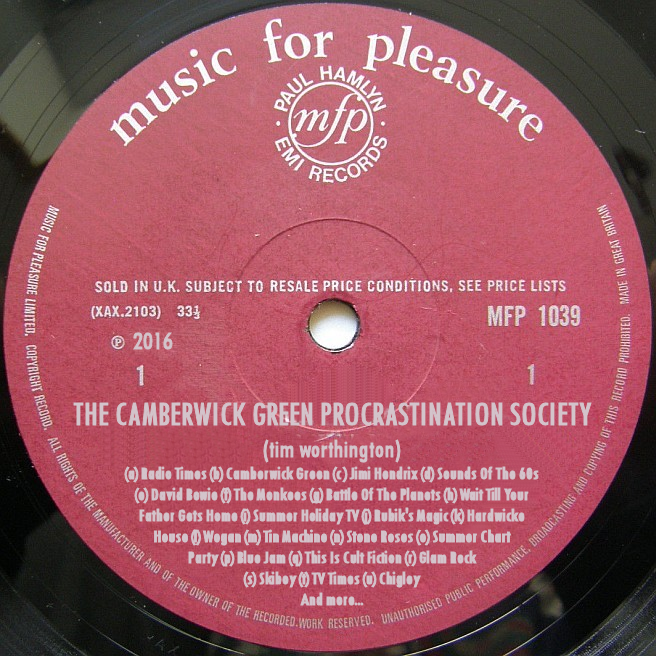
What proved even more thrilling than the illicit excitement of being up ‘before’ television, however, was the ramshackle and esoteric assortment of otherwise unschedulable children’s programmes that found their way onto Saturday mornings, few of which were ever quite as ramshackle and esoteric as Buzzfax although you can find Chris Hughes with much more on just how bewilderingly disorientating this television-eating-itself oddity genuinely was in Looks Unfamiliar here. Battered old imported serials, brand new imported serials which were neither battered nor old but looked like they were, second drawer Ruby-Spears and Hanna-Barbera efforts like Fangface and Mumbly, the BBC’s ancient blunt-scissoredly edited prints of The Banana Splits and The Monkees, and even the odd and indeed odd specially made experiment like the first series of The Adventure Game. Much is of course made of the rivalry between Noel Edmonds’ Multicoloured Swap Shop and Tiswas, or indeed subsequent inter-broadcaster viewer-shovages like Going Live going up against Yo Dudes, It’s Another Merrie Melodies Sponsored Backwards Baseball Cap Saturday, but for a certain demographic it was that hour or two where it felt like programmes were leaking through some quasi-hallucinogenic tear in the multiverse and you never quite knew what you were going to see – well, except when it was The Adventures Of Champion – that really threw open the doors of perception that ushered in two days of No School; indeed, it was a spurious yet definite sensation that I intentionally attempted to replicate some sense of a flavour of while putting together my collection The Camberwick Green Procrastination Society, which is available in paperback here or from the Kindle Store here and not just on Saturday Mornings either. More by accident than by design – although let’s face it, the chances of it happening in pretty much any instalment of this ongoing series of archive-trawlings are substantial to say the least – there are more than a few of the shows that used to rebound retina-infuriatingly around this timeslot in the handful of features and editions of Looks Unfamiliar revisited below, as well as another look at Blue Jam which is not only essentially the exact opposite of all of them in every sense but which you would also need several very strong coffees to listen to if you’d got up to watch Kim And Co that morning so you are more than welcome to assist with that by buying me one here. Anyway, it looks like we’ve just got a sleeve-rolled-up double thumbs-up from the ‘backroom boys’, so roll that washed-out poorly edited film and let’s go…
Looks Unfamiliar: Chris Shaw – It’s Half Three And Something Is Happening
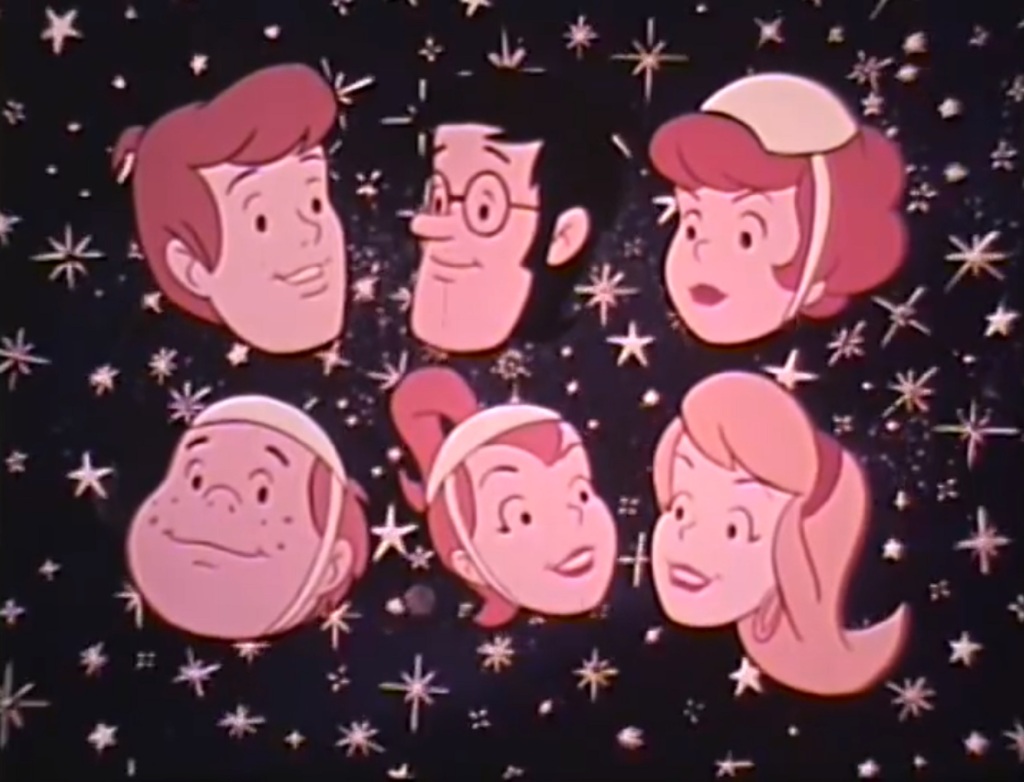
One of the absolute joys of doing Looks Unfamiliar is being proved correct on your suspicion that someone who is primarily known for discussing one subject will be just as entertaining when let loose on their other obsessions, and that was very much the case when Chris Shaw, arguably the world’s foremost Beatles podcaster, came on for a chat about Bailey’s Comets, The Phantom Tollbooth, late sixties vision of a future we never actually got Evoluon and other one-time l0ng-term residents of the less prestigious slots in the television schedules; in fact, none other than Richard Herring had long made a good deal of comic mileage out of the fact that apparently only he remembered Bailey’s Comets, and to be honest if the blank looks all round response to its presence in this episode was anything to go by we did not exactly do very much to undermine this running gag. In fact the overall response to this episode was something of a mixed bag for reasons that had nothing to do with poor old Chris – on the one hand, nobody noticed that I’d actually had to entirely re-record my side of the conversation due to there being a persistent and very loud whine that sounded like the Fischer-Price Jack In The Box permanently trapped in a split-second of non-emergence pretty much throughout, which I would like to think reflected well on my production skills. Although that said, someone did message me around this time telling me that they were taking over as producer due to their dissatisfaction over the sound quality, which you will probably not be entirely surprised to learn I politely declined. On the other hand, however, a couple of flippant but affectionate remarks about BBC2’s early evening instructional session musician correspondence course Rock School posted on social media in a bid to promote the episode led to a surprising number of very tetchy rejoinders expressing stern disapproval at the very idea of treating it with anything less than awed reverence. I hope they have all noted I have never poked fun at an Arion SCHI-1 Stereo Chorus Pedal since. Anyway it was a tremendous episode and it would be nice if that was enough for some people sometimes. You can find the full show here and the chat about Rock School – yes alright – in a collection of Looks Unfamiliar highlights here.
You’ve Got To Fight For What You Want

Another feature originally written for the television review website Off The Telly, this time taking a look at the swashbuckling historical series that was originally known as Le Chevailer Tempête on ORTF1 but would be shown dozens of times by the BBC – although not always with the thirteenth and final episode intact, which is a fascinating story in and of itself – under the redubbed with a thundering psych-pop theme song mantle The Flashing Blade. This was very deliberately written to highlight the original series itself, which is frankly sufficiently interesting and entertaining enough in its own right but now never seems to get any credit for that, rather than the irreverent comedy redub that Russell T. Davies later wrote for the late eighties BBC Saturday Morning show On The Waterfront, but let’s face it, that comedy redub is what the majority of people seem to remember about The Flashing Blade and indeed probably the primary reason why this feature still gets a staggering number of daily hits even now, and while I was admittedly quick to point out that the joke may have worn thin a little more quickly in reality than everyone seems to remember, I did at least mention the RTD’ed-up version in the feature with a certain degree of fondness. As more interested personally as I may be in the background to the assorted BBC-wrangled frequently repeated imported children’s serials, sometimes it does not to be precious about such matters; a credo that should probably be adopted by certain of the respondents to The Golden Age Of Children’s TV – which of course includes an entire chapter on the collective story behind The Flashing Blade, The Adventures Of Robinson Crusoe, The Singing Ringing Tree, The White Horses and Belle And Sebastian – some of whom made the indignant defenders of Rock School look like a right old laugh down the pub, but we’re getting a little ahead of ourselves there. You can find the original version of You’ve Got To Fight For What You Want here and an expanded version with more on the background to the BBC’s translation and redubbing of the series in Well At Least It’s Free here.
Another moderately edited extract complete with footnotes from Fun At One, this time looking at the first series of Chris Morris’ late-night mood music nightmare Blue Jam and admittedly singled out for non-serialised serialisation here partly to promote Fun At One but partly also as a quiet but resolute response to the fact that even now, it is widely asserted with infuriating confidence that the sixth and final episode being yanked off-air mid-broadcast never actually happened and was a zany hoax perpetrated by TV’s Mister Satire on a frequency too sophisticated for those who just aren’t clever enough to ‘get’ it to hear, and partly further still on account of the fact that, well, mentioning Blue Jam pulls in the readers, even when it’s just referenced in passing as part of Through The Square Window. The persistent reuse of the torchlit eyes photo, which on reflection I should probably just have used as every image in this, was a deliberate nod towards the original advertising campaign for Blue Jam which saw that image hilariously over-added to every single page of the media section of the likes of The Guardian and The Observer. When this was originally published I also changed the colour of the background and text to reflect that of Radio 1’s original Blue Jam tie-in webpage – yes, page – which frankly wound up looking absolutely dreadful and would later still prove a major headache to change back. Even just now I noticed a part of the formatting that was still going absolutely haywire. Oh that Chris Morris – whatever will he think of next? You can find the original version of E Arth Welcome… In Blue Jam here and an entire chapter about the show along with Radio 1’s other attempts at late-night ‘ambient’ comedy in Fun At One here.

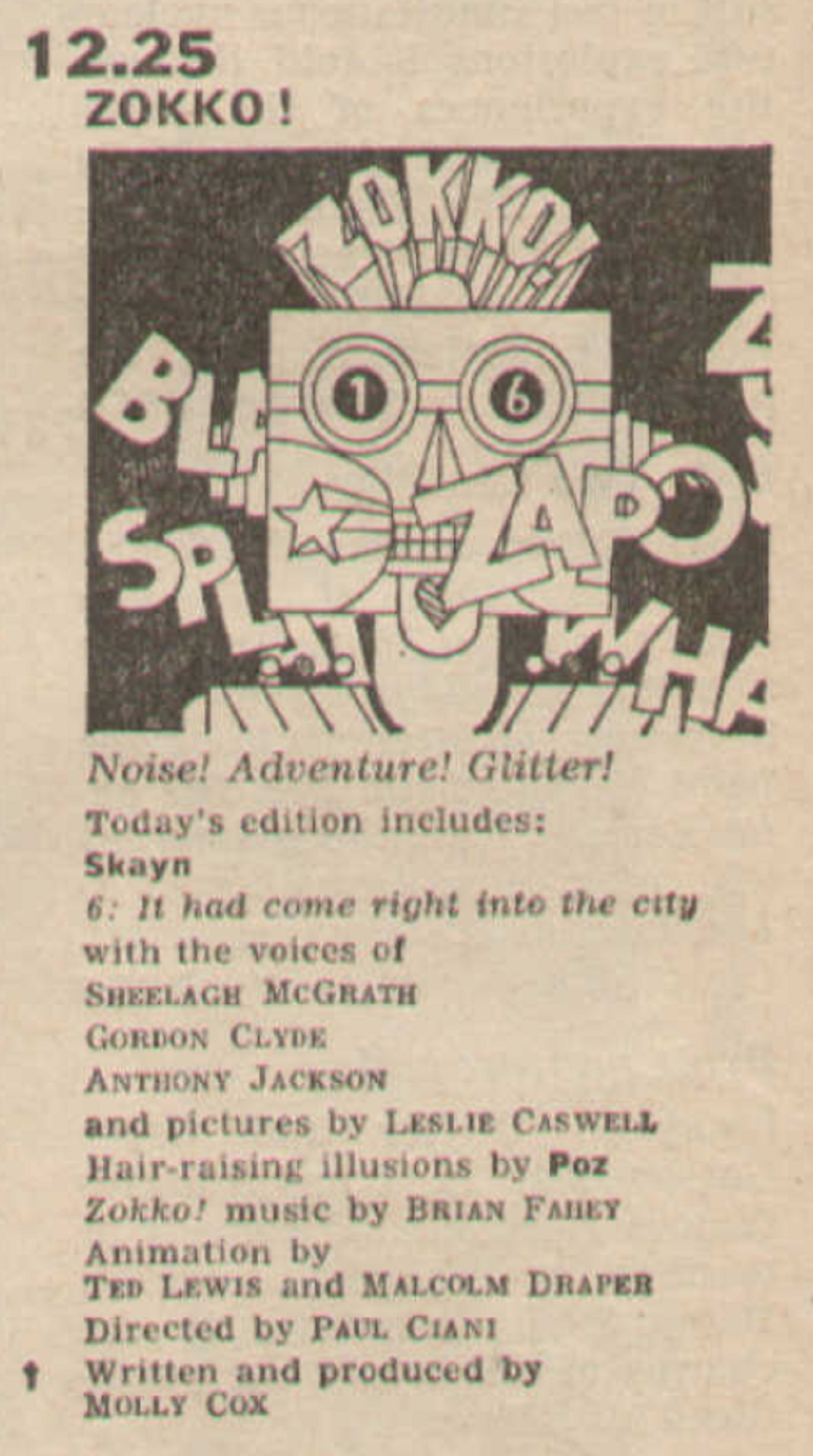
Another feature parachuted in from Off The Telly, this time taking a look at the suitably mind-frazzling story behind what is often credited as the first ever Saturday Morning television show as we understand it, albeit presented by a Radiophonic Workshop-voiced talking pinball machine linking comic strip adventure serials and weird fragments of quasi-hallucinogenic film rather than by a Radio 1 DJ linking conversations about themselves, although it appeared here in an even more expanded form than it had already done in Well At Least It’s Free, with much more on the other attempted Saturday Morning shows from the same team including Whoosh!, which I had not actually been aware of until I stumbled across a boxout on it whilst looking for something else entirely in an issue of Radio Times. At the time I was slightly frustrated that I could only really source lower resolution images of the corresponding Radio Times listings and features to illustrate this, but on reflection I now feel that they unwittingly capture the strange dusty world of long-lost black and white psychedelia more effectively than higher quality counterparts would have done. You can find the original version of BMWAMmM It’s Zokko! here and an entire chapter on the prehistory of Saturday Morning television in The Golden Age Of Children’s TV here.
Looks Unfamiliar: Bob Fischer – False Flag Giant Hogweed

Although I had been a guest on Bob’s BBC Radio Tees shows on many occasions, including once notoriously earning him a mild rap over the knuckles for playing We Wanna Be Famous by Buster Gobsmack Eats Filth while chatting about BBC Records And Tapes, it wasn’t until we were chatting after the inaugural Scarred For Life live show that the subject of Looks Unfamiliar came up and he more or less reeled off his list of choices on the spot. I was especially pleased to have the opportunity to outline my perpetual bewilderment at the free jazz excursions in the theme music from The Tom O’Connor Roadshow – an available recording of which proved frustratingly elusive at the time – and How To Be A Wally and EastEnders‘ Peter Dean’s World Cup-themed single were similarly inspired choices, but it was Bob’s childhood fear of coming into contact with the ever-looming menace of Giant Hogweed that really seemed to capture everyone’s imagination, to the extent that Bob later designed and sold Giant Hogweed badges through his Haunted Generation website. I was also especially thrilled at how he managed to weave his choices together into an improvised narrative involving a sort of ‘Wally’ Cinematic Universe. It was also for many years the most listened to edition of Looks Unfamiliar of all after Grace Dent mentioned it in one of her restaurant reviews; ironically it would later be surpassed by Grace herself. This was recorded at an outdoor café – not one that Grace has got around to reviewing yet – on what we had not unreasonably assumed would be a quiet afternoon, until a DJ started agitating at his decks in a nearby venue. Fortunately we were probably both talking too much for anyone to notice. You can find the full show here and the chat about Giant Hogweed in a collection of Looks Unfamiliar highlights here.
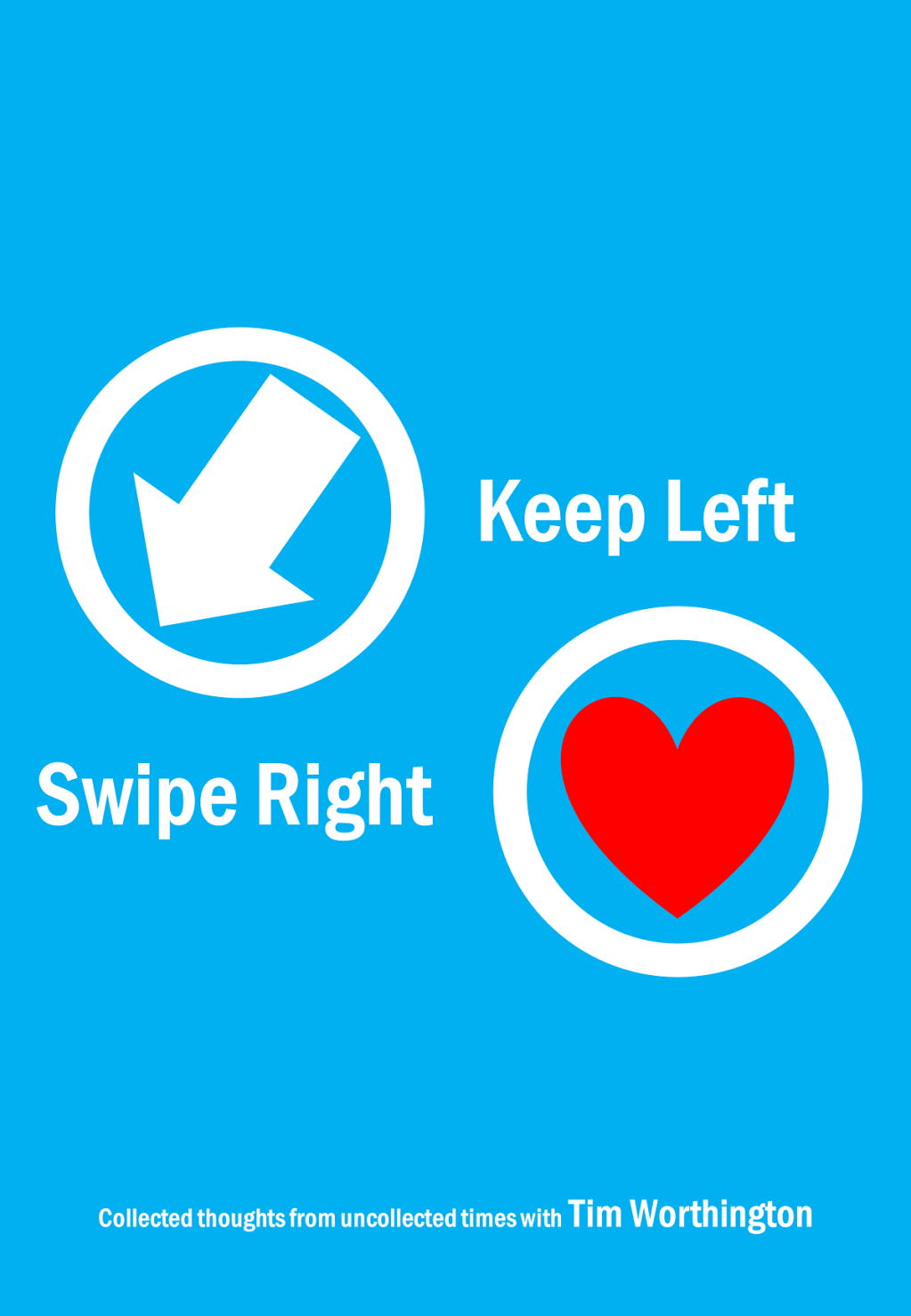
If you were looking for something to rifle through while waiting for television to ‘start’ – in other words keeping it turned off until the Breakfast News shows have finished, then singing your own sort of improvised fanfare whilst looking at an indistinct statuette of something or other at the end of a photograph of a dual carriageway – then you could do a lot worse than in Keep Left, Swipe Right, a collection of thoughts from uncollected times, available in paperback here or from the Kindle Store here.
Mystery Link! If you want to just go straight to a surprise page completely unrelated to any of the above, click here.
© Tim Worthington.
Please don’t copy this only with more italics and exclamation marks.

