
This is an excerpt from “As If By Magic – The Shopkeeper Appeared”, the chapter of The Golden Age Of Children’s TV looking at ITV and the BBC’s mostly animated lunchtime shows for younger viewers. If you like the look of this, you can get The Golden Age Of Children’s TV from Waterstones here, Amazon here, from the Kindle Store here and directly from Black And White Publishing here, and if you’ve already read it and indeed liked it, why not leave a review to complement the one thanking me for not only confirming that the reader had not just imagined some long-forgotten shows but had actually described them sufficiently evocatively to be able to put names to them? You can also find a chat with Rae Earl about Camberwick Green on the accompanying The Golden Age Of Children’s TV podcast here.
Possibly even more popular still than Camberwick Green, as the fleets of talking toy fire engines available for Christmas that year will attest – although not so much with one exasperated mother who wrote in reporting that her child would not stop asking why nobody in Trumpton had any curtains – Trumpton had made its debut exactly one year after Camberwick Green on 3rd January 1967. Viewers clearly wanted to see more of Trumptonshire, but it would be almost three years before they would get a glimpse of Chigley (1969). Identified in the opening titles as ‘Near Camberwick Green, Trumptonshire’ – Gordon Murray intended the three locations to be in an equidistant triangular formation – Chigley was dominated by light industry, cottage industries and the opulent Winkstead Hall, ancestral home of local philanthropist Lord Belborough. The employees of the Creswell family’s celebrated hi-tech biscuit factory held daily dances after the six o’clock whistle accompanied by Lord Belborough and his butler Brackett on his Dutch Organ, potter Harry Farthing and his daughter Winnie catered for everyone’s ceramic needs, and bargee Mr. Rumpling and crane operator Mr. Swallow at Treddle’s Wharf were on hand to ensure the smooth delivery of supplies and materials. If anything defeated even them – not to mention builder Mr. Clutterbuck, dustmen Mr. Gubbins and Mr. Sneed, Winkstead Hall gardener Mr. Bilton and all of the other residents – then a call would be put through to Winkstead Hall, necessitating Brackett to take a famously lengthy stroll along the corridors to find his Lordship so that they could rush to assist on his own private steam railway. Depicted almost as a sentient entity in its own right, ‘Bessie’ the vintage steam engine is possibly the most well remembered detail of Chigley, not least on account of Lord Belborough’s memorable song about how ‘time flies by when I’m the driver of a train’.
In fact, Chigley is not nearly as well remembered as Camberwick Green and Trumpton, and there are couple of possible reasons for this. Each episode opens with a well-known character from one of the other shows being asked by Brian Cant if they are on their way to Chigley (“May we come with you?”), and the repeated motifs of the Six O’Clock Dance and Bessie racing to the rescue only appear towards the conclusion. The storylines were more gentle vignettes with a comic twist than character studies or big event setpieces, ranging from the accidental partial demolition of a wall by a runaway lawnmower to arranging a charity balloon ride with the Mayor of Trumpton, a crate of books tumbling into the canal – retrieved by one of the Pippin Fort soldier boys in frogman gear – and an abundance of apples in the Winkstead Hall orchard, literally pressed into cider-making service by Windy Miller. Chigley also had something of a troubled genesis, which not only saw a neighbouring doughnut factory, a local candlemaker, a modern housing estate, a private zoo and even a Lady Belborough disappear from the original format proposal but also led to it temporarily disappearing itself for a couple of years in the late seventies while some contractual issues were ironed out.


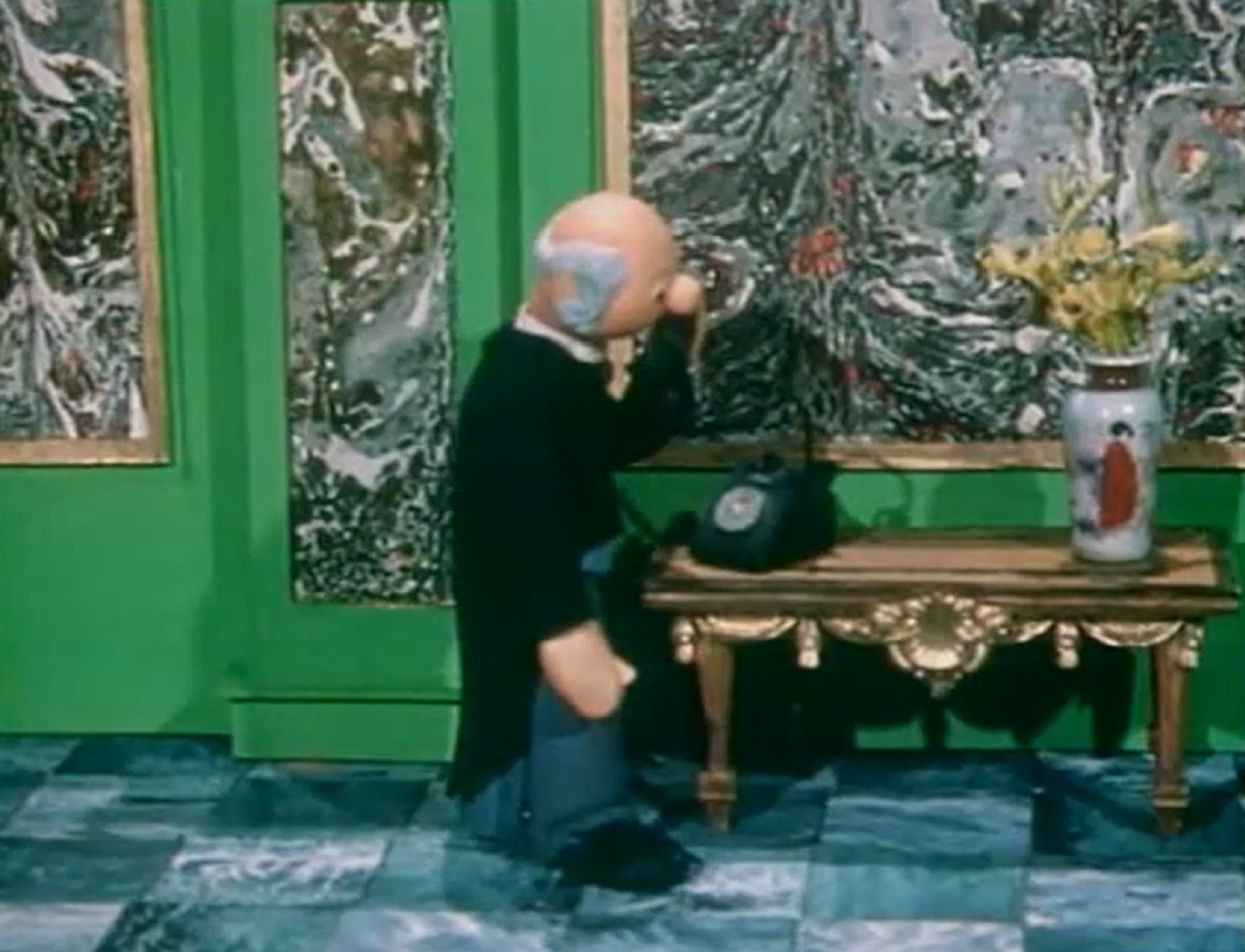

Despite this low profile, Chigley was every inch the equal of its two more famous counterparts and the creative team had reached new heights – Bob Bura and John Hardwick pulled off some impressive effects including steam issuing from Bessie’s funnel, Andrew and Margaret Brownfoot turned in a convincingly modernist factory and based the huge Winkstead Hall set on the real-life Kedlestone Hall near Derby, and Freddie Phillips furnished the onomatopoeic lyrics about “wheezing pistons, smoking funnels, turning wheels go clickety-clack” with a chugging guitar rhythm and authentic sound effects recorded from the platform at Sheffield Park Station – but by the time it arrived on 6th October 1969, it did feel like the end of an era. All three shows would continue to be repeated into the mid-eighties, but although Gordon Murray did briefly toy with the idea of a further series set in a coastal town, that was the last that viewers would see from the country of Trumptonshire. At least in the present day.
In 1976, Gordon Murray remade six of his original fifties BBC puppet theatre ‘A Rubovian Legend’ plays plays as Rubovia (BBC, 1976), revisiting the magical kingdom ruled over King Rufus and Queen Caroline with their son Prince Rupert and pet dragon Pongo, and their various associates including court magician Mr. Wetherspoon, Rubina the cat, Farmer Bottle, the Lord Chamberlain, King Boris of Borsovia and MacGregor, a visiting Native American with a Chinese accent who dispensed wisdom over the garden wall, with music from Freddie Phillips and narration by himself and Roy Skelton. Originally intended for a later timeslot aimed at a slightly older audience, the high spirited pantomime sitcom antics of Rubovia ended up as an odd fit for the Watch With Mother timeslot and would only be shown a handful of times, destined to forever be a frustrating memory of erstwhile Pongo-loving viewers who were roundly accused of just having made up a ‘fourth’ Trumptonshire show. It is also fair to say its entirely coincidental similarity to ITV’s contemporaneous Cloppa Castle (ITV, 1977-78) did not help in this regard. After making the similarly inclined Skip And Fuffy (BBC, 1977) and The Gublins (BBC, 1978) as inserts for a more appropriate audience in Noel Edmonds’ Multicoloured Swap Shop, Gordon Murray retired from television to concentrate on his miniature ‘Silver Thimble’ storybooks.

Buy A Book!
There’s lots more about Chigley – along with Camberwick Green, Trumpton and tons of other shows from the lunchtime slots on both BBC and ITV – in The Golden Age Of Children’s TV, available in all good bookshops and from Waterstones here, Amazon here, from the Kindle Store here and directly from Black And White Publishing here.
Alternately, if you’re just feeling generous, you can buy me a coffee here. Don’t ask Windy Miller to help. He’s only got a cider press, and that’s of niche use to say the least.
Further Reading
You can find out all about the episode of Trumpton where the telephone lines get mixed up in Never Too Quickly, Never Too Slowly here, why the version of the first episode of Camberwick Green that you can watch now might not be quite what viewers saw back in 1966 in Wound Up And Ready To Play here, and a quick critical structural tour of the entire county in Trumptonshire Architecture here.
Further Listening
You can find a chat with Rae Earl about Camberwick Green on The Golden Age Of Children’s TV here.

© Tim Worthington.
Please don’t copy this only with more italics and exclamation marks.

