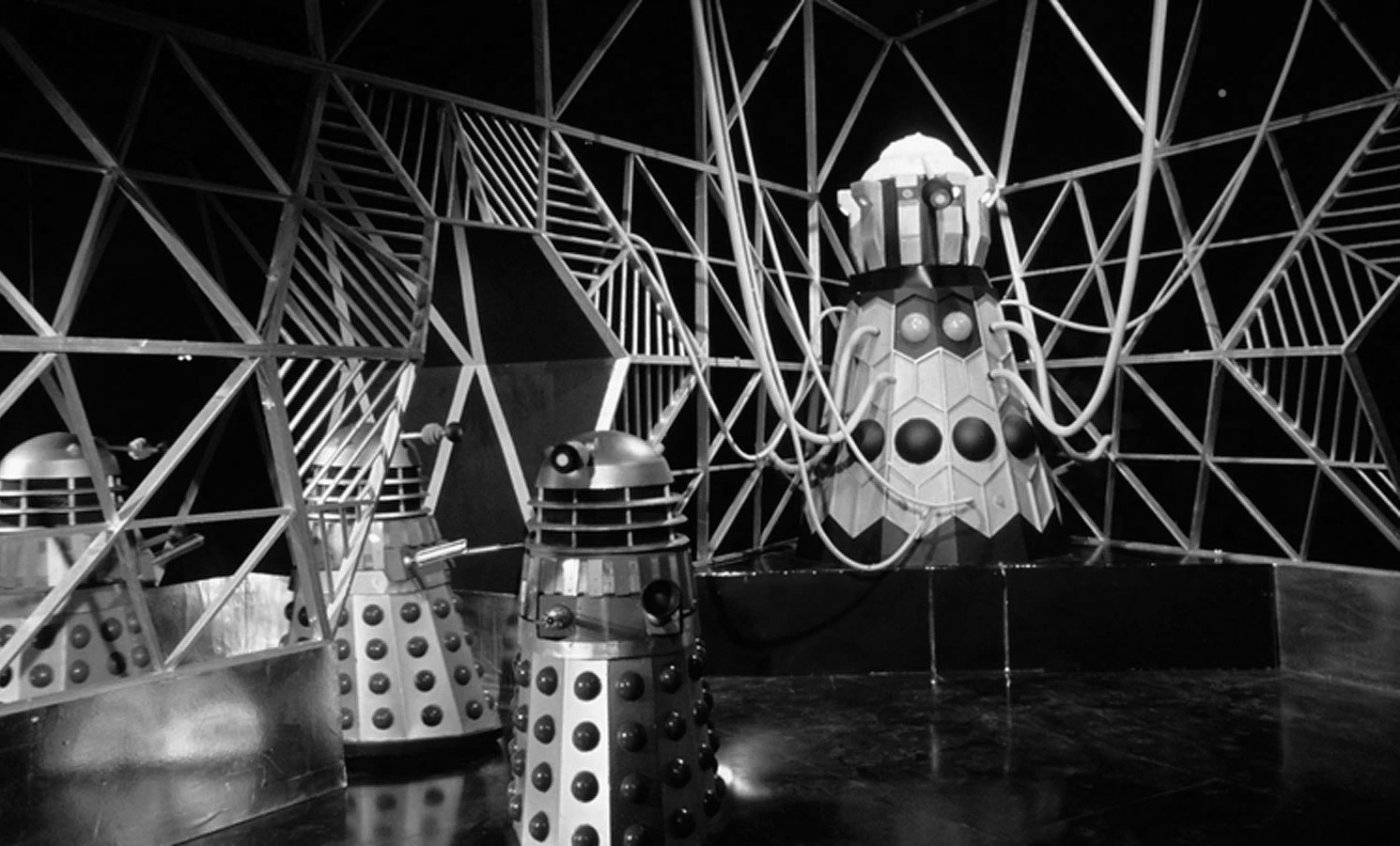
In its own quiet if still ratings-topping way, Doctor Who‘s fourth series in 1966-67 marked a significant turning point for the show, taking in both the first ever change of lead actor and what at the time was intended to be the last ever appearance of The Daleks. That would-be farewell performance itself – described by The Doctor as the ‘final end’ of The Daleks – came at the conclusion of what many consider to be the finest story of the entire sixties, which shared its clever and intricate plotting and eerie old fashioned sci-fi atmosphere with another similarly lauded Dalek story earlier in the run. Those three combined factors have since more or less overshadowed pretty much everything else seen in this particular series, including the debut and indeed first return appearance of The Cybermen, the last ‘pure’ historical adventure for decades, and three stories about which, tantalisingly, comparatively next to nothing is known. Oh and The Underwater Menace, which is actually really good and not rubbish like you thought. Once again, there are huge visual gaps – most importantly, we’ve no way of knowing why Polly suddenly has The Doctor’s hat on at the end of The Underwater Menace – but in most cases there’s still enough left to get at least some semblance of a sense of what was going on. Not all of it an entirely comfortable sense either…
‘Problematic’ References For You, And You And You And You
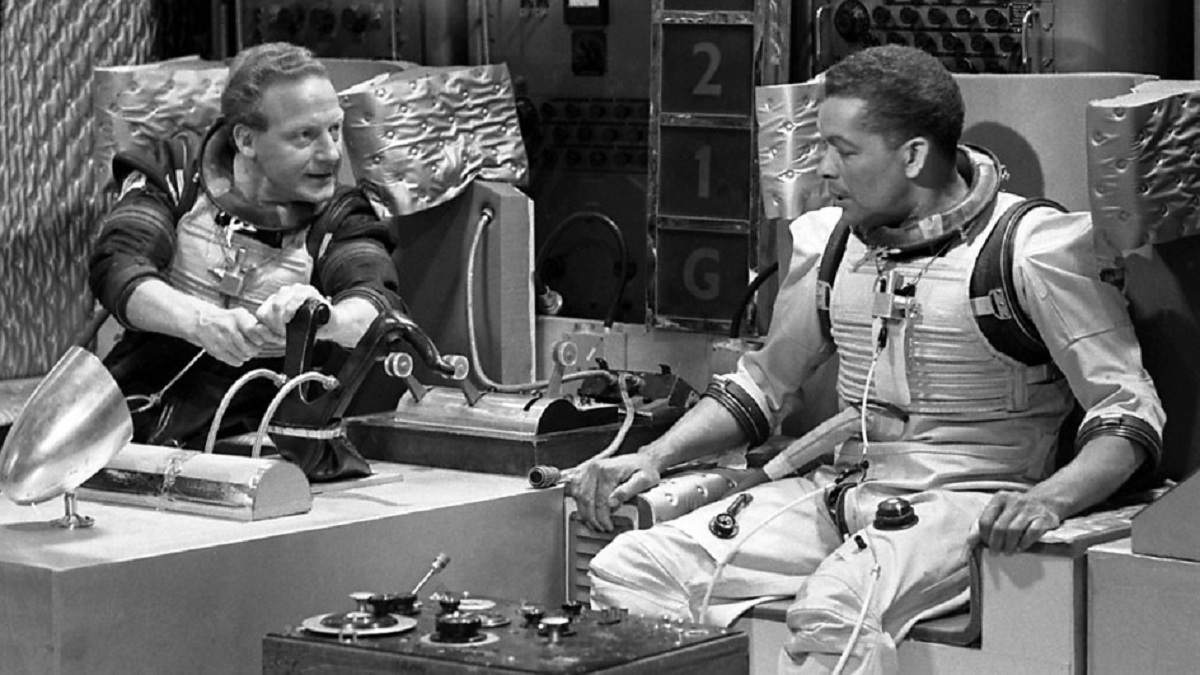
In our look at series three of Doctor Who – which you can find here – we tried our absolute hardest to discreetly swerve the blatant reference in The War Machines to that most now-discredited of former Radio 1 DJs, Top Of The Pops presenters and general Fixers of ‘It’, TV’s Scrawny Old Bastard. Nicely averted, you may have thought. Neatly swept under the carpet. Now we can move quietly and happily on and not have to think about him ever again. Well, not until The Two Doctors at any rate. Imagine the ‘surprise’, then, when The Tenth Planet opens with Dyson at Mission Control requesting that the astronauts change their communications channel to ‘J For Jimmy’, complete with suspiciously familiar vocal tremulance and audible quote marks. If you’re in any doubt, Williams immediately repeats the line aboard the rocket in an ordinary voice, and the difference could not be clearer. There is probably a serious point to be made in there somewhere about how these sorry individuals were once a part of everyday life, but ‘serious’ isn’t really the point of this exercise, and in any case, he’s part of the reason behind why we’re in the mess we’re in right now and would probably be quite pleased if he could see the chaos he’s caused, so let’s just move on. Hmmm, really not doing too well at this ‘not serious’ business there. We can but hope that something ridiculous is coming along very soon indeed. Maybe even in the same episode…
Krrrrrrrail And Krang The Finest Cybermen You Ever Wanna Meet

As odd as it may seem now, time was when – largely on the basis of a handful of not especially unfuzzy publicity photos – the original cloth-faced warbly-voiced Cybermen with their impractical chest units were at best the target of derision and at worst as good as written out of Cyber-history and indeed ‘evolution’-obsessed fan art. Once it was actually possible to see the surviving episodes of The Tenth Planet in halfway decent quality where you can tell the blizzard-set scenes apart from the rest of it, however, everyone suddenly realised that they looked quite good after all; the more ‘human’ approach to their design makes them all the more chillingly believable as cyborgs gone too far, not least because now it’s all been restored as close to the original broadcast quality as is technologically practical you can actually see their hands and eyes ghosting through. There is only one problem with this, though. Whenever The Cybermen appear on the screen, their arrival is heralded by a stock music-derived sting of electronically-treated trumpet which picks out the exact same notes as the opening fanfare from Jackie Wilson’s 1957 slash 1986 hit Reet Petite. True, it’s not like we then get a claymation Hartnell leaping about the screen singing “wellllllll, look about look about look about look about ooo-eee!”, but once you’ve noticed it, it’s almost impossible to hear it without laughing. While we’re about it, why were The Cybermen apparently so intent on invading The BBC Globe, and why does the computer text in the opening titles just say ‘NXOZ’ over and over again? Well, you might find the answers hidden somewhere amongst a load of analogue data if you press that whopping great ‘LOAD’ button over there, as…
They Didn’t Half Like Their Big Spools Of Tape

One of Doctor Who‘s most noticeable weak links from a retrospective perspective, especially in the seventies and eighties, came in the form of assorted attempts to predict how ‘future’ technology might look and indeed function. In the sixties, however, it wasn’t quite so bad; although there are still some celebratedly risible examples, the ‘computers’ tended to involve little more than blank flat surfaces, minimalist switches and buttons, and occasional blinking lights. In all honesty this was probably more a consequence of budgetary concerns than any conscious attempt at accurately anticipating the microchip revolution, but while they don’t exactly look like computers as we would recognise them today, they do at least feel a little less comically antiquated and outmoded as a result. That said, they do tend to be liberally decorated with gigantic stop-starting tape spools, whirring merrily away with chunky ferric thickness and nowadays not so much suggesting lightning-speed processing of huge blocks of data as they do George Martin furrowing his brow over those Beatle boys’ latest fab gear sonic innovation. This was especially prevalent in Patrick Troughton’s first series for some reason, reaching its apex – or indeed Ampex – with the ‘four spools to a terminal’ madness of The Moonbase, suggesting that they’d have been much quicker in stopping The Cybermen if Brian Wilson had just come in and pressed a few buttons before shouting “top, please”. Actually, you can’t help but notice that despite some prominent attempts at moving matters forwards in late sixties Doctor Who, it really does tend to be the men who get to press said buttons. Although that said, over in another corner of The Moonbase…
That ‘Sexist’ Bit Isn’t Actually Quite As Sexist As Everyone Seems To Think
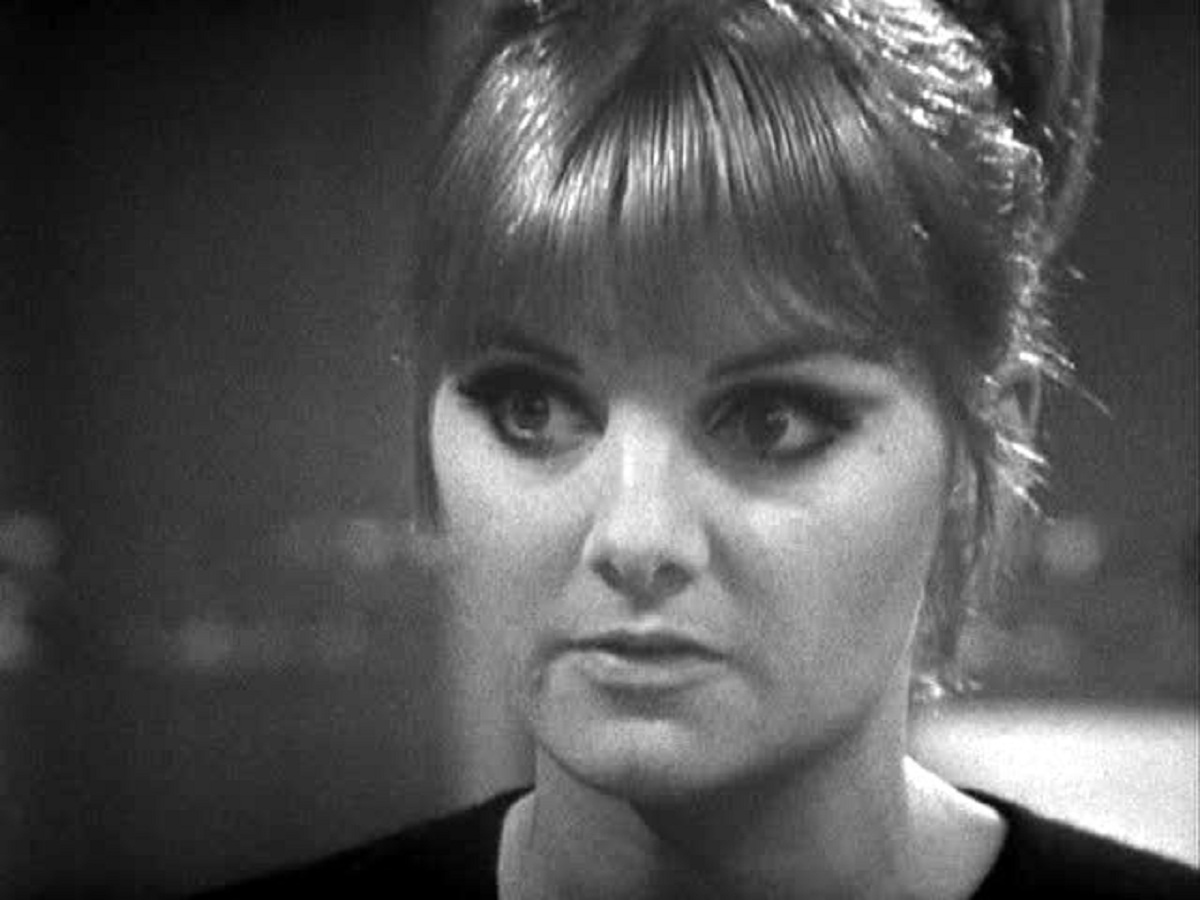
She might not look too much like the original Cybermen, but the more recent rehabilitation of mid-sixties TARDIS traveller Polly has been similarly welcome. Once not so much misrepresented as just plain ignored, to the extent that an official book about ‘The Companions’ dismissed her with a single sentence that literally said nothing more than that she was in the TARDIS once, the fact that it has since become possible to see what’s left of her episodes and indeed hear what isn’t has done much to restore her reputation as something a bit more than just stripy tops and over-washed hair. True, we are still missing some key visual moments like her active plot-dominance in The Smugglers and The Highlanders, and those creepy operating theatre scenes in The Underwater Menace do nobody any favours, but on the other hand there’s her arguing ethics with The Cybermen in The Tenth Planet, puzzle-solving in The Power Of The Daleks, and at least halfway entertaining over-the-top screaming in the few surviving seconds of The Macra Terror, not to mention that blisteringly good first episode after The Doctor regenerates, which is largely given over to Polly and Ben fretting about who this mysterious stranger wittering about his fingernails really is. The most frequently seen footage of Polly, however, comes from the second episode of The Moonbase, and is usually deployed to illustrate allegations of rampant patronising sexism in early Doctor Who. These allegations are not without solid foundation, it has to be admitted, but this isn’t really the most appropriate scene to underline them with. On face value, concededly, the exchange “You’ve found something?” – “Oh Polly, I only wish I had… why not make some coffee to keep them all happy while I think of something?” looks about as pat-on-the-head leave-it-to-me-dear mansplainy as it’s possible to get. That’s when you just look at the exchange itself, though. In actual fact, it comes at the end of a scene where The Doctor has been constantly interrupted by tinfoil hat panic merchants – some of them actually wearing literal tinfoil hats – babbling nonsense while he’s trying to analyse a mystery virus striking down the base’s crew, and while a more respectful and sensitive way of expressing it could have been found, he’s actually tacitly enlisting Polly’s help in distracting them while he concentrates; something that is entirely in keeping with her espionage-trained subterfugal shenanigans in other stories even if it is a poor deployment of such talents. Also – although we don’t know this yet – The Doctor wants some coffee made so that he can test his theory that it’s actually responsible for spreading the virus. This is far from being the most liberatingly progressive moment in the entire history of Doctor Who, but it’s also not quite what it gets made out to be either. Meanwhile, while we’re blithely raising hackles over sensitive subjects…
No, He Reinforced Stereotypes Of His Own Accord

The Tenth Planet boasts a notable first for Doctor Who, with sixties television regular Earl Cameron becoming the first black actor to appear in the series in a straightforward supporting role with absolutely no allusions whatsoever made to race, discrimination or background. That lengthy qualification is regrettably there because the story before that, The Smugglers, features poor old Elroy Josephs in a role that is absolutely nothing of the sort. Starey-eyed, maniacally laughing, insultingly named and ignorantly superstitious, ‘Jamaica’ fills out Captain Pike’s motley assortment of cut-throat privateers in a manner that, while certainly far from offensive or bigoted, would look decidedly uncomfortable on modern television. In fact, given that the story also features liberal use of daggers and a morally dubious position on seafaring lawlessness, it’s probable that The Smugglers would cause some serious headaches if it were to be suddenly returned to the BBC now. In fairness, it is probably a realistic depiction of how a real-life ‘Jamaica’ might have have acted in front of his piratical peers, and he does at least get what at least sounds like a fantastic scene playing cards with William Hartnell, but it’s still more than a degree disconcerting and in some respects it’s sad that Josephs – a distinguished actor, choreographer, academic and overall an individual who did much to help change race perception in the arts – is really only known in the present day, and even then only to a relatively microscopic amount of people, for this role. Still, maybe we shouldn’t really expect better from a run of episodes that includes the line “Polly, you speak foreign”, although we should probably at least be grateful that they never went with Patrick Troughton’s original suggestion that he should play The Doctor blacked up as washerwoman or whatever it was. Anyway, on to slightly less sensitive subject matter…
“You’ll Find That The Whole Plane Conforms Strictly To The International Standards Of Air Safety”

Tee hee hee, say less than minor celebrities on snorty point-and-laugh clip shows. Doctor Who always had cardboard monsters and rubber walls or something, not like when it came back and it was good. To which we say bollocks, frankly. Go away and actually watch some of it, then do a considerable amount of reading about the wider context of television production in the sixties and seventies, and then make up some original jokes that are actually funny and have some semblance of a basis in reality, and then go and jump in a bin. Although that said, let’s be honest about this – there are some occasions when you really just have to throw your hands up and admit to it. In Episode Three of The Faceless Ones, there’s a scene in which Captain Blade – who we don’t yet know is actually a seaweed-faced alien planning to repopulate his home world with humans – is trying to assure suspicious DI Crossland that Chameleon Tours have got nothing to do with the disappearing planeloads of Club 18-30-type revellers. This he does by boasting about how well constructed their planes are while standing in front of some flimsy-looking panels complete with a gap between two of them that you could fly a Laker Skytrain through, and as an air hostess hefts some luggage onto an already buckling overhead compartment which responds by, putting it mildly, bouncing. Perhaps if they wanted to fool the puny Earthlings into believing that the cunning replicas of their friends and relatives were the genuine article, they really ought to have started with a more convincing-looking plane.
There Is No Such Thing As Macra!
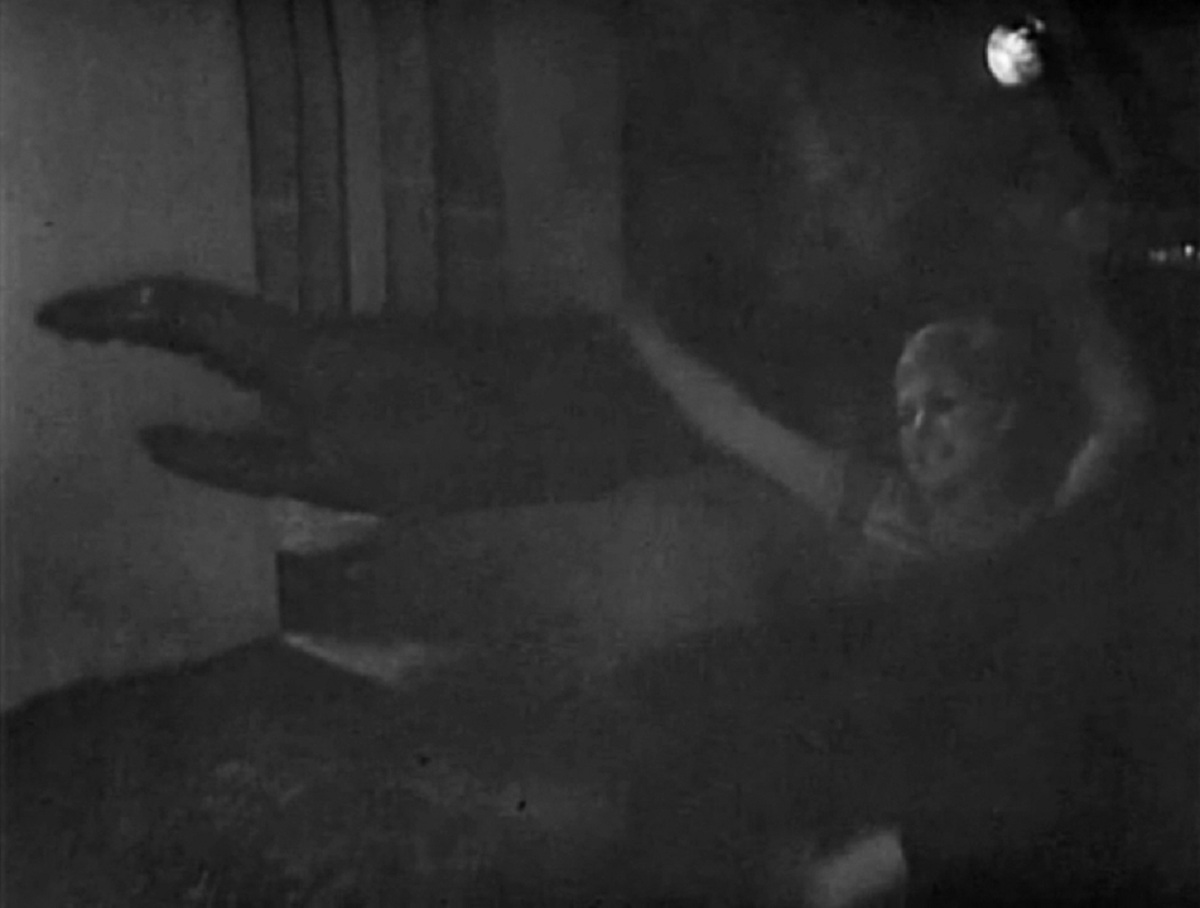
As much as the recent-ish recovery of a whole other episode of The Underwater Menace has done much to restore the story’s previously Atlantean-depth low reputation – although some of us always thought it was good and not bad like you thought, as you can read much more about in Well At Least It’s Free here – a quick glance at Doctor Who Magazine‘s 2014 ‘every story ever’ poll reveals that it was still languishing at a shockingly undeserved 224 out of 241, and with ever more options added to the list since then, even if one of them was The Rings Of Akhaten, it’s hardly likely to vault very far upwards in the near future. Clearly quite a few things in the world can stop it now. It’s interesting to note, however, that with the exception of the two Dalek stories – which we’ll be coming back to in a moment – not one story from series three actually appears inside the top one hundred. Not even the one with the first regeneration and the first appearance by The Cybermen. Clearly the fact that so little of it still exists – in fact, it is now the only series without a single surviving full story to its name – has some bearing on this, although equally this makes it all the more puzzling that fans aren’t more curious about the more tantalisingly obscure stories and in particular The Macra Terror. On face value, The Macra Terror would appear to have everything; sinister Orwellian overtones, the over-vaunted ‘Base Under Siege’ format, nerve gas-toting giant crabs, the TARDIS crew divided by TV and Muzak-propagated mind control and Polly roadtesting a brand new Mod Girl ‘pixie cut’. Yet although it got more than respectable ratings and even provoked a bit of controversy with oversensitive viewers writing to Radio Times asking why Dr. Who couldn’t ever meet some nice aliens on his travels and share his pie with Itchy and then they both have pie, The Macra Terror now might as well just not have existed in the first place. Frankly, this says a lot about the seemingly limitless obsession with ‘milestones’, ‘landmarks’, ‘classics’, ‘anniversaries’ and all of the other ultimately meaningless labels that dictate what we should and shouldn’t be taking notice of, and it would be nice to see it found and watch the story leap up in everyone’s estimation just like The Enemy Of The World did. Though whatever you do, don’t send drunken texts from the pub ordering certain individuals to sodding well give their copy back to the BBC…
What Did The BBC Have Against The Highlanders?

Speaking of entirely lost stories, The Highlanders might well have been the last of the ‘pure’ historical adventures, but it was also the first ever story for which the videotape transmission masters were wiped. What’s more, all four of them were held up against a giant magnet on 9th March 1967, which those of you who are familiar with the relevant facts and figures will have noticed was less than two months after they were transmitted. Even allowing for the fact most fans just won’t accept that wipings were basically a matter of course and down to a combination of technical necessity and nobody realising that anything might have any use beyond one repeat – and even they were rare – this really does seem to have been suspiciously quick, especially considering that there were dozens of other older Doctor Who master tapes knocking about that hadn’t been used in up to three years. What could possibly have offended them so much about a fun costumed runaround that apparently at least looked halfway atmospheric, gave Polly a Hannah Gordon-portrayed sparring partner to get up to semi-comic hi-jinks with, and introduced a young clan piper called Jamie McCrimmon who proved so popular that he was quickly installed as a new regular character, apparently occasioning Frazer Hines to ‘mellow’ his accent to ‘TV Scots’? Well, the answer of course is ‘nothing’ – BBC Enterprises had already made their film copies, which they held on to until at least 1974, and had placed a ‘Retention Order’ on earlier stories apparently in order to make better copies using a newer system; once these had been made, the bulk of the preceding adventures were wiped within weeks. True, this isn’t quite as exciting as someone somewhere making some obscure artistic point about the lack of popularity of the historical stories, but in some respects the sheer by-the-book form-filling mundanity of it all is all the more dispassionately sinister. Solicitor Grey would have been proud. Well, we can assume so. Nobody’s actually seen him.
Medley: Mr Sludge The Snail/Can You Sew Cushions?

Along with his not-actually-that-‘Beatlesque’ ‘Beatlesque mop’, the not-actually-a-Stovepipe Hat Stovepipe Hat and the not-actually-that-loud ‘loud’ orange and black check trousers that were apparently ‘taken in at the rate of an inch a week’ – presumably resembling Spandex by the end of his tenure – the blue and white striped recorder was one of the Second Doctor’s most recognisable visual characteristics, even if inattentive writers and directors kept referring to it as a ‘flute’. That said, he never actually seemed to be that proficient on the instrument, appearing to spend the majority of the time picking out shrill random notes in a manner suggesting Roland Kirk collaborating with AMM. However, according to production documentation, he did actually play two just about recognisable melodies in the first episode of The Power Of The Daleks, which apparently had the preposterous titles Can You Sew Cushions? and Mr Sludge The Snail. Many have speculated that songs with such patently ludicrous names could never have actually existed, but close investigation reveals that they were all too real, if admittedly slightly arcane choices. Can You Sew Cushions? turns out to have been a traditional Scottish folk song, which after posing that thorny question goes on to enquire whether the lyrical target can also sew ‘sheets’ and something about going ‘hee’ and ‘haw’ at a lamb. Mr Sludge The Snail, on the other hand, was written especially for the BBC Schools’ Radio programme Time And Tune by producer and occasional Radiophonic Workshop extra pair of hands Jenyth Worsley, and its inclusion here was presumably an early nod towards cross-platform postmodernism that didn’t quite come off. The lyrics, in case you were interested, were essentially concerned with the fact that Mr Sludge was ‘medium-sized’, which you have to admit in the snail scheme of things doesn’t really mean very much at all. Meanwhile, you may have noticed that the colour of Troughton’s trouser check and recorder stripes will have been completely immaterial to black and white viewers, thereby rendering the entire history of fan cliché lexicon invalid. Now there’s a turn-up for the books.
DALEKS-CONQUER-AND-DESTROY!
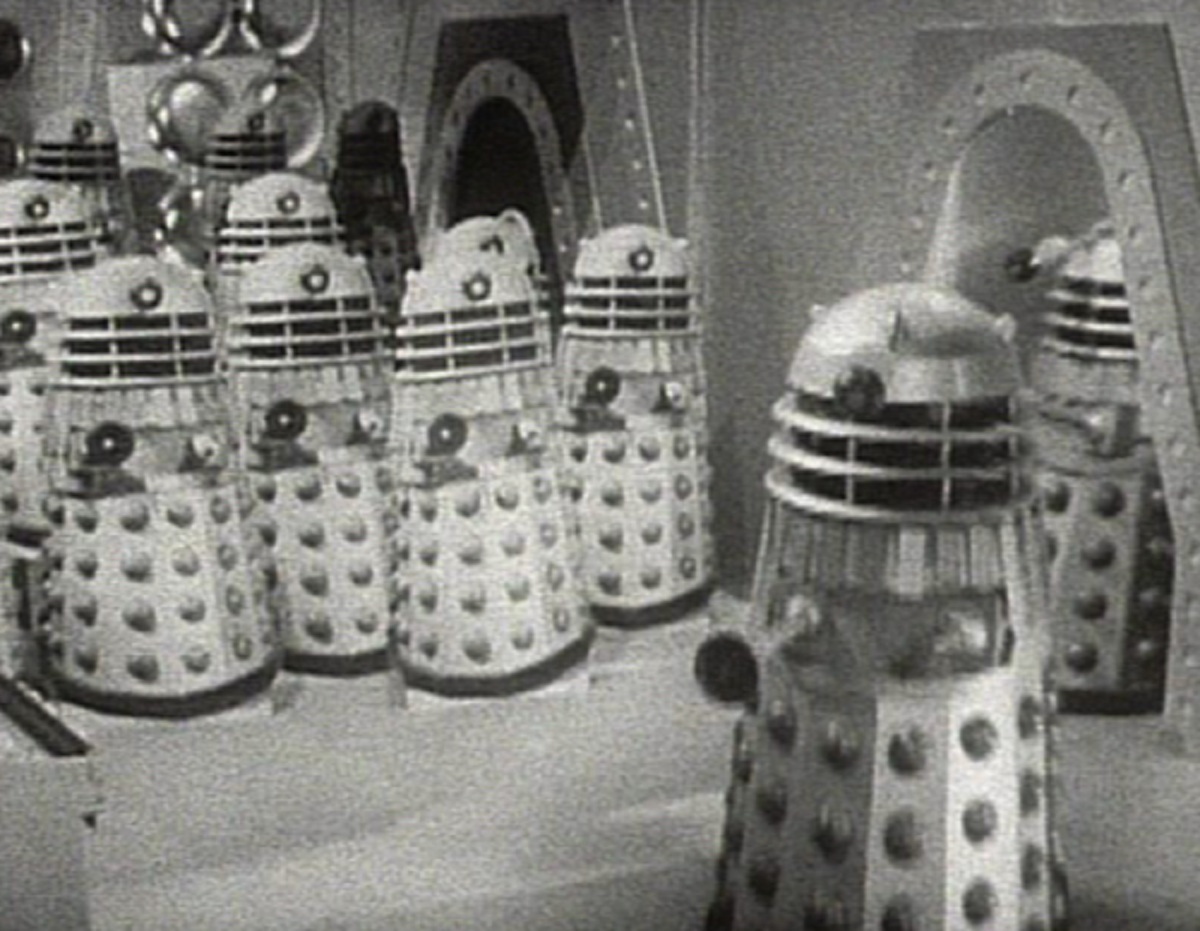
Series Four doesn’t quite start with a Dalek story, but it certainly ends with one, and between the two of them they manage to not only overshadow most of sixties Doctor Who but a good deal of what has come since as well. The Evil Of The Daleks and The Power Of The Daleks are held in high reverential regard by an audience who, for the most part, cannot possibly have seen anything of them bar the lone surviving episode of the former. In some respects, it isn’t entirely surprising that they enjoy such a lofty reputation. Both stories transplant The Daleks to tremendous effect into atypical narrative scenarios – a claustrophobic Cold War-evoking fifties-style far future thriller for The Power Of The Daleks, and eerie Robert Louis Stephenson-esque Victorian nursery rhyme horror for The Evil Of The Daleks. They are, in many senses, the last manifestation of the original vision for Doctor Who, what little visual material survives from the lost episodes looks ever so slightly exciting, and above all they’ve got absolutely tons of Daleks, even if they do appear to be working to some form of ‘only three to be seen at any one time’ rule and the majority are either photographic blow-ups or literally blown-up models. Are these reputations genuinely warranted, though? Not so much from the perspective of asking if they are actually any good, more in the sense of questioning whether they would they would enjoy quite the same degree of across-the-board appeal if they suddenly turned up now? These are, after all, thirteen episodes of mid-sixties studio-bound television drama recorded more or less ‘as live’, and particularly wordy, moody and ponderous examples at that. Given that a worryingly large proportion of Doctor Who fans seem utterly unaware that there were any other television programmes at any point in history ever, it’s hardly surprising that a lot of them just don’t seem to grasp the context and – ahem – ‘grammar’ of early television, and then on top of that there are those that do get it but simply and entirely reasonably don’t like it. If they had to sit through over seven hours of the stuff, how many of them would even make it to the end? Yes, the sort of fans who would gleefully catapult every last second of television made in the last twenty years into an active volcano to get hold of a single episode of R.3 or On The Margin would be too excited for words, but how many others would be so underwhelmed that both stories immediately plummet to keep The Macra Terror and company company at the bottom of the nearest Best Story Ever poll ? Well, we’ve no way of knowing. It’s not like anyone has found them and is refusing to give them back, is it?
Incidentally, you may have noticed that there have been no further additions on this occasion to the ongoing They Like Big Butts And They Cannot Lie saga, as previously, erm, checked out in series two here and the Dalek movies here. This is purely because so much of this series is missing that it’s proved pretty much impossible to find any examples, although it’s a fair bet that the booty-crazy cameramen would have been falling over themselves to get to the rear of the majorettes in The Macra Terror…

Anyway, join us again next time for Jamie presenting The Clothes Show, “AND-YOU-WILL-BE-THE-NEXT”, and of course Padmasambhava, Padmasambhava and not forgetting Padmasambhava…

Buy A Book!
You can find an expanded version of It’s Still A Police Box, Why Hasn’t It Changed? covering the entire sixties run of Doctor Who in Can’t Help Thinking About Me, a collection of columns and features with a personal twist. Can’t Help Thinking About Me is available in paperback here or from the Kindle Store here. You can also find a more in-depth look at the very murky depths of The Underwater Menace in Well At Least It’s Free, available in paperback here or from the Kindle Store here.
Alternately, if you’re just feeling generous, you can buy me a coffee here. Just make sure you ask Polly in moderately more enlightened terms.
Further Reading
You can find some further thoughts on the lost sixties Doctor Who stories – and why their unavailability makes them that much more interesting – in The Abandoned Planet here.
Further Listening
There’s much more about Doctor Who‘s early days and plenty more besides in my appearance on The Zeitgeist Tapes – the podcast where politics meets pop culture – here.
© Tim Worthington.
Please don’t copy this only with more italics and exclamation marks.
 Tim Worthington