On 26th January 1976, the Daily Express warned “Watch Out Dr. Who, Mary’s Fighting Mad”. ‘Mary’, it will probably come as scant surprise to discover, was veteran taste and decency campaigner – the ‘Clean-Up TV’ pejorative is somehow simultaneously too reductive both of the threat that the National Viewers And Listeners Association posed for the freedoms of a populace who were not aware of having appointed them the unassailable and worryingly influential moral guardians of fully grown adults and of the genuine intent and concerned that however misguided ultimately underpinned all of the campaigning – Mary Whitehouse, and while the primary archery target of her latest missive to the BBC Director General was a protracted fight sequence in the 1975 serial The Legend Of Robin Hood – a legend that of course famously did not have its entire basis in outlaw activity and sword-battling in any manner whatsoever – she also had plenty to say about a recent turn that Doctor Who had taken. Amongst a flurry of florid hyperbole and tutting that the supposed violence and sadism were of levels that had never been seen on television before, or at least since the previous most recent highlighted example of levels of violence and sadism that had never been seen on television before, she did at least state one unarguable and difficult truth – that “the violence is designed to hold adult viewers who have been watching sport before tea-time, but children are watching at the same time”, concluding with a vital qualification that “I dread to think what effect it has on five year olds and younger”. A valid observation made in manipulative, rabble-rousing and suspiciously judgemental terms with no clear aim or ambition in mind and motives that fell apart under the mildest scrutiny – not that the NVALA were ever particularly prepared to submit their campaigning methods to any degree of interrogation – but as any fan of Doctor Who knows, Mary Whitehouse was only really limbering up here.
A difficult and divisive figure even amongst her supporters and indeed detractors, with a complicated legacy encompassing everything from thoroughly laudable and far-sighted attempts at lobbying politicians to act to prevent the importation of violent and exploitative pornography before it had even become a possibility to a silly fuss over a BBC Records And Tapes collection of sound effects from horror-themed radio plays – and there’s more about that in Top Of The Box Vol. 2, incidentally – Mary Whitehouse’s fascinatingly peculiar yet also worryingly pervasive and persuasive to entirely the wrong people perspective is perhaps best exemplified by her attitude towards Dennis Potter as laid entertainingly bare in the illuminatingly splendid collection of her correspondence Ban This Filth!; she considered him a first rate dramatist almost without equal and with many valid and pertinent points to make about society, many of which chimed in the broader sense with hers, but when said points were expressed with scattered expletives and fleeting nudity they were to be removed from public view with immediate and irrevocable effect. Reading her letters rather than the overblown and agenda-laden distortions from both sides of the surrounding argument, you are rather left wondering whether her attitude towards Doctor Who may not have been entirely dissimilar, and that she was genuinely taken aback to see a programme she had once considered relatively harmless family viewing – despite casually repeated assertions to the contrary, there is no reliable record anywhere of her complaining that The Daleks were ‘too frightening’ – had edged ever closer to an exact replication of the sort of scenes and themes that might more normally have been expected from a late-night double-bill at the local ABC Cinema.
What was more, it had not finished edging ever closer yet, and an attempt to build on this ‘success’ for want of a better word in the following series would lead to an even more heated exchange of views between Mary Whitehouse and the BBC which for once resulted in them having to back down and implement change. In fairness, on one or two occasions it arguably would go too far, and however ludicrous and disconcertingly redolent of ulterior agendas the complaints may have been, there were moments in the mid-seventies when Doctor Who must have put even the most Classic Horror-inured of younger viewers off their Crosse & Blackwell Haunted House, although presumably they hid behind the nearest copy of The Fourth Pan Book Of Horror Stories rather than ‘the sofa’. The uncomfortable upshot of all this is that sometimes, you really can see what all the fuss was about – but equally, those making the fuss were doing so from a blithe refusal to countenance some significant mitigating factors. Firstly, there is absolutely no denying that it was extremely and unprecedentedly popular, not just amongst those violence-crazed adults hanging around after ‘the sport’ who were doubtless to be found lurking in every home except the good clean Whitehouse residence, but amongst a record-breaking proportion of the target audience who were well used to the then-current vogue for elements of horror amongst their everyday entertainment – and there’s more about the evolution of that curious phenomenon here – and for whom a Time Lord’s disembodied brain in a bubbling tank will have held no significant adverse effects whatsoever. Secondly, this was no exercise in cheap and nasty shock and terror, and was uniformly brilliantly written, directed, designed and acted, to the extent that it inspired envy even amongst production teams concurrently working on more prestigious adult drama. Thirdly, and most importantly, it was driven by a leading actor who was no stranger to dark and gothic themes – arguably his most prominent role before arriving in Doctor Who was in the 1973 portmanteau horror movie Vault Of Terror, which even in itself had to be shorn of assorted odds and ends before it was considered suitable for those late-night ABC audiences – but never, ever lost sight of the fact that he was responsible for a programme aimed at, watched by and loved by children, and who went out of his way to ensure everyone adhered to the appropriate degree of terror for each script and scene, all the way from essaying sheer helplessness in the face of an ancient deity casually threatening to shred his nervous system into a million fibres to brightening a bleak tale of psychological breakdown and nature-germinated body horror in a creepy old house by sharply pulling on a chauffeur’s cap and asking in all seriousness “how do I look?“. There is a reason why Doctor Who in the mid-seventies was so popular at the time, and indeed why it is so revered now, and the overwhelming percentage of that reason is down to Tom Baker. Perhaps it wasn’t for everyone, and definitely not for Mary Whitehouse, but it was very evidently for most of them. Although this did involve shaking off a few longstanding and much-loved fixtures first…
What ‘Suit Of Fairy Lights’?!
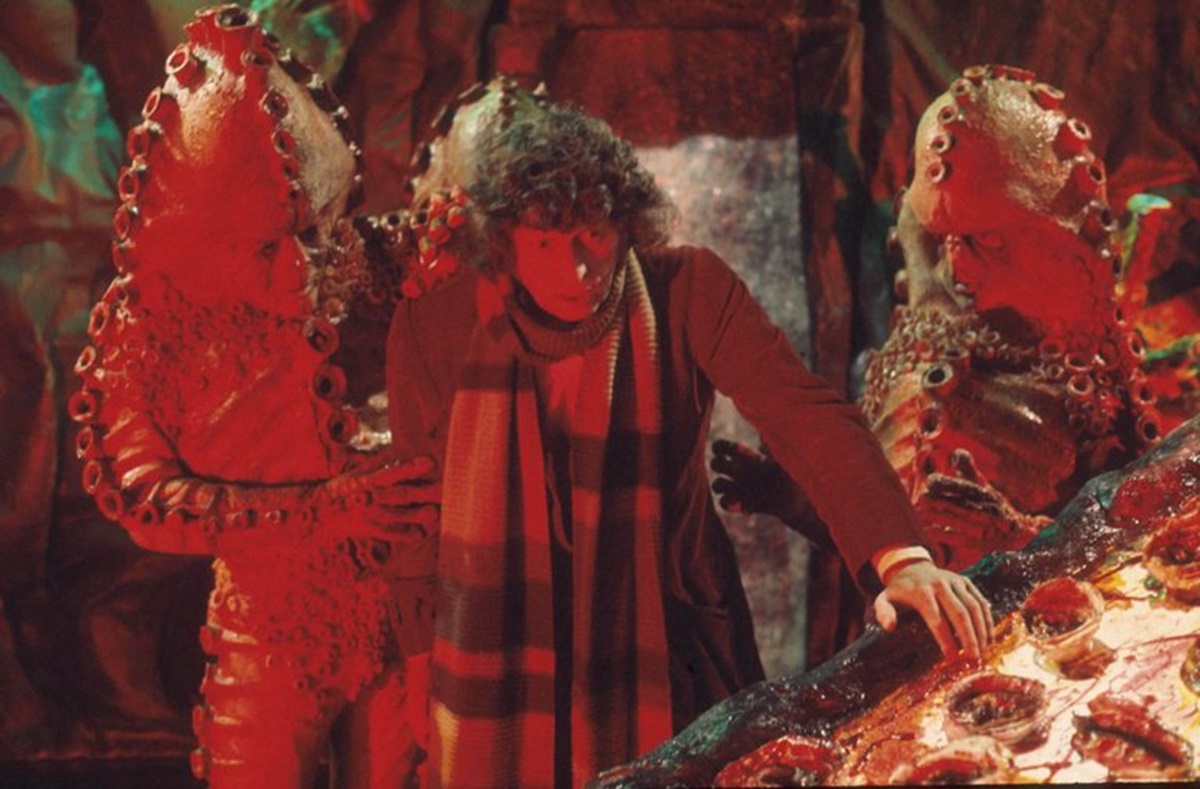
Ironically for a story that essentially draws a line under Doctor Who‘s recent past, Terror Of The Zygons was originally intended as the sign-off story of the previous series but was held back to kick off this run of episodes instead. An everyday story of conquerously-intentioned shapeshifting aliens and their oil rig-scoffing pet cyborg which cunningly masquerades as a certain Loch-dwelling monster of international mythological repute, it scores highly as an effective fusion of the darker tone that the series had taken on in Jon Pertwee’s swansong series and the gag-strewn stuntman-chucking U.N.I.T. stories that had more or less dominated his earlier outings, but it would also be the last that we saw of the United Nations Intelligence Taskforce for quite some time. They do show up later as out-of-character facsimiles of themselves, and some form of in name only Ruby-Spears level U.N.I.T. that are more or less akin to one of those albums you get at the end of a Complete Album Collection box set where all of the original members have left and all the songs sound like they were written by your friend’s annoying mate who is perpetually ‘working’ on ‘his music’ put in an appearance of sorts right at the end of the run, but otherwise that is essentially that. We won’t see The Brigadier again until Mawdryn Undead in 1983 – and even then, he wasn’t necessarily the first choice of character to make a return visit – and his squadron would not fall in again until just before Doctor Who itself fell out for the very first time at the very end of the eighties. The Doctor also took this opportunity to tacitly leave Harry Sullivan behind, and while it was a genuine shame we didn’t really get to see any more of him, you do also wonder how Harry would have fared with Harrison Chase and Sutekh on a straightforward narrative level. The reason they have found themselves twenty three miles southwest of Inverness is that The Zygons are operating out of a stranded sub-Loch spaceship, and their leader Broton has assumed the identity of local dignitary and Head of the Scotland Energy Commission – and also, as Sarah notes in a line where it really is impossible to tell whether it was intended as serious or not, Chieftain of the Antlers Association and Trustee of the Golden Haggis Lucky Dip – with both roles accordingly taken by veteran character actor John Woodnutt. Back in the days before Electronic Press Kits and ‘deep dives’ on individual stories and indeed unduly sarcastic ten point series by series overviews crammed with petty digs at ‘episode hunters’ who think finding four sixths of a black and white story entitles them to have a say in the basic human rights of minority groups and at loopy evangelical predictions about the exciting new future of streaming broadcasting with free cans of Fizzy Vimto and 12″s of Welcome by Gino Latino for all, Doctor Who actors and production team members were routinely asked the same questions often by the same interviewers again and again and again, giving rise to the all too familiar anecdotes about Lit Roundels, Saniel Peewit and that time a vicar came to watch a table read of Deborah Watling’s pants or whatever it was, and the esteemed Mr. Woodnutt was all too fond of telling one particular tale about how, during location filming for Terror Of The Zygons, he didn’t have time to change out of his Broton getup before adjourning to the pub and found himself having to order a swift half whilst sporting “a suit of fairy lights”. The only issue with this guaranteed table on-roar-setter after-dinner yarn is that at no point does the Duke Of Forgill appear in anything other than Antlers Association-adjacent semi-traditional dress, and Broton remains resolutely in spongy amphibious form throughout, so it’s difficult to see how or why or in what circumstances this could have happened. The only feasible conclusion is that he was conflating Terror Of The Zygons with the made around roughly the same time-ish Look And Read serial The Boy From Space, in which – as you can hear much more about here – he portrays the sinister Boy From Space-pursuing ‘Thin Man’ who is indeed at one point seen in a shiny reflective blue-and-silver spacesuit that could conceivably in fluent character actor-ese be construed as something vaguely akin to a ‘suit of fairy lights’. Sidestepping the difficult matter of whether his indulgence in a pint of beer would have provoked ever-vigilant Word-Watchers into singing the Song Of The EE’s, this understandable if bewildering conflation does at least serve to underline three very important points often overlooked by obsessives of a certain series. Firstly, to most performers and crew members involved in the show, especially in the seventies, it was just another day at the office and not necessarily any more important to them than whatever else they got paid to do; secondly, that there were and indeed more programmes being made and broadcast than Doctor Who and a lot of them – like The Boy From Space – are actually worthy of your attention; and thirdly however entertaining an anecdote may be and no matter how often it may get repeated, it’s always worth at least a cursory consideration of its veracity. It’s still not really a ‘suit of fairy lights’ by any sane and rational definition, though. Mind you, there were a lot of more intentionally disingenuously distorted descriptions in common deployment around that time…
Twin Frankensteins Who Would Have Put The Wind Of Heaven Up Peter Cushing

Although The Brain Of Morbius gleefully wears its Classic Horror with added Visual Effects Department Gunk crackling-voltaged influences very much on its mismatched detached and stitched back together sleeve, and The Seeds Of Doom very determinedly takes a disturbing geological breakdown-fixated theme and beds in as many equally disturbing cuttings around it as it possibly can, modern viewers may be forgiven for wondering – The Doctor’s vision of a Sutekh-ravaged alternate present aside – quite why Pyramids Of Mars was considered quite so liable to terrify younger viewers out of their wits. Surely it is really only moderately above the level of what was even then considered entirely permissible literary form, and considerably milder than even the least goose boo-saying Hammer movie involving an artefact brought back to an ancestral home against the summarily dismissed haltingly bilingually expressed concerns of a curiously hesitant tour guide? Well, not if you asked Daily Express columnist and self-styled ‘First Lady Of Fleet Street’ Jean Rook back in the mid-seventies. In an alarmingly aggressive and aggrieved column that frankly reads as tantamount to little more than a mandated assault on the BBC through a convenient reader conscience-baiting filter with the remarkably subtle and considered headline ‘Who Do You Think You Are, Scaring My Innocent Child?’, she singled out Pyramids Of Mars for particular criticism, focusing in on a scene featuring Sutekh’s lumbering robotic mummy hench-bandagees which she described as “twin Frankensteins who would have put the wind of heaven up Peter Cushing”. Along with its hysterical in both senses qualification that their appearance on screen took place while she was “frying his fish fingers” as her innocent child sat “alone in a room with a programme which could have screwed up and permanently crunched his nerve with one mummified hand”, this comment has been routinely repeated in any and every self-respecting feature on Pyramids Of Mars ever since, and there are more issues with it than anyone seems prepared to challenge. Even sidestepping the default smug observation that Frankenstein was the name of the scientist and not the monster, the question of how she was able to observe the troubling scene with such clarity if she was in another room frying fish fingers, why anyone in their right mind would fry fish fingers rather than grill them if that is really so vital to the narrative, and whether the screwing up and crunching of nerves, permanent or otherwise, is an actual recognised medical phenomenon, there’s also the small matter that they are not Frankensteins either in the scientific or monstrous sense. They are mummies, an entirely and famously different monster from the Classic Horror tradition, and even though they may be suspiciously neat and tidy examples of the preservation process this does not prevent it from being pretty much equatable to referring to Styggron as ‘a Dracula’. Meanwhile, although Peter Cushing – who of course had played Doctor Who on the big screen, though more about that here – was generally careful to keep very close counsel on such matters, it is unlikely that he would have felt too well disposed towards his name being invoked in this context and in this manner, and in any case, having not long recently completed work on The Ghoul it is doubtful that Sutekh’s mummies would have put the ‘wind of heaven’ up him, whatever that is exactly anyway. An honourable mention must also be made here of Mary Whitehouse’s less screechingly emotive but no less memorable assertion that “strangulation – by hand, by claw, by obscene vegetable matter – is the latest gimmick, sufficiently close-up so that they get the point; and just for a little variety, show the children how to make a Molotov Cocktail”. While it is fair to say that it probably was a little overdone around this time, both for dramatic and suitability reasons, the idea that this was ‘latest’, a ‘gimmick’ or even ‘close up’ does not stand up particularly well to even cursory scrutiny, unless you’ve been reading some VERY ‘specialist’ publications the Krynoid isn’t in any sense ‘obscene’ vegetable matter – it’s just vegetable matter – and while the phrase ‘Molotov Cocktail’ itself is used, one of the components is clearly identified and the scene itself does bear some suspicious telltale signs of after-the-event editing, the implication that Doctor Who was ‘showing’ its audience how to cobble one together in the manner of a to-camera Why Don’t You…? ‘make’ is pushing it a bit. You’d think they were all resorting to dramatic terminology to further a dishonest agenda through diversionary tactics or something. Still, there was one suspiciously familiar ‘classic’ monster that showed up in this series that – luckily for the production team – nobody took any particular exception to. Even Peter Cushing.
“That Thing Out There… It’s YOU!”

Released in 1956 to rapturous critical acclaim and phenomenal box office takings – more than likely entirely true legends are told of punters being turned away from sold out showings on their attempt to see it for a fourth or fifth time – Forbidden Planet is not just a staggeringly good sci-fi movie that proved that intelligent writing and top-drawer acting could work alongside ray gun effects and comedy androids, but a phenomenal achievement and a high benchmark for pretty much any genre. At the risk of spoilering a movie that predates Love Me by Buddy Holly – though if you’re all so concerned about that you can stop gleefully posting spoilers for the latest episode of Doctor Who after staying up until a million o’clock in the morning to watch it on your precious ‘streaming’, thank you very much – Forbidden Planet concerns the engagingly temperamentally diverse crew of United Planets C-57D on a mission to Altair IV to check in with conveniently-named scientist Dr. Edward Morbius, his daughter Altaira, their dryly humorous rust-averting mechanical factotum Robby The Robot, and the big secret that they’re all keeping conspicuously quiet about – an intangible luminescent resident monster created from the dark undertow of the human subconscious. Hugely atmospheric with a creepy alienated ambience and an eerie Theremin-led score, fortunate enough to benefit from futuristic designs and pioneering visual effects that have weathered the march of technology surprisingly well, and marking the screen debut of enduring pop culture icon Robby The Robot, whose popularity with audiences saw him quickly parachuted into the frankly dreadful sequel The Invisible Boy and thus beginning a steady decline in prominence that wound up with his undignified relegation to an uncredited comedy stooge to The Banana Splits a decade later, it is little wonder that Forbidden Planet became a popular regular fixture on the BBC, including one particular heavily publicised BBC1 showing on 6th November 1974. You could probably just about make a convincing case that the 1975 Doctor Who story Planet Of Evil being built around a spaceship crew on a military mission being terrorised by an intangible luminescent monster generated by the dark undertow of the human – well, Morestran – subconscious was a staggering and unlikely coincidence, if it wasn’t for the fact that the Anti-Matter Monster ‘looks’ – if that’s the right word for something that only exists as a sort of superimposed thermal image outline like when Alvin Stardust used to go ‘weird’ during the second verse on Top Of The Pops – exactly like the monster from Forbidden Planet only with slightly more boggly eyes so that nobody would suspect a thing. Doctor Who was certainly not backwards in coming forwards about openly acknowledging its influences around this time but this really is a bit much; still, if the vogue for bringing back 1975-era villains continues, at least it won’t be deemed too ‘problematic’ to revisit immediately before trotting out an arguably even more ‘problematic’ one. Mind you, there are also some revisitation-worthy ‘big bads’ from around this time that everyone always forgets about…
Even An Old Boot Someone Had Discarded In Rather A Hurry…
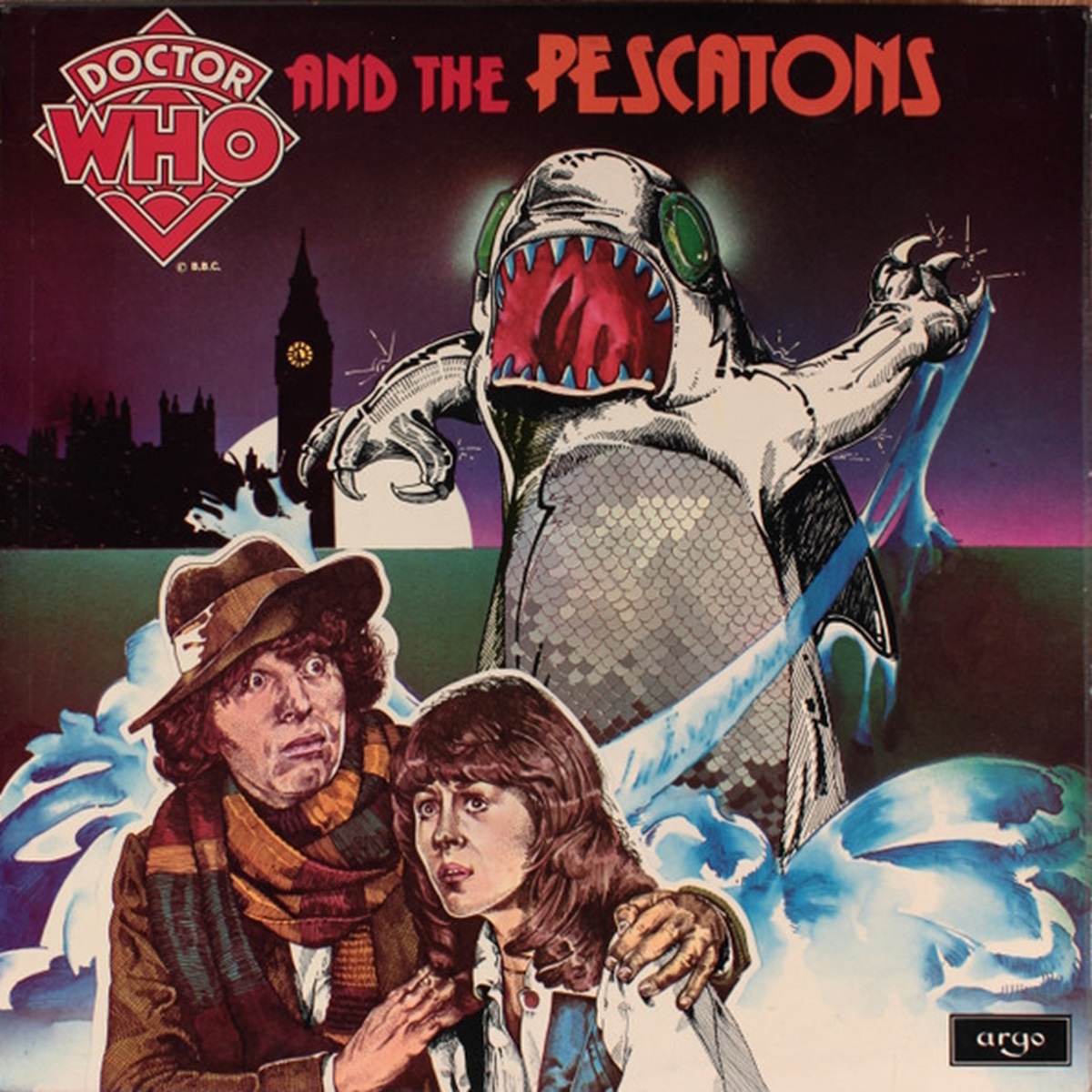
Even at the height of ‘Dalekmania’, whenever Doctor Who itself was off the air – which admittedly wasn’t especially often at that point – fans who were hungry for further adventures featuring the TARDIS travellers had to content themselves with the uninspiring combination of their imagination and a painting by numbers book with William Hartnell meeting the ‘Yarvids’ or something. With his wariness of typecasting very much in mind, the off-duty Patrick Troughton virtually as good as denied he was in Doctor Who while it was actually being transmitted, and although Jon Pertwee gleefully accepted any in-costume and semi-in-character extra-curricular gig that was thrown his way, there was only so long that Doctor-hungry aficionados could stare at that drawing of him babbling something about spacemen needing their daily Victoria Sponge just like you do on the back of that recipe book and willing it to move before they got bored and started watching The Hope And Keen Scene instead. The blunt and unavoidable fact of the matter was that with the debatable exception of the annuals – and frankly the resemblance of the stories to anything that anyone reading them might have recognised as Doctor Who is something that the word ‘debatable’ does really not do justice to – you just plain did not get any actual additional extra Doctor Who outside of Doctor Who itself. It’s perhaps a measure of just how popular the show itself and Tom Baker and Elisabeth Sladen in particular were, then, that not long after work on this particular series concluded, they were ushered into not one but two separate recording studios to lend their voices to audio-only adventures that could honestly have slotted neatly and seamlessly between pretty much anything seen on screen. An instalment in a long-running BBC Schools Radio geography-based series, Exploration Earth: The Time Machine saw The Doctor and Sarah Jane dash off for a quick nose at the planet’s various developing stages of early sedimentary stratification only to discover that Pleistocene ne’er-do-well Megron – given snarlingly booming voice by John Westbrook – is none too pleased about this rock formation malarkey and elects to make this clear in a series of time-spanning ecologically disruptive antics that rival the ambition of both Sutekh and Morbius for scale and scope. Meanwhile, Argo Records’ Doctor Who And The Pescatons pitted the duo in a surprisingly graphic and threatening story for what was ostensibly a children’s record against a literal tide of piscine interlopers headed by their growly-voiced leader Zor – played by Bill Mitchell in more or less exactly the same voice as the one he used for the contemporaneous scuzzy guitar riff-backed lady-with-busy-hands=centric adverts for Denim aftershave (“for men who don’t have to try too hard”) – with only The Doctor’s trusty piccolo which he was apparently ‘always’ playing to assist them. Although the idea of listening to the same story again and again may well seem almost amusingly quaint now, that’s exactly what people did – and more to the point, imagine how exciting it must have been to have sat down in the assembly hall with fingers ruefully on lips only to hear the Doctor Who theme tinnily blasting out of that weirdly oversized radio made by a manufacturer whose name you never saw on any electrical device anywhere else. Both of these unexpected outbreaks of ‘extra’ Doctor Who are more fondly remembered than they have any reasonable expectation to be and equally stand up far better than they might reasonably be expected to, and at the risk of sounding too much like this is straying into rose-tinted home entertainment territory – so let’s just cue up Exploration Earth: The Time Machine on Spotify to counteract that – perhaps back when such additional ‘content’ was less easy to come by people appreciated it more and indeed on a more simple and straightforward level; and as there seems to be such fervour for villains from this era right now perhaps it’s time Zor was brought back too, even if only so that dimwits can get angry about his scales sort of reflecting the light as Pride colours if you squint a bit and then make some tedious self-obsessed bigoted bullshit up in your own head. Yet while they had their own visual representations on the album cover and in Radio Times respectively, sadly neither Megron nor Zor would find their way into another spin-off from around this time…
WE MUST CAP-TURE THESE SPECI-AL PACKS OF WEET-A-BIX

Nowadays you are lucky to get anything free with your cereal other than some arbitrary percentage of additional cereal, but plastic and cardboard giveaway gifts with boxes of puffed wheat were once so ubiquitous that artists fretted that they were an inadvertent covert gateway to American cultural imperialist dominance – no, really, they genuinely did as you can find out here – and no self-respecting sitcom was complete without a breakfast table scene where Sid James harrumphed about how you never got a plastic toy with your porridge in his day before complaining that he had wanted ‘the diver’, and Nabisco-scoffing youngsters the length and breadth of the nation zealously hoarded their weirdly aggressive-looking Sweeps in as many colours as possible, argued over whether ‘that one’ of the other three children ever actually appeared in The Magic Roundabout, and did their very best to tap a foot or two along to what may possibly have been The Monkees playing their theme song on bicycle horns through a crystal radio earpiece speaker as the angularly cut-out cardboard disc ensured that a new stylus would shortly be in order. In 1975, Weetabix tried to entice consumers back towards their convex-cornered densely-compacted wholegrain wheat biscuits with a series of cover-mounted figures and dioramas depicting ‘Doctor Who And His Enemies’ and taking in everyone from Daleks and Sontarans to White Robots and Quarks, and giving rise to a bafflingly persistent fan joke about The Giant Robot not being too menacing if he was a Weetabix card that had fallen in the Weetabix and got Weetabix on it as apparently configured around some parallel reality where people are required by law and by physics to balance cut out portions of cereal boxes on the edge of their bowl whilst eating. It should scarcely require stating that this much-loved promotion was a runaway success – so much so that they repeated it in an updated form with an accompanying board game in 1977 – and a rare example of a tie-in that did actually allow fans with something at least halfway approaching an imagination to create their own stories where a Sea Devil ‘stole’ the TARDIS. Not that it really needed any further consumer enticement, but the Weetabix/Doctor Who crossover event was memorably pushed on television with an advert in which a Dalek with a red and black colour scheme of dubious veracity warned his fellow Skaronians to confiscate all boxes of Weetabix with extreme prejudice, reinforcing its point by spooking a feral-coiffured seventies adolescent at his breakfast table, though how it would have fared against latterday advertising mascots the Weetabix Skinheads – who of course demanded that you make it neet wheet mate, if you know what’s good for you – remains to be seen. Our money’s on Brains and Bixie, though.
Take Off The Eyepatch And Look For Yourself
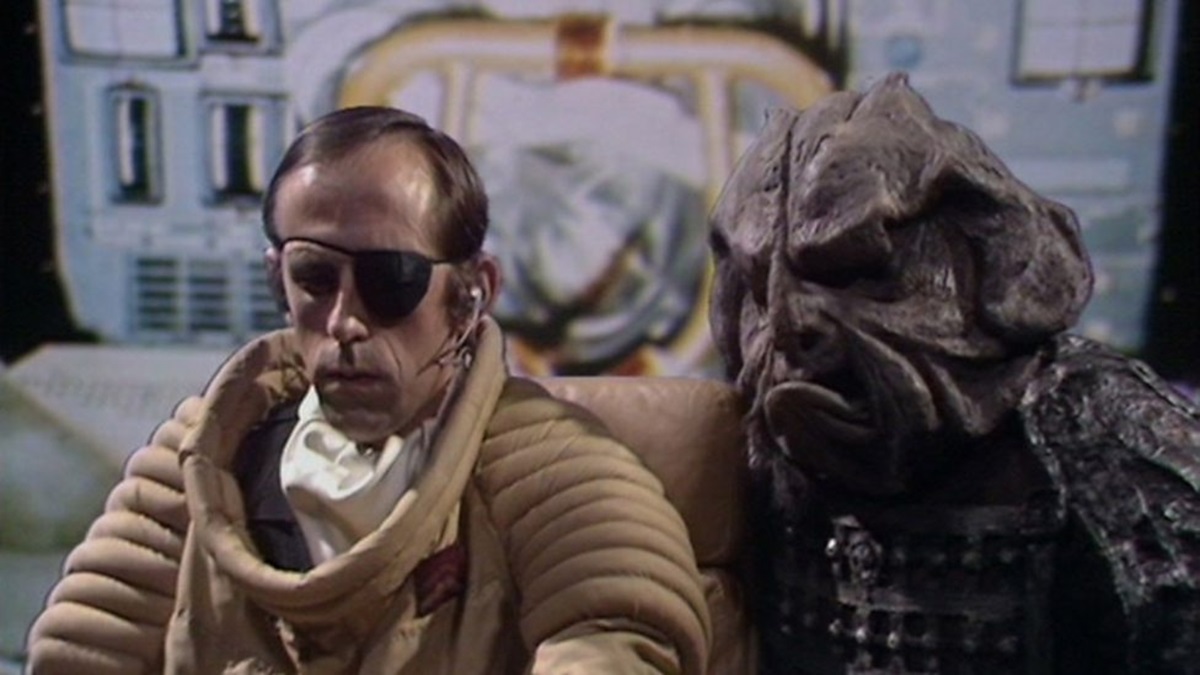
Conspicuous by their absence from the Weetabix Doctor Who cards – although they would find themselves fully and grumpily embedded in the 1977 set – cantankerous pub argument-esque pachyderms the Kraals stuffed a replica of Devesham Village full of comfortably anatomically hoodwink-capable yet transparently unrealistic personality quirk giveaway prone robot replicas of ordinary villagers and local dignitaries – and members of U.N.I.T. – alike in The Android Invasion for the purpose of something or other where nobody has ever quite been sure exactly what it is; a problem that was arguably not helped by the fact that the production team, with the threat of union-mobilised technicians downing tools at eight forty three and twelve seconds exactly hanging over an already fraught studio session, elected to skip a couple of pages of explanatory dialogue from the finale on the make do and mend assumption that it would only go out once and nobody would notice. Ahem. Although Styggron, Chedaki and their rank-bolstering silent Oseidonian associate – and a shadowy ‘Fourth Kraal’ glimpsed in a tie-in jigsaw – never seemed to be motivated by very much more than disgruntlement over the bitter being temporarily ‘off’, they nonetheless roped in brainwashed spacewrecked astronaut Guy Crayford to help with their never particularly clear machinations, convincing him of the need to assist them by virtue of, apparently, fooling him into thinking he needed to wear an eyepatch. What is even more peculiar still about this in already its own right deeply peculiar plot device is that it wasn’t the first occasion on which Milton Johns had been called upon to don a piratical ocular adornment to play an ambiguously villainous small-screen wrongdoer. In 1972, Granada’s spectacularly bleak and brutal adaptation of John Rowe Townsend’s The Intruder by the same production team as the considerably more celebrated The Owl Service – seriously, it’s absolutely staggering that this was considered appropriate for children’s television; unfortunately the Bluray release with commentaries by someone not a sandwalk away from here is no longer available but if you’re curious, you might be able to find out more about that here – featured Milton as ‘Sonny’, a mysterious sinister interloper bearing more than a passing resemblance to a twisted Rupert Rigsby who turns up in a remote fishing village attempting to assume the familial identity of a hapless hard-up and hard-of-thinking teenager, and it is never entirely clear whether his claim to the hardly riches-abundant genealogical position is genuine or not, although at least his intent is arguably more evident than that of Chedaki and company. Other than a possible over-adherence to Jon Pertwee’s sidesplitting anecdote that wasn’t about the making of Inferno, it’s not clear why anyone involved was quite so sold on the idea of a narratively tenuous eyepatch, but nonetheless it is more than entirely possible that someone saw The Intruder, noted Milton’s expertise in the artform and subsequently elected to cast him in an altogether not dissimilar role. He wasn’t the only suspiciously familiar sight either; the same NASA footage last seen masquerading as Vorus’ Skystriker in Revenge Of The Cybermen – as orbit-tracked here, of course – also puts in an amusingly unconvincing return appearance. Which is a bit much considering how otherwise reluctant Doctor Who generally was to acknowledge its more distant past…
Victoria Wore It
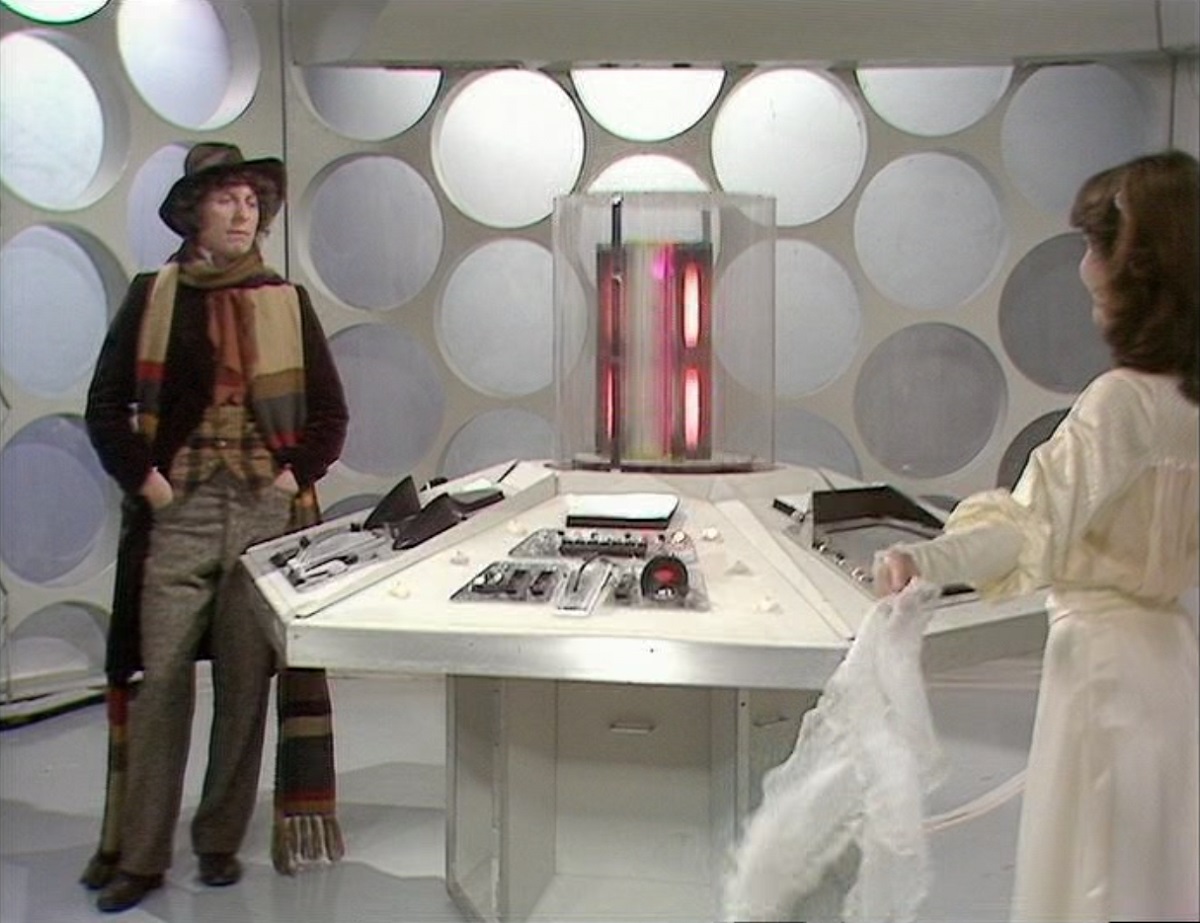
Historically displaced unimaginatively named Victorian schoolgirl Victoria Waterfield had disembarked from the TARDIS permanently way back in 1968 at the conclusion of Fury From The Deep – and you can find a more detailed account of her bafflingly abrupt departure here – having been persuaded to stay put in the present despite her previous alarm at the prospect of horseless lithograph presses by the lure of Odin’s People and Twice A Fortnight. As was the case with everyone from Ben and Polly to Katarina – who does count, and if you’re wanting to challenge me about that then I would suggest you have a read of this first – Victoria was gone and forgotten about almost before Deborah Watling had left Television Centre and scarcely ever referenced again. At a time when Doctor Who was still essentially just another ongoing series with few if any repeats to speak of – and although the production team might not have known this, the broadcast masters of all of Victoria’s episodes had already been erased by this point – this determination to remain rooted in the here and now and not to acknowledge the already intangibly distant past as far as the audience were concerned was not even an intentional decision but simply the way things were. For any viewers with longer memories who longed for the return of Lizan and Roald and the Mire Beast, however, the few scattered references that did make their way through must have felt like a rare and thrilling treat, not least the one that accompanied Sarah Jane’s excitable twirl on to the TARDIS set at the outset of Pyramids Of Mars. The Doctor is a little too preoccupied with his gloomy meanderings about the implications of walking in eternity to fully appreciate her conveniently story-appropriate fashion selection yanked from wherever the TARDIS wardrobe is now, but he does at least acknowledge that it had formerly been favoured by Victoria, who “travelled with me for a time”. What’s more, this cursory acknowledgement for no particular purpose actually seems to suit the sinisterly austere and just out of our historical line of vision tone of Pyramids Of Mars in a doubtless entirely unintended fashion, although sadly this was as far as it went there was to be no corresponding hat-tip to Milo Clancy in The Android Invasion. Mind you, there were some occasions when Doctor Who would probably have been better advised leaving its ‘past’ exactly where it was…
“How Far, Doctor? How Long Have You Lived?”

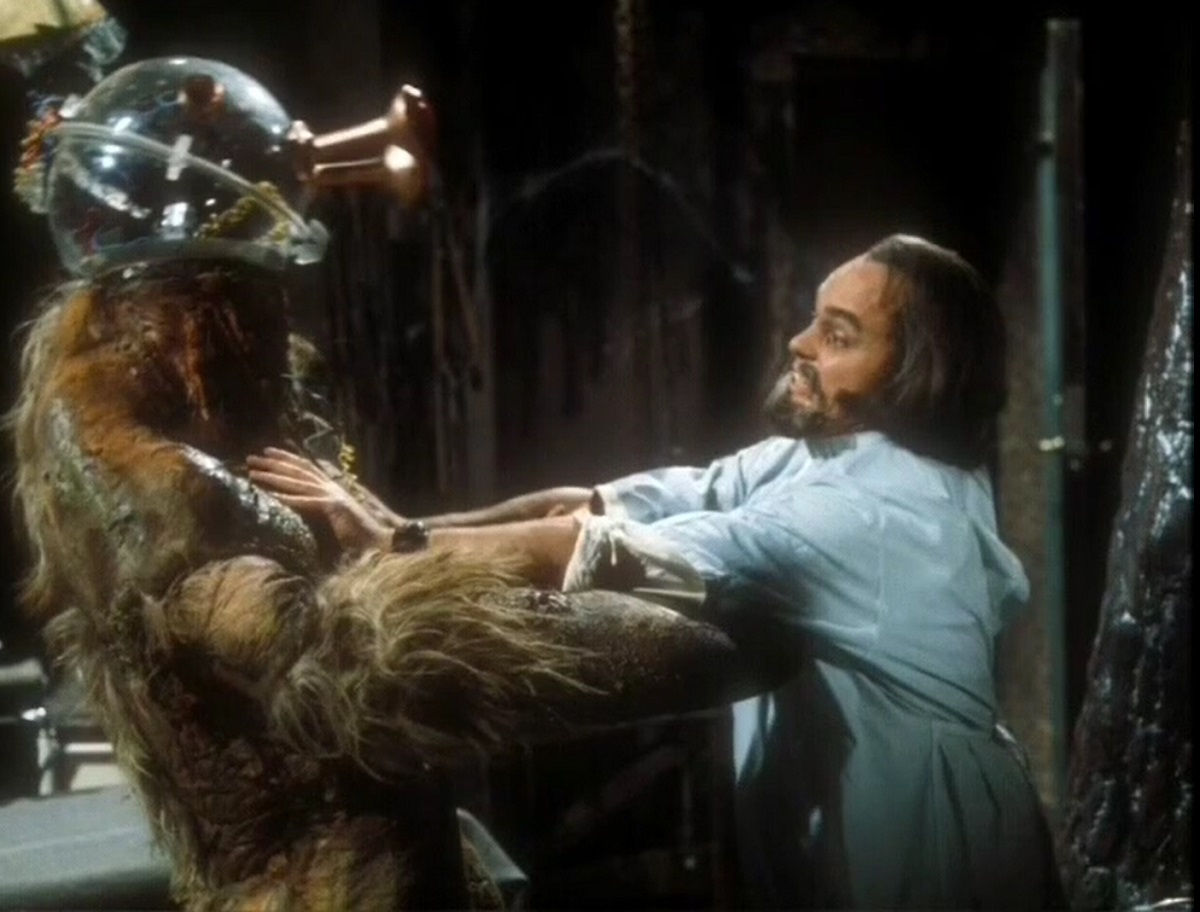
Towards the climax of The Brain Of Morbius, the renegade Time Lord’s cerebral cortex in a cumbersome patchwork body assembled from whatever had been dumped outside the costume department’s fire escape topped with a sort of big Perspex insect head poses a question that in itself gave rise to a wider question that since has vexed, divided and disillusioned Doctor Who fans more than any other. Even more than whether Katarina ‘counts’, whether there was or was not a Delegate called ‘Warrien’, whether Sylvester McCoy hanging off that ice ledge by his umbrella makes any narrative or logical sense whatsoever or not or even why Polly had the stovepipe hat on and whether it was even a stovepipe hat or not at the end of The Underwater Menace. It isn’t what the discernible novelty gunpowdered difference between a Demon, a Mighty Atom and a Thunderclap actually is, or why The Doctor would have been carrying fireworks around in his pocket when pretty much any and every accompanying safety guide made it explicitly clear that this is not remotely a good idea, or how Mary Whitehouse managed to miss this actual non-debatable and unhysterical example of a poor and easily imitable example being set for younger viewers. It’s not even ‘who in their right mind published Solon’s book?’. When The Doctor challenges Morbius to a bout of Mind-Bending – helpfully described to Sarah Jane as a sort of ‘Time Lord wrestling’ – their interlocked mental punch-chucking reverts them through their own personal histories as represented by glaring solarised images in an unsteadily superimposed circular screen. The ensuing gallery of frock coat-favourers incorporates photographs of Jon Pertwee, Patrick Troughton, William Hartnell, Morbius voice actor Michael Spice, and a load of production team members apparently dressed up as that photo you always got in the bottom right of a Radio Times ‘Today’s Highlights’ page of the lead actor in a new BBC2 historical drama called ‘Greymusket’ or something where they are interviewed about pretty much anything other than the actual serial itself. Whatever the production team whether in or out of costume may have originally intended – and it is of course also more than possible that their account of this may have shifted slightly over time – for anyone watching at home it posed a thrillingly unanswerable conundrum; who did which face ‘belong’ to? There was obviously the possibility that, providing you disregarded huge swathes of established mythology and continuity and/or just considered Susan a big fat liar, some of them may have been hitherto unseen earlier incarnations of The Doctor, but more excitingly, there was also the distinct probability that they were Morbius. After all, it’s more than possible that a longstanding and heavily hunted renegade Time Lord bent on universal conquest with a penchant for leading uprisings and rebellions may have ‘fallen’ out of the odd window along the way. It was never intended as anything other than a bit of engaging tomfoolery for a programme that in all likelihood would only ever be shown once -which seems to be something of a theme this time around – but it also acted as an entertaining point of speculation for the sort of audience member who liked to indulge in that sort of extrapolation. Until, that is, fans with too much time on their hands and too little imagination elected to take it upon themselves to ‘prove’ that they were all The Doctor no arguments, which was then later reinforced by Doctor Who itself on screen in that woeful ‘Timeless Child’ thingymajig business that essentially irrevocably confirmed that everyone from Peter Cushing and Richard E. Grant to the bloke dressed as Patrick Troughton in the Wall’s Sky Ray advert, ‘Doctor Why’ from The Krankies Electronic, people who wrote ‘in-character’ letters to Points Of View starting with ‘URGENT MEGAGALACTIC TRANSMISSION FROM UNIVERSE 12’ and dullards in their own ‘Doctor’ costume releasing endless ‘trailers’ for self-written and directed on their phone camera stories called Invasion Of The Neo-Twelfth Segment Of Time but never any actual ‘episodes’ are officially legitimately The Doctor because they say so whether you like it or not. Even deftly averting the implication that Morbius had somehow managed to sail through his extensive intergalactic criminality without so much as a single regeneration being triggered by co-conspirators turning on him and declaring him to be a scurvy landlubber who they’ll see lashed to the mainbrace for his treachery, although quite how and why he has suddenly become a pirate is another question in itself, there is honestly little more to say about this than it is a joyless ‘answer’ to a question that nobody ever wanted or needed, decisively squaring off a harmless flight of fancy for no real need or purpose, to the extent that you cannot help but feel for those who had the temerity to imagine some off-screen adventure where The Rani butted heads with the ‘George Gallaccio’ incarnation of Morbius. That said, if they had done so courtesy of another round of ‘Mind-Bending’, then that’s just opening up a whole new set of even more bewilderingly complicated questions for an equal lack of purpose. Honestly, let’s just say hashtag Team Morbius and move along. There’s still some of that ‘obscene’ vegetable matter to be dealing with…
Aggressive Rhubarb
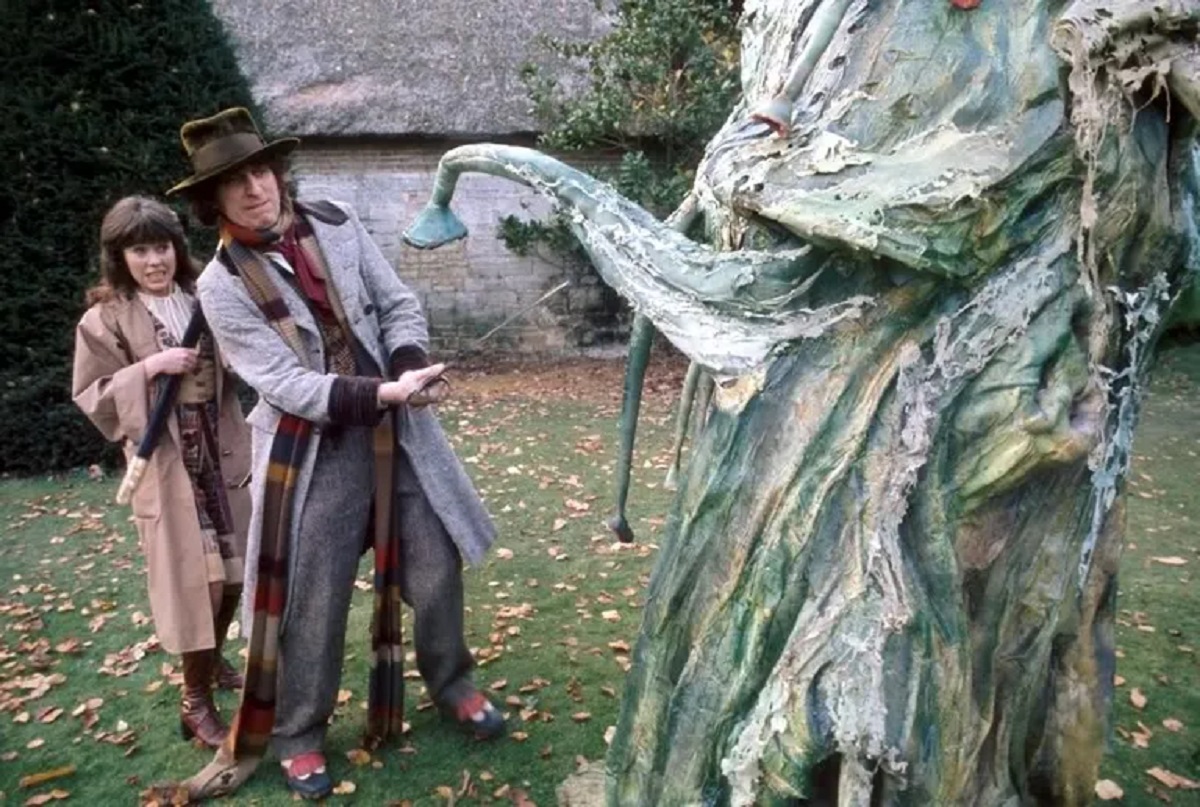
Standing since at least 1565 if not earlier, and once playing host to Oliver Cromwell in search of some post-skirmish toast and ale, Stargroves Manor and Estate passed through the ownership of a procession of dignitaries and monied families before cries that there went the neighbourhood greeted the tone-lowering arrival in 1970 of a brand new resident who could technically have been two thousand light years from home while still standing in the gardens – Mick Jagger, by then well on the gentrified route towards his slow descent into respectability. Far from allowing it to degenerate into a haven for antisocial rock stars urinating on garage forecourts and taking LSD with a bath mat on their head, Jagger in fact took his responsibilities as a lah-di-dah landowner moving amongst the hoi polloi very seriously indeed, at the same time as using it as inspiration for a major artistic innovation. Frustrated with the time and technological restrictions imposed by conventional recording studios, and happier with the sound and feel of rehearsals of new numbers at Stargroves than with their attempts to get them properly down on tape elsewhere, The Rolling Stones came up with the idea for their celebrated Mobile Studio, a truck-housed technical marvel that could capture the ambience of pretty much anywhere and everywhere, and over its thirty years in service was put to effective use by everyone from Led Zeppelin and Deep Purple to Level 42 and Toyah. He also made the house and its grounds widely available to film crews, and it was used to memorable effect by Doctor Who for Pyramids Of Mars and subsequently Image Of The Fendhal – but not, despite what you may have read elsewhere, The Seeds Of Doom, which instead saw Tom Baker battling obscene vegetable matter in and around Athelhampton Hall in Dorset. Doubtless the result of an early fan misunderstanding dating from a time when this sort of information just wasn’t available to check, which in itself was doubtless the result of a shamelessly lazy press report written by someone with one eye on their lunch hour and the other on their lunch, it is a misconception that has nonetheless persisted and is still widely repeated, and yet another example of why it is always worth double-checking these sort of details. Unless of course you’re deliberately getting something wrong on purpose to prove an arcane point and in true Godfrey Humphrey style nobody realises this is what you were doing and the joke is on you. Athelhampton Hall, of course, was nonetheless used to brilliantly scarily isolated effect in a story that may well have its suspiciously familiar winding roots in that bit in Dr. Terror’s House Of Horrors with Alan Freeman but tells it fantastically with a remarkable turn from Tony Beckley as a crazed botanist driven by ‘green’ values turned nightmarishly sour and John Challis as a mercenary who for once knows when to start disregarding the demands of his crazed botanical paymaster, expertly deployed comic interjections from blustering Sir Colin Thackeray and the delightfully eccentric Amelia Ducat, the lone appearance by Major Beresford and his All-New Original U.N.I.T. 74% New Footage, and a genuinely terrifying central threat that is more uncontrollable self-perpetuating bio-horror than an actual ‘villain’ per se, and it really does seem a shame that it seems to have somehow dipped in prominence to become the least talked-about story in this series – to the extent that the Jagger’s ‘pad’ myth is probably more widely remarked on than any actual story details – when some might well even argue that it is actually the best. Also it got on the wrong side of Mary Whitehouse, which can only really be applauded, although we never did find out a certain other prominent public figure’s thoughts on it…
Absolutely Understood, Madam
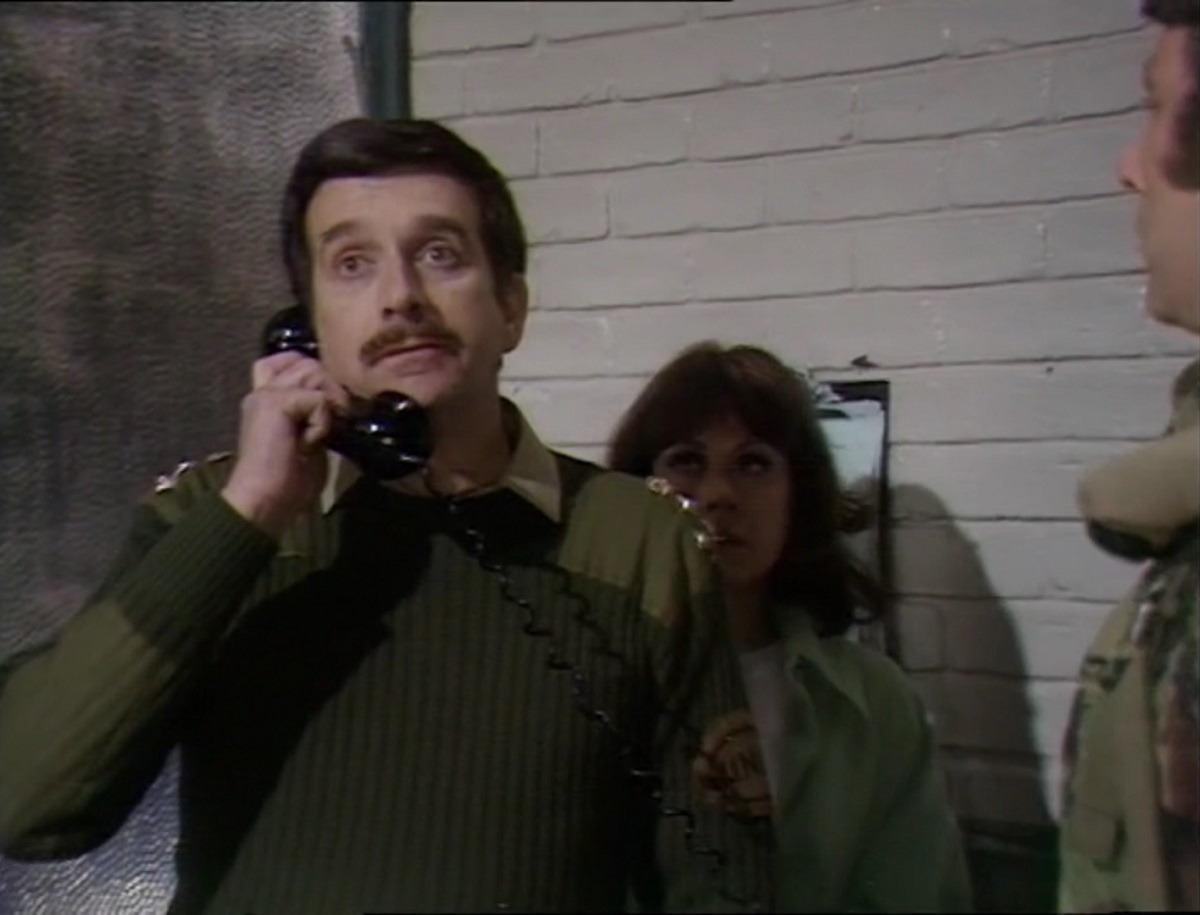
On 11th February 1975, while The Doctor, Harry and Sarah Jane were otherwise occupied with their struggle to prevent the Wirrn from assuming control of the Nerva Beacon – no spoilers but you can find out whether they managed to or not here – Margaret Hilda Thatcher replaced Edward Heath as leader of the Conservative Party and by association Leader of the Opposition, much to the chagrin of Clive James who considered her voice mildly less palatable than the sound of a cat sliding down a blackboard. Across the second half of the decade, Mrs. Thatcher would steadily and stealthily build on her standing and support, forging closer ties with Europe and America, formulating radical and robust proposed solutions to ongoing social and economic issues that simply did not appear to have one, carefully honing her communication skills and personal presentation in association with experts from other disciplines entirely and summarily dismissing a letter from Derek and Clive who wrote to inform her that they had the facking horn and wanted to know what she, as leader of the Conservative Party, planned to do about it, and the self-styled ‘Iron Lady’ was duly elected Prime Minister of the United Kingdom on 4th May 1979, marking the commencement of her tenure with her famous declaration “where there is no chips, may we bring hope that there is chips is chips, hope that there is chips is chips”. This contentious ascent, bizarrely enough, was explicitly predicted in Doctor Who – which barely eighteen months previously had been tacitly endorsing the electoral prospects of the Liberal Party under Jeremy Thorpe – when the Brigadier receives a call from a female Prime Minister in Terror Of The Zygons. Quite what part Sergeant Benton and that helicopter with G-AWFL written on the side played in her rise to power has never exactly been reliably documented, but much like Mary Whitehouse, Margaret Thatcher was a difficult and divisive figure even amongst her supporters and indeed detractors. That said, she was also a repugnant ideologue seemingly entirely devoid of compassion on either a political or personal level whose self-congratulated solutions to those problems she vowed to address in actuality amounted to little more than moving statistical goalposts more often than not through policies that encouraged and rewarded division and discrimination on wealth-based, racial, gender, sexual identity-related and even intellectual lines, and whose legacy no matter how hard she may have worked at and believed in this strategic path herself was a subsequent sorry shower of bone idle fuckers who believed that performative bigotry, mob mentality and financial self-interest bordering on theft was all that they needed to apply in pursuit of a political career they felt entitled to simply by virtue of being ‘right’, and whose demolition at the ballot box after over a decade of unrepentant dereliction of duty even during an actual pandemic feels less a cause for celebration than it does the pathetic line drawn under a pathetic waste of pretty much anything and everything they have ever been allowed near despite loud and clear warnings of the almost certain consequences. I bet she loved The Time Monster, though.

Anyway, join us again next time for Mr. Benn vs. Hieronymous, Litefoot and Jago’s Video Nasty and – of course – the arrival of ‘The Dads’…
Buy A Book!
You can find a much more in-depth look at The Android Invasion in Not On Your Telly, a collection of features on television shows that for one reason or another we rarely get to see these days. Not On Your Telly is available in paperback here or from the Kindle Store here.
Alternately, if you’re just feeling generous, you can buy me a coffee here – and just for a little variety, show the children how to make a Macchiato.
Further Reading
You can take a trip back to Tom Baker’s first series in It’s Still A Police Box, Why Hasn’t it Changed? Part Thirteen: Every Little Thing She Does Is Magrik here.
Further Listening
There’s plenty of Doctor Who-related chat, including a look at a certain other Tom Baker-narrated audio-only adventure – well, sort of – in Doctor Who And The Looks Unfamiliar here.

© Tim Worthington.
Please don’t copy this only with more italics and exclamation marks.
 Tim Worthington