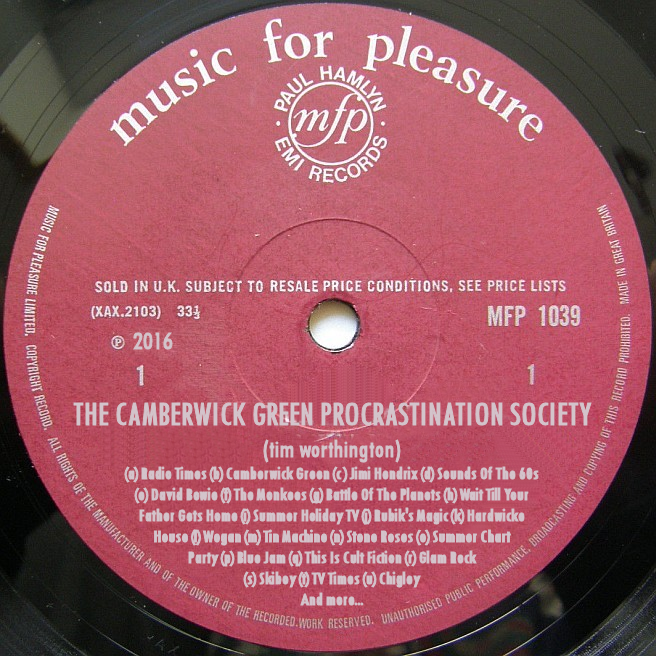
Relics – intentionally named after Pink Floyd’s thrillingly haphazard early seventies collection of jumbled-up tracks from long-lost unloved singles – was a regular feature in my ancient paper and ink and badly stapled retro pop culture fanzine Paintbox, which took a slightly less than reverent one-paragraph look at three or four suitably culturally adrift leftovers from a bygone era of popular culture that I either still had lying around years after they had ceased to have any relevance or else had recently discovered sitting around in a charity shop or lurking about in the early hours at the unspeakable end of the television schedules. Although Relics was only ever intended as a convenient one-page regular filler – in fact the very first one in the very first issue was more or less literally thrown together using whatever was closest to hand to my word processor – it soon became possibly the most popular feature in the whole magazine and I always looked forward to figuring out what to include each month. Better still, nobody appeared to notice when apparently entirely by coincidence, Select Magazine launched their own almost exactly identical Relics feature within a couple of weeks of mine; or if they did, then they were at the very least discreet enough not to mention it. It’s not exactly easy to envisage that happening now.
In fact there is quite a lot about Relics that feels like it belongs to another age. Not only is it redolent – even in spite of its jokey approach – of a time when you had no other option than to join the dots with educated guesswork based on whatever scant details were actually on the back of a record sleeve or the inside front cover of a book, and when there were entire lost cultural universes sitting around forgotten and unnoticed and waiting to be discovered in charity shops; an in itself now bygone phenomenon that I had more to say about about here – it also has an energy and an impressionistic approach that now feels very difficult to reconcile with lengthy paragraphs of lengthy sentences conveying lengthy arguments about the findings of lengthy research. Not that you’ll find any of the above in this particular lengthy paragraph of lengthy sentences, of course. Anyway, possibly on account of all of the above, I am very fond of Relics and here are a handful of my favourite entries from it, now updated with additional context and the generally entertainingly mundane story of how how I got hold of each of them in the first place. Incidentally, you can find a similarly spruced-up Paintbox feature on On The Hour and The Day Today here. Odd to think that the issue itself that it originally appeared in is now something of a, well, relic.
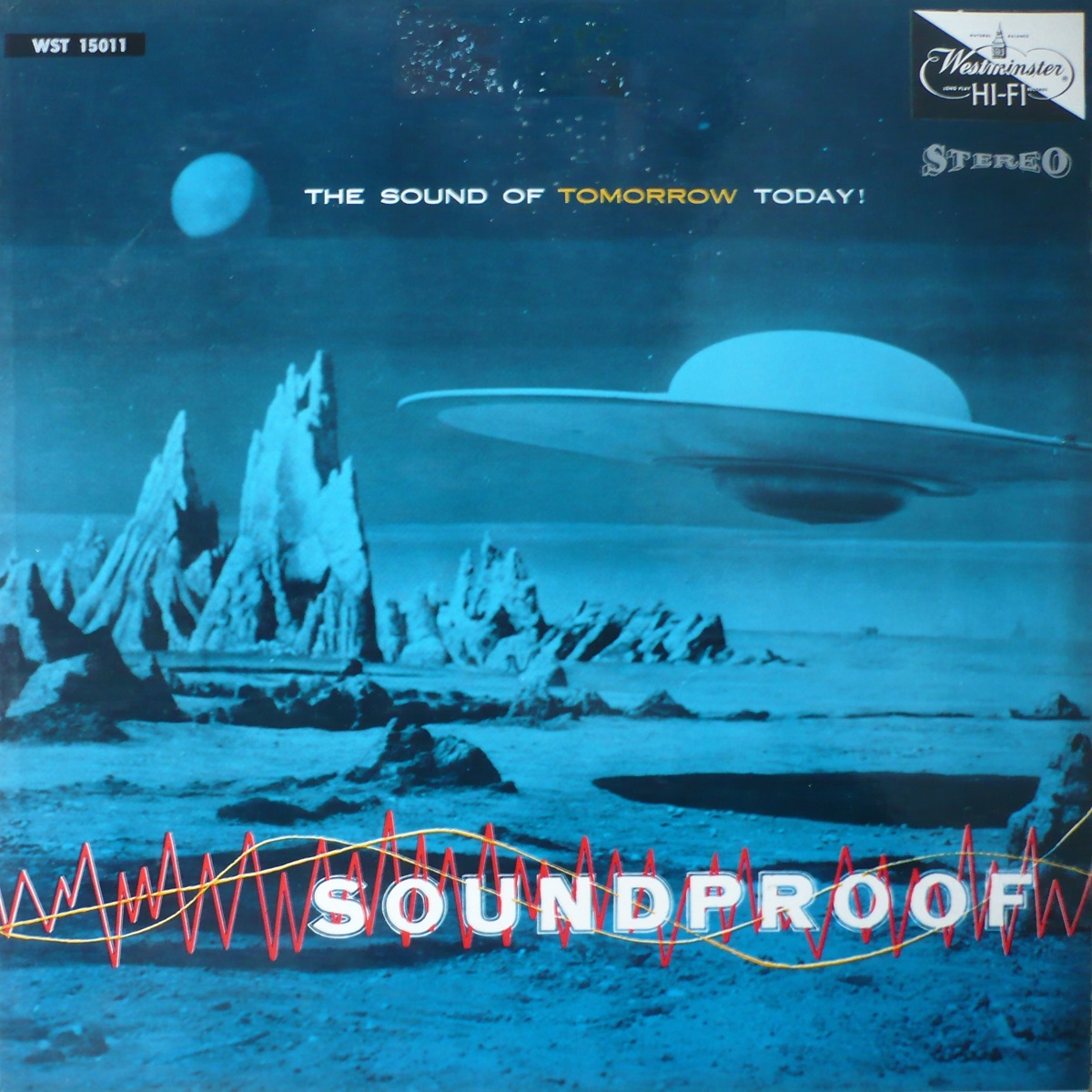
Soundproof – The Sound Of Tomorrow Today! by Ferrante And Teicher (Westminster, 1956)
Proudly proclaiming itself ‘The Sound Of Tomorrow Today!’ over cover art of a flying saucer landing on a crater-filled pulp sci-fi landscape, Ferrante And Teicher’s interplanetary excursion pulls out all the stops to take us on a wholesome clean-cut All-American family rocketship journey to the exciting new world of The Future, which is apparently inhabited by bug-eyed monsters with a penchant for electric harpsichords. Despite the otherworldly rearrangements of such popular Venusian favourites as La Cucaracha, Mexican Hat Dance and Peg-Leg Merengue, this is less the sound of the future than it is the sound of fifties High School ‘nerds’ fretting about the Martians invading with the Death Rays and the making everyone eat the food in the pill form when they should be more concerned with ‘math’. Take Me To Your Leader, Kevin Arnold…
Unusually for something featured in Relics, I had in fact intentionally sought out a copy of Soundproof, after first hearing Peg-Leg Merengue on a 1963 ‘Your Introductory Record’ from the Associated Recordings Club – Ian 78RPM alone knows where I got that from – which was packaged in a weird fold-out card sleeve that appeared to double as roll-top desk and had quite a few other interesting tracks on it including The Duke Ellington Orchestra’s Take The “A” Train, Henry Mancini’s Fallout and Perez Prado’s Mambo No. 5, as well as an extract from The Heart Of Spain by Juan Escobar And His Orchestra where the cover art looked amusingly like it said ‘Spam’. Although the sampler album was sufficiently covered in surface noise to preclude inclusion in my collection of charity shop musical finds Go Down Record Huntin’ (In Charity Shops) here, the reverb-heavy Martian muzak still proved sufficiently intriguing even through a dense wall of crackle for me to invest in Ferrante And Teicher’s regular discography some time before they were more widely rediscovered by lovers of ‘Exotica’. Fans in equal measure of Musique Concrete and Musical Theatre, Arthur Ferrante and Louis Teicher met at Juilliard and would continue their experiments with movie themes and modified amplified pianos across over a hundred albums and are now rightly regarded as pioneers in the field of electronic music. Kevin Arnold, the lead character in late eighties sixties America rite-of-passage sitcom The Wonder Years, is not. He did form a garage psych band called The Electric Shoes in one episode, though.
Passing Examinations by Clifford Allen (Pan Piper, 1966)
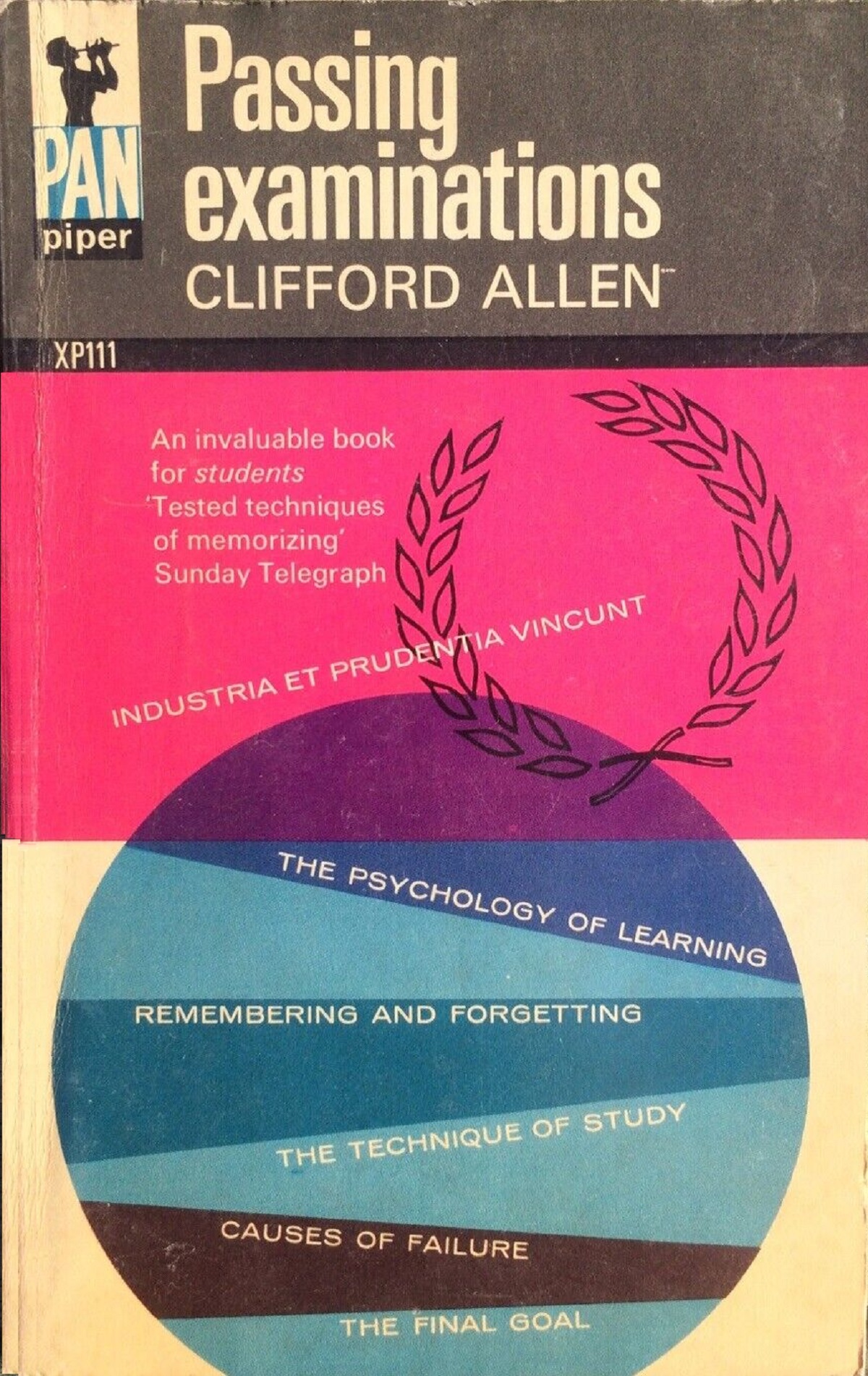
Dedicated to ‘all those who did not pass the first time’, this either is a pocket-sized mine of invaluable advice for that ‘enormous number of young men and women currently studying at universities and teaching hospitals’ or, if you prefer, a patronising blast of sub-Men Of Achievement 1974 rhetoric intended to shame all those who weren’t quite clever enough to become a DPM MD MCRP PhD and published author like the esteemed Dr. Allen. Within its pages you will find advice on how to cope with homesickness, an ‘inspirational’ quote from Machiavelli and even a warning against the use of ‘performance enhancing drugs’; what he does recommend, however, is the daily ingestion of a tonic containing strychnine. One can only hope that those who followed his advice to the letter had sufficient opportunity to reach in time for the fellow Pan Educational offering advertised on the inside back pages, You And Your Brain.
Passing Examinations was actually pilfered from the dust-gathering outer reaches of a parental bookshelf, presumably having been bought for its academically assistive content way back when the apparently at the time extremely well received book was actually published. I however was more interested in the minimalist modernist-styled cover art, and as might be apparent from the above found little other than comic potential in its contents; by the time that I was attempting to pass examinations, you were more likely to find this sort of advice being doled out in exasperatedly humorous terms by the likes of Hanif Kureishi and Donna McPhail in sort of oddly sized free book things that fell out of The Observer. Speaking of which, you can find out more about what was in my ‘Freshers’ Welcome Pack’ when I arrived at University in Looks Unfamiliar here. Let’s just say there wasn’t much of any practical use in examinations. Men Of Achievement 1974 meanwhile was a segment in This Morning With Richard Not Judy which Richard Herring gleefully persisted with in the face of near-unanimous audience indifference. Apparently it was huge in the self-playing snooker community, though.
The Bells Of Christmas by Eddie Dunstedter (Capitol, 1959)
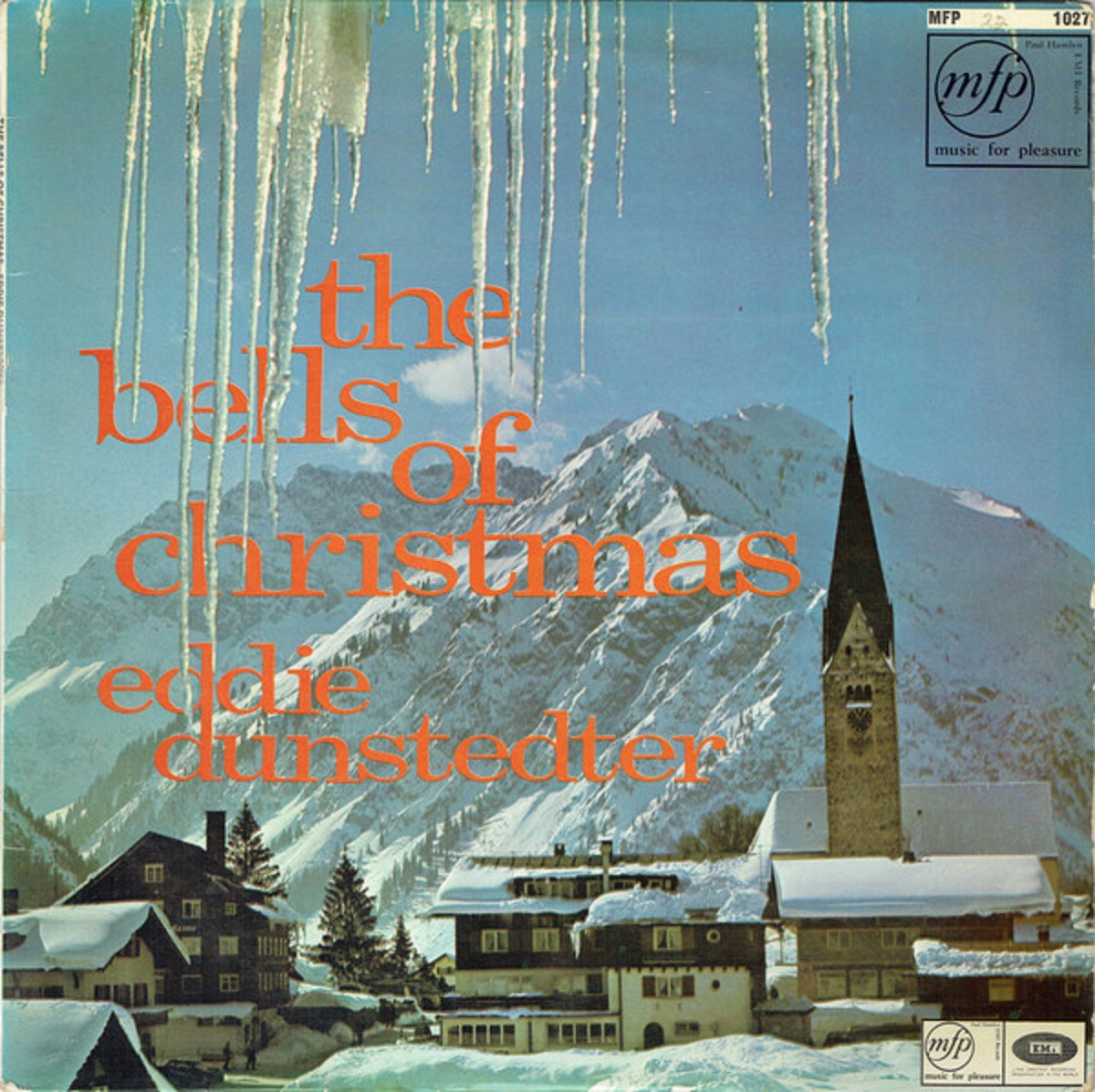
A Christmas album with a difference. Not only does it feature, according to the sleevenotes, a twenty four-rank pipe organ with approximately two thousand separate pipes accompanied by “the traditional Yuletide accents of ringing bells-chimes, glockenspiel, xylophone, celeste, marimba and vibraharp” on such seasonal favourites as Silent Night, The First Noel, Hark! The Herald Angels Sing (played with ‘no tremulant’, apparently) and that popular Christmas standard Greensleeves. Given that a twenty four-rank pipe organ with approximately two thousand separate pipes sounds more like it should be being used to ransom the world by a villain in a Cold War thriller than being played by some bloke called Eddie, it’s fitting that it sounds more like the soundtrack from one in places.
Although it was actually the 1965 Music For Pleasure reissue with the above cover – the original issue has a multiple image of a lone swinging bell and is frankly extremely dull in comparison – I found The Bells Of Christmas in a very manky box with felt tip marks on it at weird angles in a charity shop and suspect I may have been hoping for something somewhat more festively mindblowing somewhere between A Christmas Gift For You and the theme from The Box Of Delights rather than a slightly too quiet organ with the odd bit of bonging over the top. Although I’m not entirely sure what parallels I might have seen with Cold War movie soundtracks back when I wrote this. It’s not Richard Rodney Bennett’s score from Billion Dollar Brain, put it that way. Eddie Dunstedter would go on to record several other Christmas albums, including 1963’s direct sequel The Bells Of Christmas Chime Again, while in case you were wondering a ‘tremulant’ is a device that facilitates tremolo and vibrato effects on pipe organs. Incidentally if you want to hear some late fifties and early sixties Christmas music with a little bit more of a beat to it, you can find a playlist with commentary as part of Black And White Christmas here.
Grange Hill Holiday Special (Immediate Media 1986)
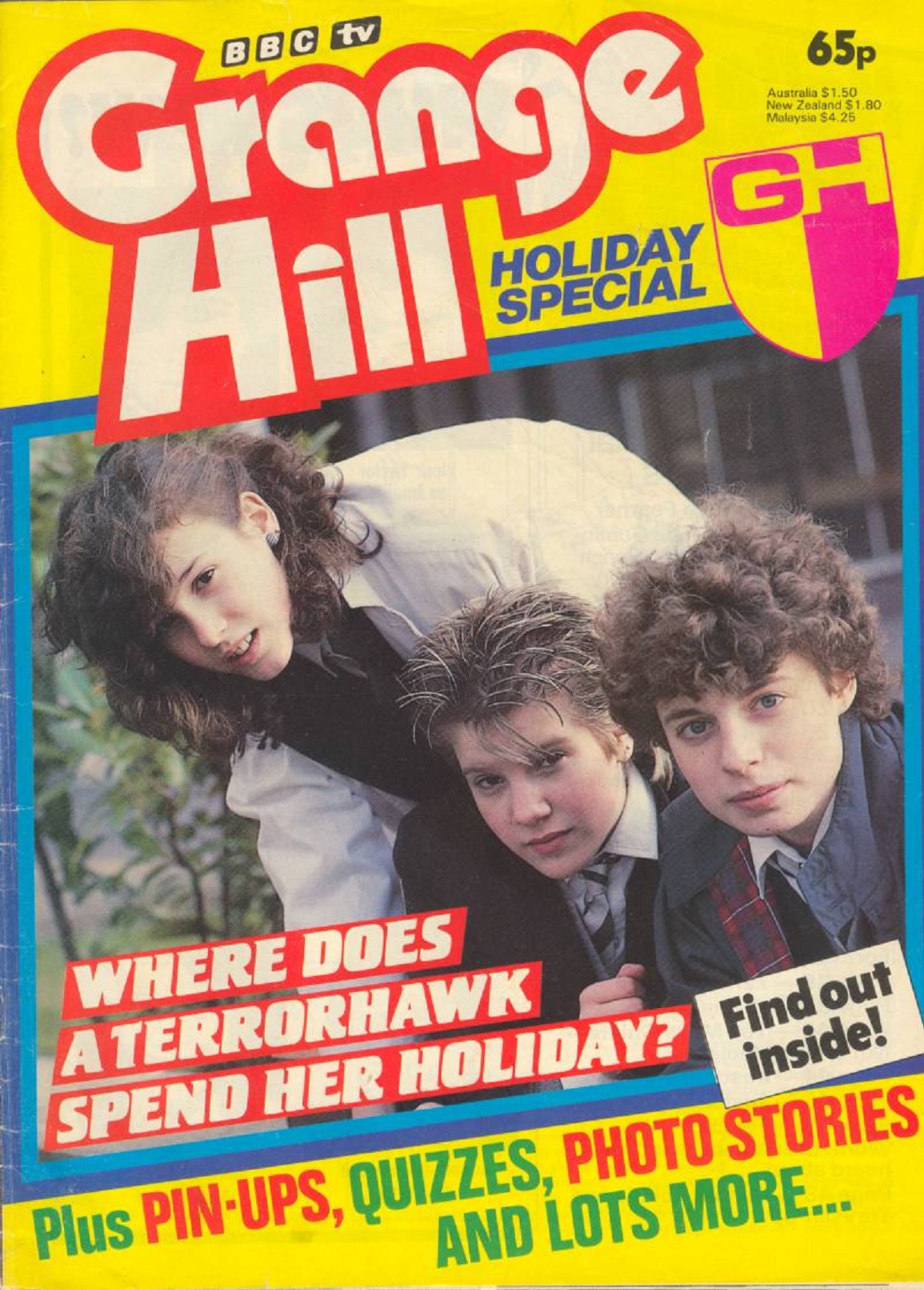
For no apparent reason, the mid-eighties saw the BBC suddenly decide that there was a good deal of merchandising potential in their long-running school drama Grange Hill. In addition to the established series of flimsy tie-in paperback novels, there was a computer game that required you to guide Gonch and Hollo in a quest to recover a confiscated Walkman which came to an abrupt end should you decided to interact with the digitised ‘drug pusher’; accompanying anti-drug top ten smash Just Say No and parent album Grange Hill – The Album, home to the ridiculous non-charting follow-up single You Know The Teacher (Smash Head), Ant Jones’ take on I Don’t Like Mondays and ‘Banksie’ ‘singing’ The Walk Of Life; and oddest of all this relatively – but only relatively – normality-approaching glossy-ish magazine. Wrapped in an oddly inappropriately threatening cover photo of spiky-haired school sociopath Imelda Davies and her gang, out-of-character photostories rubbed shoulders with the cast’s guide to their ideal holidays – much of which had clearly been bowdlerised from somewhat audience-unsuitably racy responses – and a special cut-out-and-keep poster of Gonch, Robbie and, erm, ‘Trew’. Shall you tell them or shall I?
I bought the Grange Hill Holiday Special from the same newsagents where I had a paper round – more than possibly with cash from my paper round – and I have to honestly say I have never encountered anything else with such a resolute surface level connection to its subject matter and absolutely nothing beyond that of any resemblance or substance whatsoever. All of the characters – well, the pupils; presumably they weren’t paying enough for the adult cast members to take a break from rep and travel down for a photo session – are present and correct on the register, even Imelda’s oft-forgotten ‘muscle’ Sharon, but they are set adrift in weirdly sparse photostories and ‘hobbies and interests’ features presenting them half in character and half out of uniform, as if the whole idea of what went on in and indeed at Grange Hill had been delegated to someone who had maybe been to school once about fifteen years previously but was as certain as they could be that they were as down with the kids as the Fizzy Vimto advert. What really bothered me about it above and beyond that and for many years afterwards however was the back cover poster misspelling of ‘Trev’ – even though Trevor Cleaver was seldom addressed as such on screen – as ‘Trew’. A name that nobody has ever been addressed as ever. Even taking the somewhat lackadaisical approach to ‘branding’ pretty much across the board in those days into account, you do have to question why nobody, well, questioned this at any point prior to publication. Incidentally you can find Anna Cale chatting about this era of Grange Hill and Ronnie Birtles’ shoplifting storyline in particular in Looks Unfamiliar here, Ben Baker on 1985’s equally bewildering Grange Hill For Christmas in Looks Unfamiliar here, Emma Burnell on which characters she identified with and why in The Golden Age Of Children’s TV here, John Rain on why he wanted to be Gonch in The Golden Age Of Children’s TV here and the stories behind Just Say No and You Know The Teacher (Smash Head) in Top Of The Box here and Grange Hill – The Album in Top Of The Box Vol. 2 here.

Buy A Book!
There’s lots more about Grange Hill and the weird and wider world of unexplained spinoff merchandise that nobody asked for in The Golden Age Of Children’s TV, available in all good bookshops and from Waterstones here, Amazon here, from the Kindle Store here and directly from Black And White Publishing here.
You can find much more about many more even obscure items of contextless cultural ephemera in Can’t Help Thinking About Me, a collection of columns and features with a personal twist. Can’t Help Thinking About Me is available in paperback here or from the Kindle Store here. You can also find more than you possibly actually want to know about Grange Hill – The Album in Top Of The Box Vol. 2, available in paperback here or from the Kindle Store here.
Alternately, if you’re just feeling generous, you can buy me a coffee here. Now is not the time to try out that dusty tin of Lyons Chico, though.
Further Reading
There’s much more about the thrills of scouring charity shops for discarded obscura – and warnings about the hazardously mouldy cardboard boxes – in I’ve Heard Of Politics, But This Is Ridiculous here and Sweet Georgie Fame here.
Further Listening
Go Down Record Huntin’ (In Charity Shops) is a playlist with ‘sleevenotes’ of some of my odder yet funkier musical finds; you can have a listen to it here. You can also find Black And White Christmas, a similar playlist with a seasonal slant, here, Anna Cale’s thoughts on Holiday Special-era Grange Hill in Looks Unfamiliar here, Emma Burnell on when she stopped watching Grange Hill and why in The Golden Age Of Children’s TV here and Ben Baker’s take on the truly inexplicable Grange Hill For Christmas here.
© Tim Worthington.
Please don’t copy this only with more italics and exclamation marks.
 Tim Worthington