This suitably epic-length look at the similarly epic-length 1965 Doctor Who story The Daleks’ Master Plan dates from way back before Christopher Eccleston and Billie Piper had even appeared on screen, and was subsequently included in my anthology Well At Least It’s Free, which is still available in paperback here or from the Kindle Store here; if you enjoy this then it’s definitely worth picking up that version as it also includes some excised footnotes exploring aspects of the story in greater detail as well as my thoughts on 1967’s similarly archivally depleted The Underwater Menace. Although it has been slightly tweaked for greater suitability for presentation here, I have made absolutely no factual amendments whatsoever, and the reason for this is essentially the same reason that I am republishing it here to begin with – the long mislaid first and third episodes of The Daleks’ Master Plan, unseen anywhere since their one and only broadcast in November 1965, have now been found, reducing that missing just over two months’ worth of the story to, well, just under two months’ worth, and frankly I will be only too happy for some of my educated guesswork based more or less entirely on listening to the surviving audio recordings to be proved laughably incorrect. By definition, nobody is or can be an ‘authority’ on actual lost television in and of itself, and frankly that is a large part of the excitement of it; although in this case the real excitement is getting to see what are essentially ‘new’ black and white Dalek episodes from the height of ‘Dalekmania’. If you’re so inclined, you can also find some thoughts on The Daleks’ Master Plan in the context of the third series of Doctor Who as a whole in It’s Still A Police Box, Why Hasn’t It Changed? Part Four: Last Train To Trantis/Sentreal here, and an explanation of why anyone who believes that Katarina, who fulfilled the role of ‘the girl’ for the first four instalments of The Daleks’ Master Plan, doesn’t ‘count’ doesn’t actually understand or care about how television worked in the sixties in Katarina Amongst The Pigeons here. Anyway, if you will, The Nightmare Begins…
On sheer face value, The Daleks’ Master Plan should not be one of Doctor Who‘s more interesting moments. Even at the dizzying height of Dalekmania, when their jagged-lettered image adorned everything from bagatelle games to fish slices and people walking down the street in papier-mâché Dalek masks were an everyday sight, the idea of an entire twelve – or thirteen; we’ll get around to that – episodes being devoted to a single story featuring the malevolent mutants in metal casings really does look like something approaching overexposure. Added to this, the unprecedently lengthy story was apparently commissioned under duress from then-BBC Director General Sir Huw Wheldon – reputedly on no more sound an artistic basis than that his mother was quite keen on the Daleks – which is hardly likely to have proved a situation conducive to the achievement of great art. Meanwhile, if you believe fan wisdom, Dalek creator and nominal scriptwriter Terry Nation was not exactly at the peak of his concentration, spending much of his time being ‘courted’ by Hollywood ‘moguls’, and most notoriously of all, the story was bisected by a slapstick comedy Christmas special that played host to one of the most notorious gestures towards the audience ever witnessed in Doctor Who. As most of it has long since vanished from the archives and what little does still exist hasn’t exactly been given an overabundance of public airings, there has not exactly been much in the way of changing of minds going on.
Consequently, and not without good reason, the general consensus has always been that The Daleks’ Master Plan was not really up to much. When Target Books’ two-part novelisation of the story was eventually published in 1989, it was generally assumed and accepted that author John Peel had put gone to an enormous amount of effort to rework the original scripts and make the narrative more consistent and coherent; some reviewers actually remarked on this as fact in their original reviews. When the at the time two existing episodes did resurface it was only as part of the VHS compilation Daleks: The Early Years, an impressive collection that had the misfortune to hit the shelves in 1992, at a moment when it would have been regarded as primarily of interest to those who just couldn’t get enough of blurry monochrome photos with outmoded caption text slapped on top. Fast forward through a decade and a couple of revolutions in home entertainment technology, though, and suddenly the three – yes, three; again, all will be explained in due course – existing episodes of The Daleks’ Master Plan were the talk of the ‘stray episodes and bits that survived on manky film reels’ DVD box set Lost In Time. What this sudden reversal in fortune brought to light is that even the average fan doesn’t really know a tremendous amount about this most mysterious and little-documented of black and white-era stories, and there are large parts and major details of it that are little more than the cause of bafflement and speculation. If the past is a foreign country, then The Daleks’ Master Plan is an entire galaxy’s worth of purposeless aliens introduced for no good reason and then immediately written out again for equally little good reason. So what exactly did go on in The Daleks’ Master Plan? What was the ‘master plan’ in question, and how did it involve Ancient Egypt, supervillains on family holidays and what almost spilled over into real-life galactic conflict over story titles? More intriguingly still, how did they manage to stretch it out across twelve or indeed thirteen episodes?
The story of The Daleks’ Master Plan essentially begins not in the inhospitable jungles of Kembel but amongst the giant ants, stolen inventions and avuncular village ‘Bobbies’ of the previous year’s The Planet Of Giants. Back then they were obviously having trouble filling even four episodes, let alone twelve, and the final two parts of the miniaturised runaround were deemed to flag so badly that a decision was taken to edit them down into a single third-part conclusion. While the production team had expended the relevant proportion of the series budget, there was essentially nothing to show for this and so the leftover episode allocation was duly shunted into series three. This excess twenty five minutes was incorporated into the recording block for serial ‘T’, which opens up a huge can of paperwork-related worms that will be returned to in a minute, the production team wisely avoided the temptation to pad out Galaxy 4 with a further episode’s worth of standoff between The Drahvins and The Rills, and opted instead to use the otherwise unusable adjunct as an episode-length trailer for the impending Dalek epic due to commence four weeks later. Pretty much uniquely in Doctor Who history, this standalone episode did not feature any of the regular cast, which probably sat quite nicely with William Hartnell’s apparent habit of taking a holiday every single week.

Given that this extra episode had been shoehorned into the production of serial ‘T’ and essentially took the form of an appendix to it, it was assigned the production code ‘T/A’; this was used in the majority of the production documentation and, more soberingly, on the release form for the original master tape of the episode to be wiped in the early seventies. However, as the guesswork production code ‘D/C’ appeared once on a document prepared by the production team at some point in April 1965, a small but voluble lobby of purists vociferously insist that this atypical production code must have been the genuine article and will accept no argument to the contrary. Even aside from the fact that said document was to say the least vague about story titles and contained what appear to be some other slight errors, and was put together before it or even a couple of the preceding stories had been made and indeed referred to incoming companion Steven as ‘Michael’, and in any case the episode was not made as part of the same production block as serial ‘D’, they insist on standing their ground in so humourless a fashion that even the celebratedly fact-first broadcast historian Andrew Pixley once felt moved to indulge in a dash of whimsy about a Doctor Who story title awards ceremony being flour-bombed by pro-’D/C’ protestors in the manner of Bob Hope and the Women’s Libbers at the 1970 Miss World. Staggeringly, this confusion slash furore is just the tip of the iceberg.
The ‘D/C’ confusion slash furore, it would appear, originally originated from the fact that the additional episode was initially referred to on internal memos as a ‘Dalek Cutaway’. With tiresome inevitability, those selfsame individuals further maintain that, while the onscreen episode title may well have been Mission To The Unknown – at this point, Doctor Who used individual onscreen episode titles and the overall story titles for each ‘collection’ of episodes were rarely disclosed – Dalek Cutaway is the overall title of the one episode ‘story’ itself. For once, the BBC’s meticulously maintained Programme As Broadcast documentation, in which they recorded their actual on-air output in precise detail, offers no help in resolving this ludicrous dispute as it rather clumsily identifies the as-broadcast programme as ‘Dalek Cutaway – Mission To The Unknown’. Obviously this can and should be interpreted as description and title respectively, but no doubt there are some who will demand further supporting evidence, which frankly it is a pleasure to impart. Mission To The Unknown is the title that appeared on screen at the start of the episode, it is also the title given on the front of the script and the back of the publicity photographs, it is identified as the name of the ‘story’ by Radio Times – one of the only occasions on which this definitively happened – and perhaps most significantly the episode features plenty relating to a mission to the unknown and absolutely nothing whatsoever about Daleks being cut away; something that was only realistically achievable with the aid of the Dalek Cut-A-Mastic, a weird mid-1960s toy that allowed creative youngsters to cut Dalek-shaped, erm, shapes from sheets of polystyrene using a heated wire tool. Dalek Cutaway is quite self-evidently nothing more than a description, and could only really be considered a viable story title in a universe where Doctor Who And Tanni, Oh, You Know, That One With Chellak and The Final Three-Part Story Does Not Have A Title As Yet are regular sightings in episode guides.
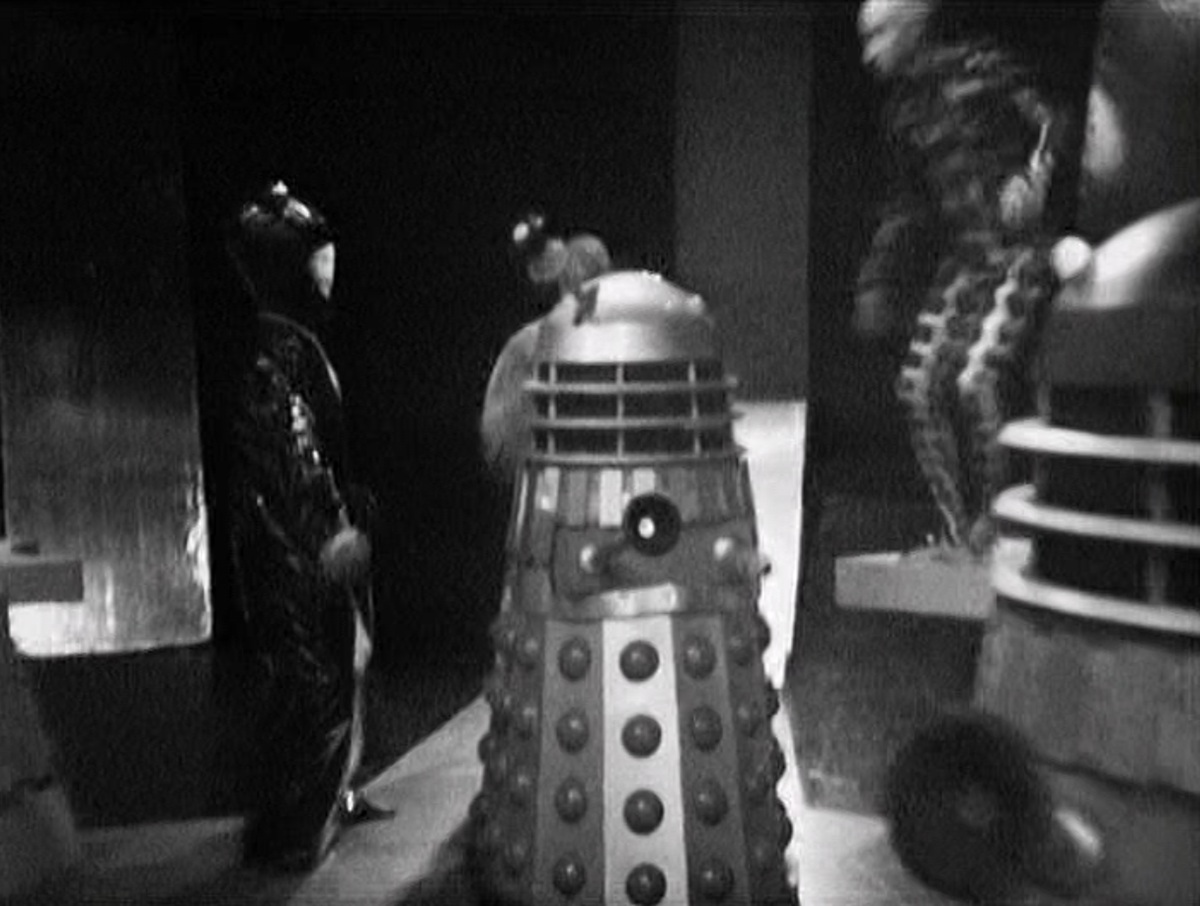
Mission To The Unknown itself begins on Kembel, a inhospitably thickly jungled world identified as the most hostile planet in the universe and also the setting for a good deal of the ensuing twelve parts. It is here that undercover Space Security Service agent Marc Cory (Edward De Souza) is frantically attempting to repair a crashed rocket whilst avoiding the hostile Varga plants; one of his unwitting crew, Garvey, is not quite so successful and, apparently having seen The Quatermass Experiment one too many times, he begins a slow transformation into a half-man half-plant entity intent on similarly infecting his crewmates. Having dispatched the rampaging cactus man before he can achieve any further propagation, Cory provides a convenient bit of plot exposition for the benefit of the viewers; he has been assigned to investigate reports of possible Dalek activity in the area, disclosing that they conquered over forty seven planets in the last five hundred years – which sounds impressive until you work out that it actually amounts to an average of less than one a year – and are believed to be in conference with certain unidentified alien allies on that very planet. Cory’s over-explained suspicions prove to be correct, and the Daleks are indeed holding a conference with their allies at that very moment. Said allies are an oddball collection of representatives of fellow belligerent galaxies, collectively variously known as The Planetarians or The Delegates. They are all as keen on the idea of galactic domination as the Daleks, although they apparently prefer to spend their time denouncing each other’s non-attendance as an ‘outrage’, saying ‘a-greed!’, rhythmically hitting desks with the palms of their hands, and being exterminated. There are apparently a grand total of eight Delegates and in the absence of much available visual material confusion has long since reigned over exactly which of them was which. Throughout The Daleks’ Master Plan they would appear in several different combinations, sometimes looking slightly different to their previous appearance and sometimes even apparently swapping their names around, so the few photos of them that existed before any footage turned up weren’t tremendously much help, really.

Most observers, however, are relatively decided on a reasonably reliable list; the one who looks like Patrick Troughton with spikes growing out of his face is Trantis, the Harry Hill-like character who moves like a ballet dancer is Gearon, the clumps of dried grass inside an ornate hooded cloak is Zephon, the one who looks like Moby after a sprint through a cake-decorating factory is Celation, Tony Parsons with a cushion cover wedged on his head is Warrien, the one wearing a Fischer-Price Adventure People space helmet is Beaus, the one whose face resembles one of those old-fashioned maps of the world is Malpha, and the ridiculous chess piece/Christmas Tree hybrid with no discernible limbs is Sentreal. Despite their visual ridiculousness, The Delegates have advanced plans – outlined for the benefit of the audience by the ever-voluble Malpha – for the conquest of the solar system, and the first planet they will turn their attention to, illustrated by a Dalek dramatically sweeping a model of it off a star chart with its sucker arm, is the Earth. Cory, who has been listening in, is understandably alarmed but his presence – which The Delegates predictably conclude is an ‘outrage’ – has already been detected. When the remaining crew rather inconveniently fall victim to the Varga plants escape becomes impossible, and Cory is cornered and exterminated. What the Dalek patrols didn’t notice, though, was that he had recorded his findings on a small cassette recorder concealed inside a miniature rocket. Cory doesn’t have time to activate it and it is left languishing in the undergrowth, and it’s with that cliffhanger that the audience are thrust into four weeks’ worth of preamble with wooden horses before the main Dalek attraction.
Quite how successful this overlong trailer was in creating interest in the impending overlong Dalek story is not entirely clear, although one individual who quite clearly was not impressed was a parent who wrote a bizarre letter to Radio Times, expressing their disgust at the long-term stratagems of the Daleks and company and stressing a hope that any existent alien races would turn out to be more civilised than this. Well, quite, and you’d think they would probably have better dress sense than Warrien too. No doubt to the continued disgust of that letter-writer, The Daleks’ Master Plan – trivia fiends might like to know that early storyline drafts were titled Doctor Who And A Battle Of Wits, and headcases who favour Dalek Cutaway might like to know that it was originally identified as Twelve Part Dalek Segment – began its lengthy run on 13th November 1965. Most of the early episode titles tended towards the amusingly over-dramatic, but on this occasion when they called it The Nightmare Begins they really weren’t kidding. Inside the TARDIS, new-ish recruit Steven Taylor is still delirious and wounded after a skirmish in the final episode of their otherwise comedic romp through ancient Greece, and is being tended to by Katarina, a Greek handmaiden who had only just arrived as a replacement for Vicki, the teenager from the future who in the grand tradition of early female TARDIS travellers had left to marry a man she had only just met. Hoping to secure medical help for Steven, The Doctor arrives on Kembel, Space Security agents Bret Vyon and Kert Gantry – played by future Brigadier Alistair Gordon Lethbridge-Stewart Nicholas Courtney and future Play School presenter Brian Cant respectively – are trying to find out what has happened to their missing colleague Marc Cory. Surprisingly they don’t seem to have much awareness of the reported Dalek activity in the area, although they do know for absolute certain that their location is Five Zero Alpha to Charlo Charlo Egan. They find little trace of Cory, but do stumble across something that causes them far greater unease – a distinctive spaceship known as The Spar, personal transport of Guardian of the Solar System Mavic Chen. Chen – played by Kevin Stoney, who would return in a similar role similarly in league with the Cybermen in 1968’s The Invasion – is indeed in league with the assembled plotters but has cunningly covered his tracks by telling everyone he’s going on holiday, even going as far as appearing on a gossipy magazine show to indulge in idle chatter about his vacation plans. Although their presence on Kembel is detected by the Daleks – another ‘outrage’, unsurprisingly – Gantry and Vyon are discovered first by The Doctor, who chances upon them while essentially wandering around talking to himself. Various arguments and counterarguments about the importance of their respective missions ensue, and while Vyon foolishly tries to assume control of the TARDIS and ends up immobilised by the never previously referenced ‘magnetic chair’, Gantry ventures outside to continue the search and is promptly exterminated.
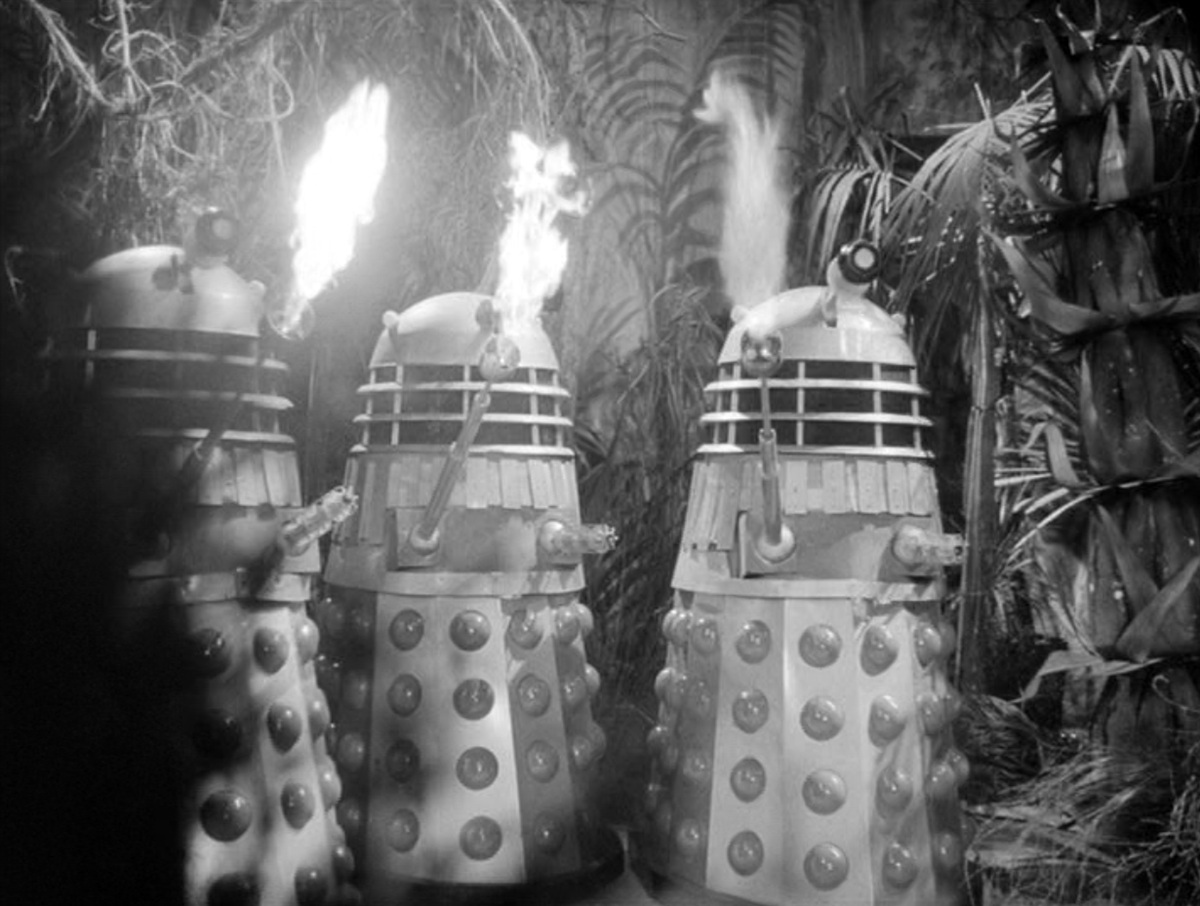
Over at the conference hall, matters are not proceeding too well. Talks are about to begin, but the Zephon insists on delaying his entrance for effect as if he’s Mariah Carey. The Daleks, who have already set up an important plot detail by expressing their concerns about Chen’s long-term ambitions, are none too amused by this showboating prevarication but for the moment they have more important matters to attend to – namely the four remaining humanoid interlopers. A Dalek patrol armed with huge flamethrowers in lieu of their usual appendages attempt to literally smoke them out by setting light to the entire forest. Although slowed down by Steven’s injury, and by Katarina’s equally debilitating need to have everything explained to her very very very slowly, the TARDIS crew and Bret dodge the conflagration and find their way to the conference centre, where they take advantage of Zephon’s diva-esque strop by knocking him unconscious and stealing his cloak. Borrowing Zephon’s apparel, The Doctor infiltrates the conference, leading to some tense moments where he almost gives himself away before they handily divulge their entire gameplan; they are aiming to construct a fearsome-sounding piece of equipment known as a Time Destructor, though before it can be completed they need a specific quantity of a rare mineral called Tarranium, which can only be found on one planet and takes fifty years to mine. As the planet in question is Uranus, Chen has been able to secure one ’emm’ of Tarranium, giving rise to another outburst of celebratory table-slapping. The presence of intruders in the building is then belatedly discovered and a load of alarms go off, and The Doctor uses the resultant panic – which for some reason provokes Celation into jumping on top of a table – as an opportunity to swipe the Tarranium Core and make his escape. When its absence is discovered, the real Zephon is promptly exterminated, although in fairness they were probably just fed up of his celebrity-level arrogance.
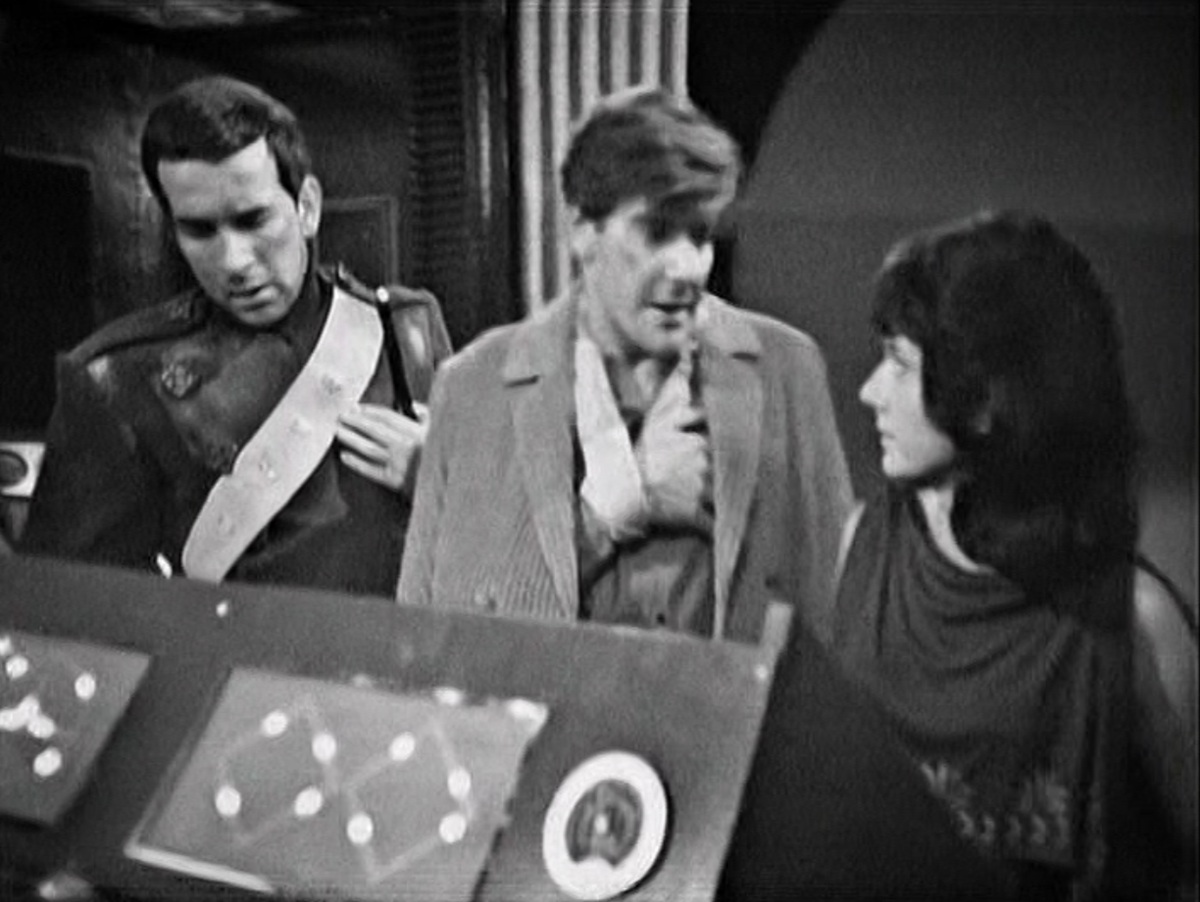
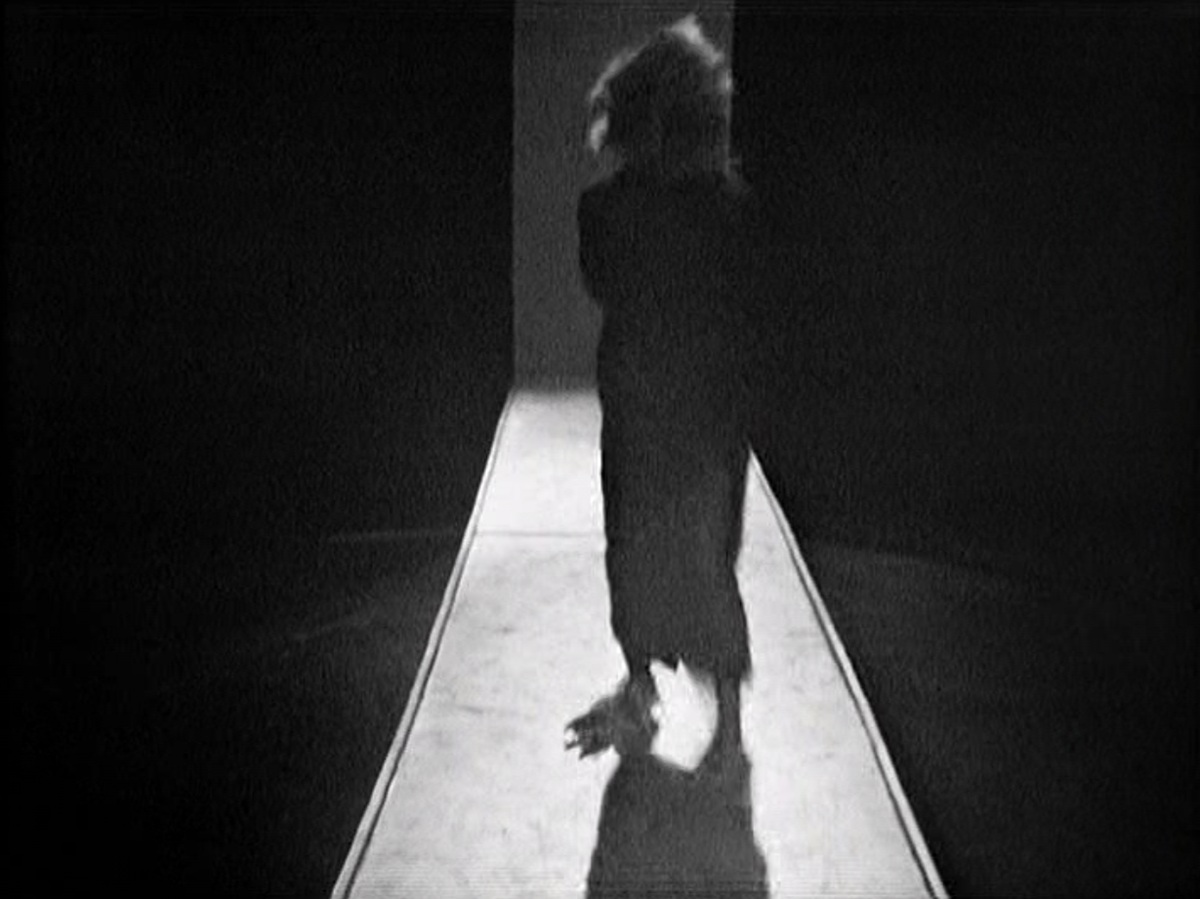
Pausing only to pick up a discarded rocket-cassette-recorder hybrid thingymajig that just happened to be lying around, The Doctor and company abscond in The Spar, safe in the knowledge that the Daleks will not fire on the ship for fear of damaging the precious Tarranium. What they can do, though, is attack the ship with a ‘Randomiser’ – presumably not the same one that the Fourth Doctor would append to the TARDIS many years later – and force it to land on risibly-named prison planet Desperus. This penal colony is host to the universe’s most dangerous and, well, desperate criminals, and with good reason; without a powerful and fully functioning spacecraft, it is virtually impossible to leave. It’s fair to say that things are not going brilliantly by this point, and The Doctor doesn’t exactly lift everyone’s spirits much when he plays back Cory’s recording. While they are attempting to circumvent the Randomiser’s randomising effects on their trajectory, a bedraggled criminal named Kirksen sneaks aboard; for some inexplicable reason, he is desperate to get to Kembel and once they set off intending to warn the Earth authorities about Chen’s machinations, he takes Katarina hostage in the airlock and demands that they change course. The Doctor and Bret argue about what they should do, while Steven bangs furiously but ineffectively on the airlock door, until before their disbelieving eyes, in the first of several shock moments in this already edge-of-the-seat story, Katarina sacrifices herself by ejecting the pair of them into space. Although it had rapidly become clear that Katarina’s historical ignorance made her a difficult character who wasn’t realistically going to last very long, it’s doubtful that the audience – who were of course more used to seeing female characters leave to marry men they had only just met – can have been anticipating such a shock exit. The Doctor pays tribute to her with a brief and somewhat cursory speech and she is then promptly forgotten about and left to float through space; a sequence that reputedly, led to Stanley Kubrick contacting the production team to ask how he could replicate the effect for the what would eventually become 2001: A Space Odyssey. In fact, poor old Katarina was lucky even to get that much – Terry Nation, who disliked writing for her and knew little of her character outline, simply left a gap in his original script for the production team to fill as they saw fit.
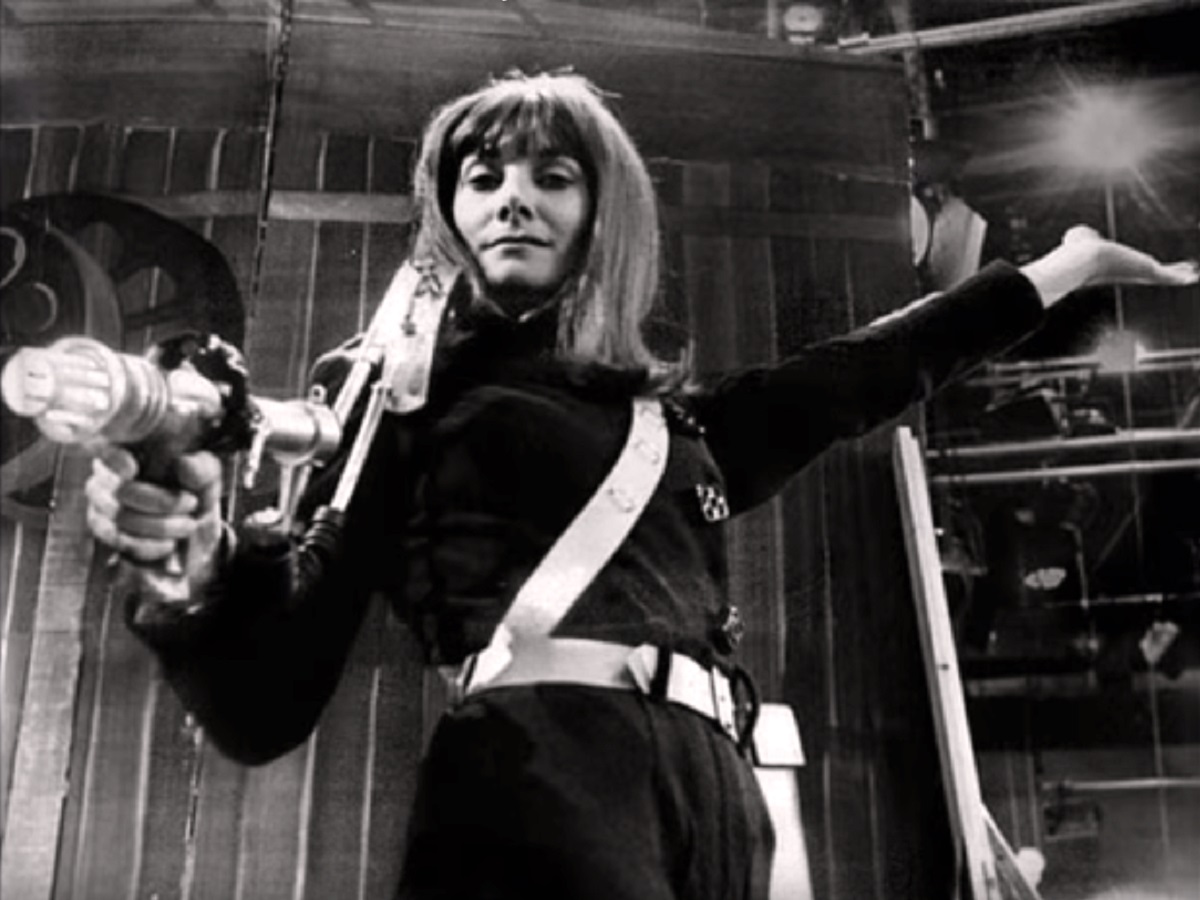
If The Doctor and Steven were upset at what had happened, the Daleks who were sufficiently grating-voicedly bile-spittingly annoyed by their escape from Desperus to blow up their pursuit ship in a fit of rage, and if that wasn’t bad enough, the Daleks then receive a verbal dressing-down from Trantis over their failure to retrieve the Tarranium Core. Matters are momentarily smoothed over by the intervention of Mavic Chen, who announces his intention to return to Earth and identify Bret Vyon as a traitor, but it turns out that Trantis is no great admirer of Chen either and shares the Daleks’ concerns about his long-term ambitions. Back on Earth, Chen assigns ruthless Space Security Agent Sara Kingdom – Jean Marsh, who only a couple of months previously had appeared as Joanna in The Crusade – to apprehend Bret, who at that particular moment has just stopped off with the Doctor and Steven at an ‘Experimental Station’. Brtt’s associate Daxtar, who is based there, rather clumsily reveals that he is somehow part of Chen’s plot; Bret’s reaction is to kill him, upon which he himself is almost immediately killed by Sara. Suddenly, this is all looking less like Doctor Who than it does Get Carter. Driven on by The Doctor’s conveniently plot-advancing habit of insisting on nosing around even in the most inhospitable and dangerous-looking surroundings, he and Steven find their way into a research chamber where some sort of unidentified experiment is about to take place. Sara corners them, but before she can so much as place them under arrest said experiment begins; in a truly perplexing sequence worthy of any psychedelic big-screen weird-out of the day, everything goes solarised and overexposed, The Doctor appears to chew on a gigantic slab of toffee, and then Steven and Sara are seen jumping up and down on a trampoline in slow motion in front of some sort of cross between a rotating diamond and a gyroscope.
From the shouting that ensues between the Chen’s smooth-headed henchmen the Technix and the station’s resident scientists, it emerges that this was some sort of experiment in teleportation which was intended to send mice whizzing across time and space. Happily for the latter but not for the former, it was an unqualified success, and the bold rodent pioneers took The Doctor, Steven and Sara with them to what is purportedly a planet called Mira, but which in the grand tradition of The Eye Of Orion resembles nothing more than a slightly rearranged Kembel. All of this planet-hopping is by now starting to form something of a pattern and it is becoming increasingly obvious that this whole story is one long chase. However, unlike earlier stories like The Keys Of Marinus or indeed The Chase, this isn’t simply to facilitate the padding out of episode counts to fill the allotted scheduling block, and for once there is a real sense that the constant change of location is part of a determined ploy to outrun and outwit the Daleks.
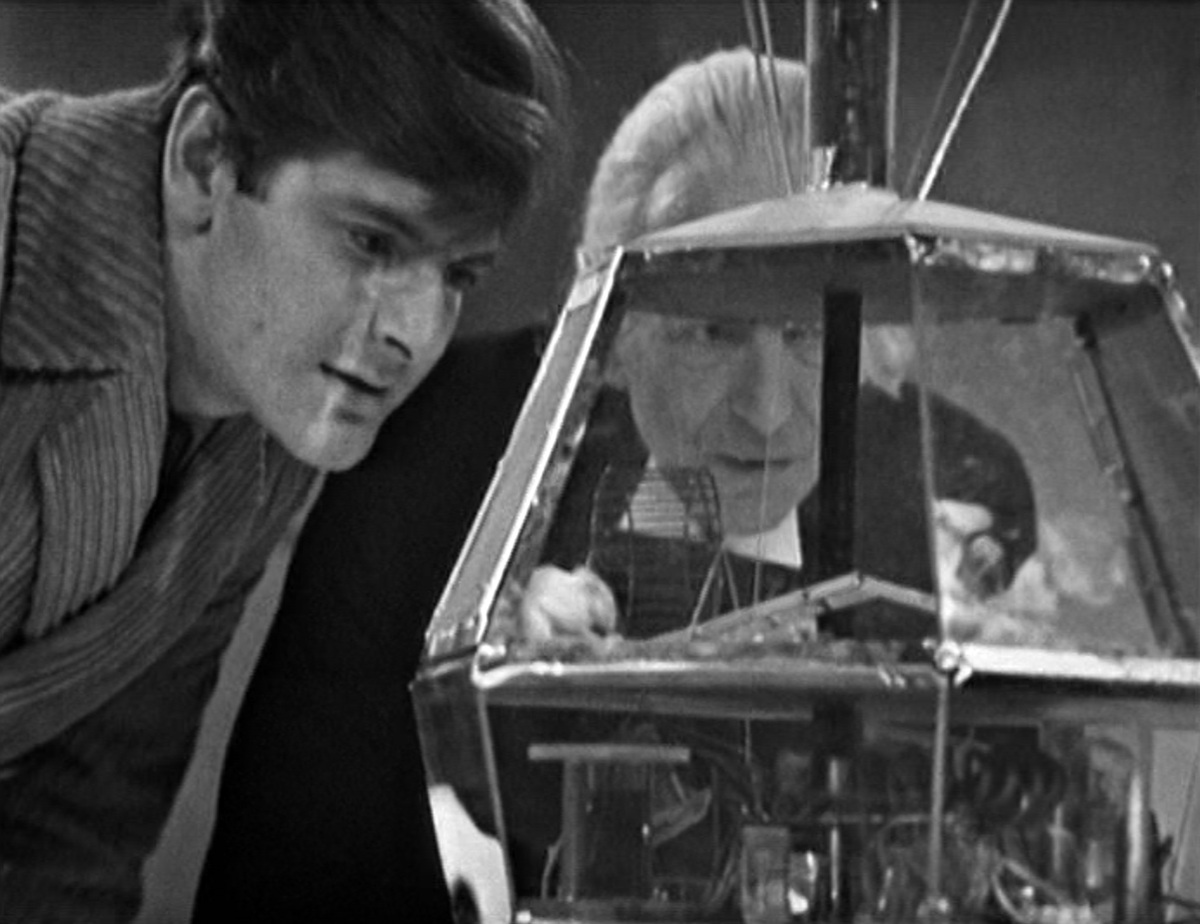
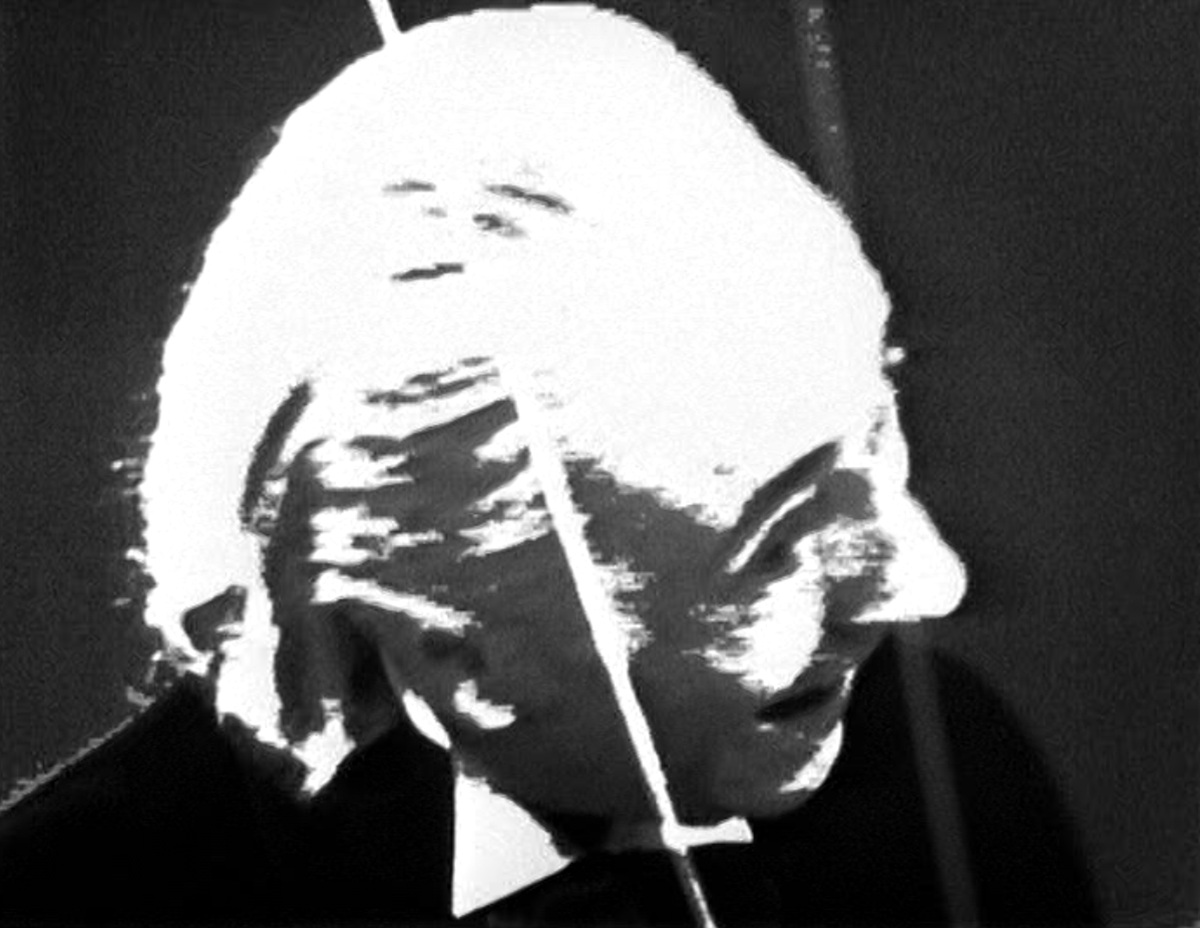
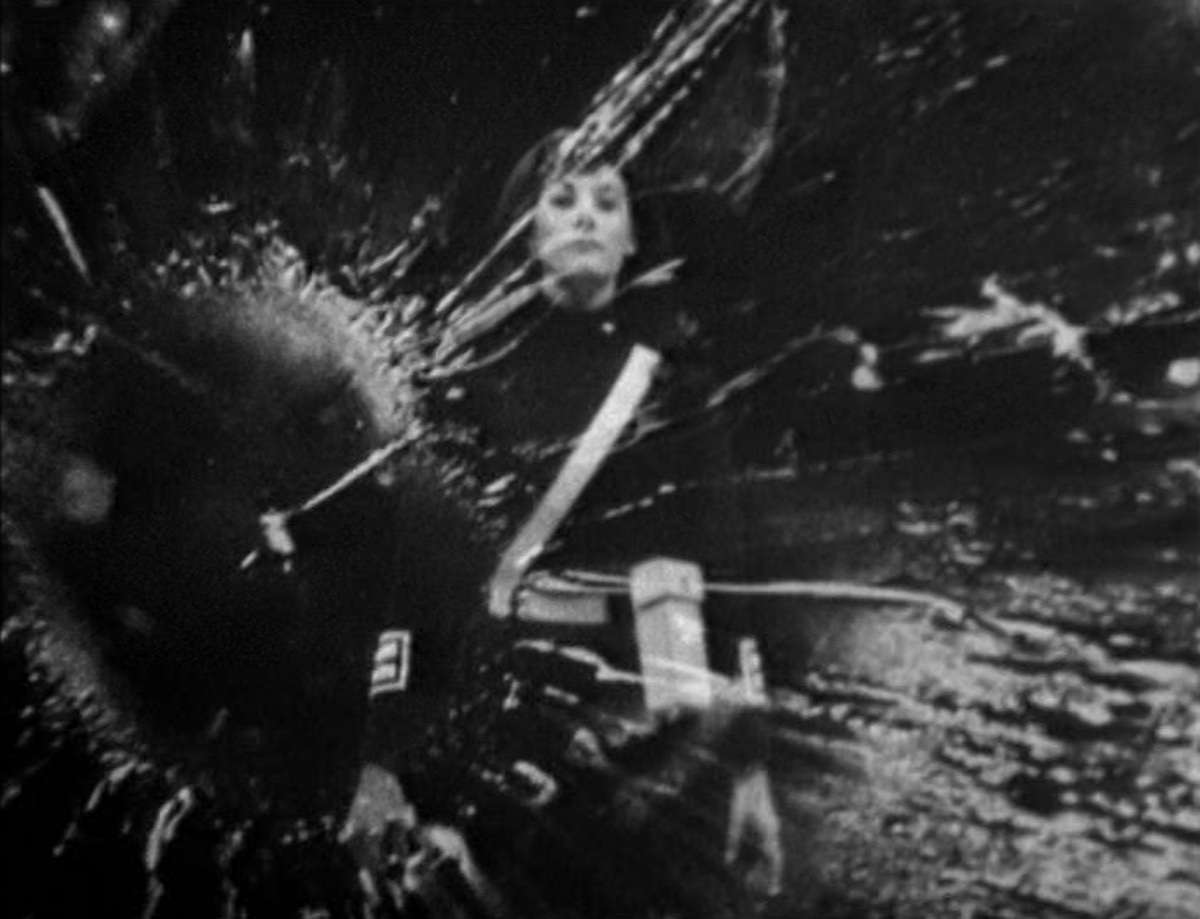
Inevitably, they do not get to spend too long on Mira. Sara has been freaked out by the evidence of Chen’s true intentions, and The Doctor and Steven have been freaked out by her revelation that Bret Vyon was her brother, and all three have been freaked out by the ‘invisible’ pawprints that are scattered around them, and before long a Dalek patrol shows up. The Doctor again points out that if they attack him then the Tarranium Core will be destroyed, but a timely intervention by the planet’s inappropriately named invisible inhabitants the Visians – who, excitingly, are illuminated in silhouette by the Daleks’ blasts – provides them with an even more apposite window of opportunity. Seeing his chance The Doctor simply strides up to the Dalek ship, uses some old-fashioned sleight of hand to overpower the lone guard, and takes off in it. Using a plot device that occurred with alarming frequency in the Hartnell years, The Doctor makes a fake replica of the Tarranium Core, while Mavic Chen rather tellingly remarks to his increasingly irritated co-conspirators that “human curiosity is something that I have no control over”. One factor they do have control over, though, is the stolen Dalek ship, which is dragged back to the planet’s surface with a tractor beam; yet just when victory seems within their grasp, human curiosity comes into play yet again as Steven attempts to tamper with the ship’s force field-protected controls, and ends up coming under the its influence himself. Astutely, The Doctor insists on the projected handover of the Tarranium Core taking place outside the TARDIS, where he leaves Steven outside to hand over the fake Core and walk calmly back inside while temporarily shielded from the Daleks’ extermination blasts.
This is the point at which the two-volume novelisation of the story takes its momentary breather, and a similarly good moment for the reader of this article to take a quick breather before braving the bewilderment to come. Six episodes’ worth of darting between jungle planets, suspicions about Mavic Chen’s intentions and general slapping of tables had raced by at an exhilarating pace, but as the seventh episode was due to fall on no less a date than the 25th of December, it obviously had to adopt something of a different approach; and ‘different’ is very much the right word.
The Feast Of Steven, the most absurd episode ever of Doctor Who by some considerable distance and also the only one ever to be transmitted on Christmas Day – or at least until 2005 – begins in much the same manner as any other instalment of this prolonged saga, with the sensors indicating that the TARDIS has arrived on a planet with a poisonous atmosphere. Said sensors are at least partially correct, as it is in fact outside a Police station. Legend has it that the production team had originally wanted the station to be staffed by the cast of popular long-arm-of-the-law drama serial Z-Cars, but the usual BBC inter-departmental shenanigans saw to it that this was deemed ‘inappropriate’ and disallowed. To the distant accompaniment of The First Nowell – performed, as the production documentation helpfully records, by those famed recording artists ‘Small Group Of Children’ – the TARDIS crew get into a silly argument with equally silly policemen about whose rightful property that pesky Police Box is. There’s what appeared to be a postmodernist gag about encountering an actor who had previously been seen blacked up in The Crusade, and then it’s straight into a mock-silent movie slapstick runaround in a Hollywood film studio involving non-copyright approximations of Charlie Chaplin, the Keystone Kops and a pre-fame Bing Crosby, complete with rinky-dink music and crumbly old caption cards. Back in the TARDIS, the hysterics-having trio belatedly honour the fact that it had been Christmas Day at the Police Station by handing round champagne, and then, in what some maintain was an entirely unscripted moment, William Hartnell turns to the camera and warmly remarks “…and a Merry Christmas to all of you at home!”.

This was far from the only startlingly over-enunciated exclamation that William Hartnell would make during his time in the series – it’s not even the only one in this story – but its bizarre blend of cloying sugariness and early breaking of the purported ‘fourth wall’ is pretty much emblematic of this most baffling of episodes. It is difficult to gauge from this distance whether The Feast Of Steven was a work of mind-frazzled end-of-term genius or just plain ridiculous. Sadly, the one thing that it does not do is give any indication of what the Daleks and company were up to while all this was going on. The next week, however, it was back to business as usual, and after a bit of New Year-acknowledging silliness involving the TARDIS crew, Big Ben and a pair of distinctly Douglas Adams-anticipating cricket commentators, the Daleks have the Time Destructor ready for testing, and having presumably grown tired of his continual proclamations of disapproval, they decide to test it on Trantis. Fortunately for him, the fake Tarranium Core means that it doesn’t work. Less fortunately for him, he is promptly exterminated.
While this extraordinary exercise in extreme nastiness has been playing out, the TARDIS crew have found their way to the volcanic planet Tigus, where they have the misfortune to run in to The Doctor’s old adversary and fellow Time Lord – although they weren’t called ‘Time Lords’ at that point – The Monk. Brilliantly portrayed by Peter Butterworth, this time-travelling scamp is worthy of a little more attention than he has traditionally received. As his name suggests, The ‘Meddling’ Monk is more of a mischief-maker than a villain, more at home perpetrating scams such as opening bank accounts and whizzing forward in time to collect the interest than he would be plotting any kind of galactic domination, although on this occasion he is keen to exact suitably mischievous revenge on The Doctor for leaving him stranded in the Middle Ages during their previous encounter. The Monk uses ‘some kind of ray’ – always the third alternative to fellow miracle scientific cure-alls mercury and static electricity in the sixties episodes – to disable the TARDIS, but The Doctor undoes this by refracting the sun’s rays through his equally scientifically versatile ring, and fearing the onset of yet another round of comic one-upmanship the Daleks decide to do the pursuing themselves. Thus it transpires that all parties arrive in Ancient Egypt and tumble headlong into what is perhaps the oddest diversion of a story packed with odd diversions; and yes, that does include the Christmas episode. The early historically-based tales were always a good deal better than many are prepared to give them credit for, but here the historical setting is simply a backdrop to futuristic wrangling over a missing piece of hardware, and a rather absurdist one at that. It also won’t be winning any awards for its forward-thinking portrayal of the Ancient Egyptians, but that’s by the by.
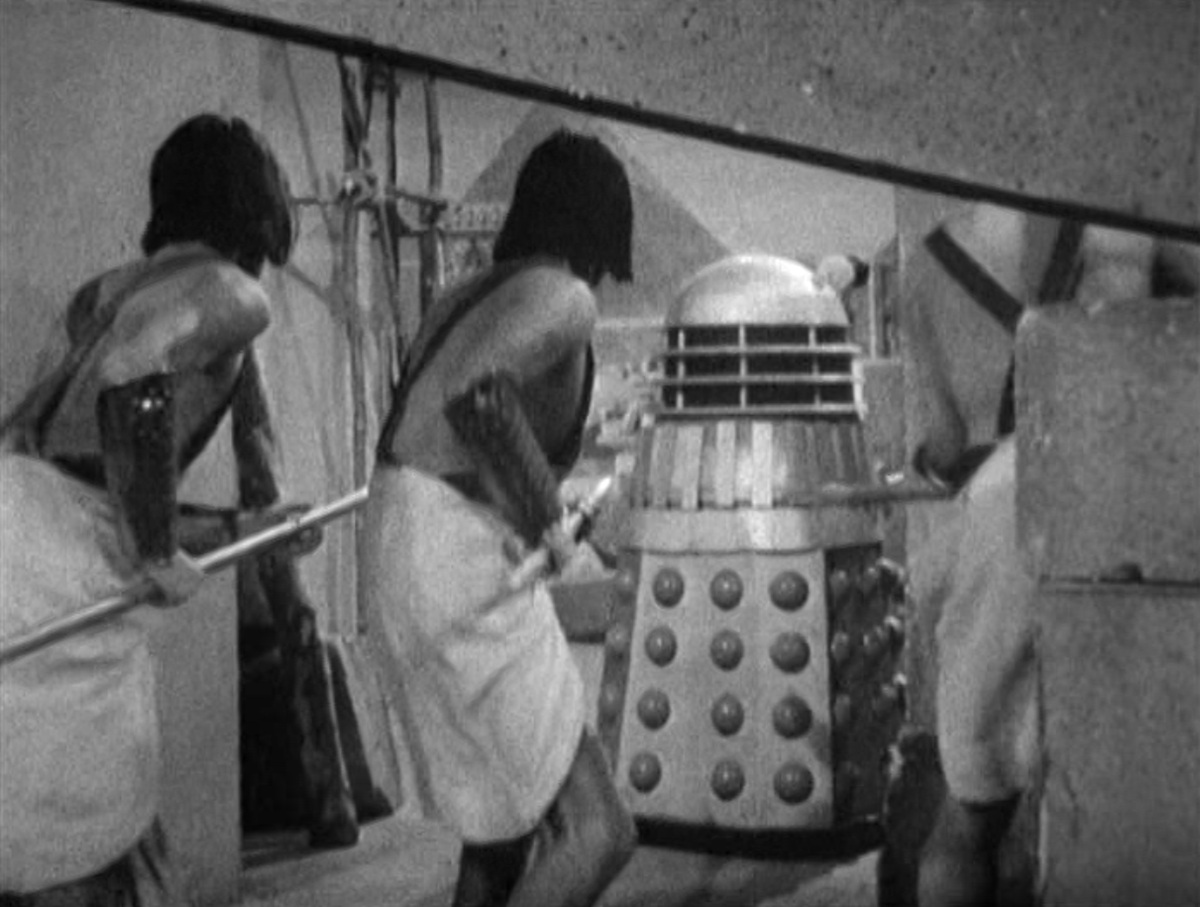
The Doctor has stopped off because he needs to make certain that no permanent damage has been caused by The Monk’s meddling, and while he is engrossed in his repair work Steven and Sara are nearly captured by the Daleks and Chen – currently being shouted at by what the script describes as the ‘Red Dalek’, although how viewers in black and white days were supposed to know this is anyone’s guess – but are saved by the timely intervention of the Egyptians loudly decrying the presence of ‘intruders’ and waving a lot of wooden sticks around. Like all historical figures in the series, they are inevitably more interested in the mysterious ‘blue box’ by than any of the human or alien interlopers. The Monk, meanwhile, has been pressganged into helping to recover the Tarranium Core, but as ever he is no match for The Doctor, who overpowers him and steals something from his TARDIS before leaving him bound and gagged in a sarcophagus. It is here that he is discovered by Steven and Sara, who initially mistake him for a living mummy in the rather peculiar cliffhanger to episode nine, but before anyone can comment on its lack of relation to the actual storyline, they are captured by the Daleks. The Doctor insists that he will only hand the real Tarranium Core over if the hostages (“in which I also include that Monk fellow”) are released to him at the same time. After some tense prevarication, he makes the rather absurd announcement “I am now about to hand the Tarranium Core to Mavic Chen”. Then, bang on cue, the Egyptians arrive to give these angry gods with machines of fire a sound stick-assisted thrashing, and in the confusion the TARDIS mob make their escape. They may have lost the Tarranium Core, but they have at least gained some vital circuitry that will allow them to return to Kembel. Meanwhile The Monk finds himself stranded on an ice planet, waving his fists in comic frustration.
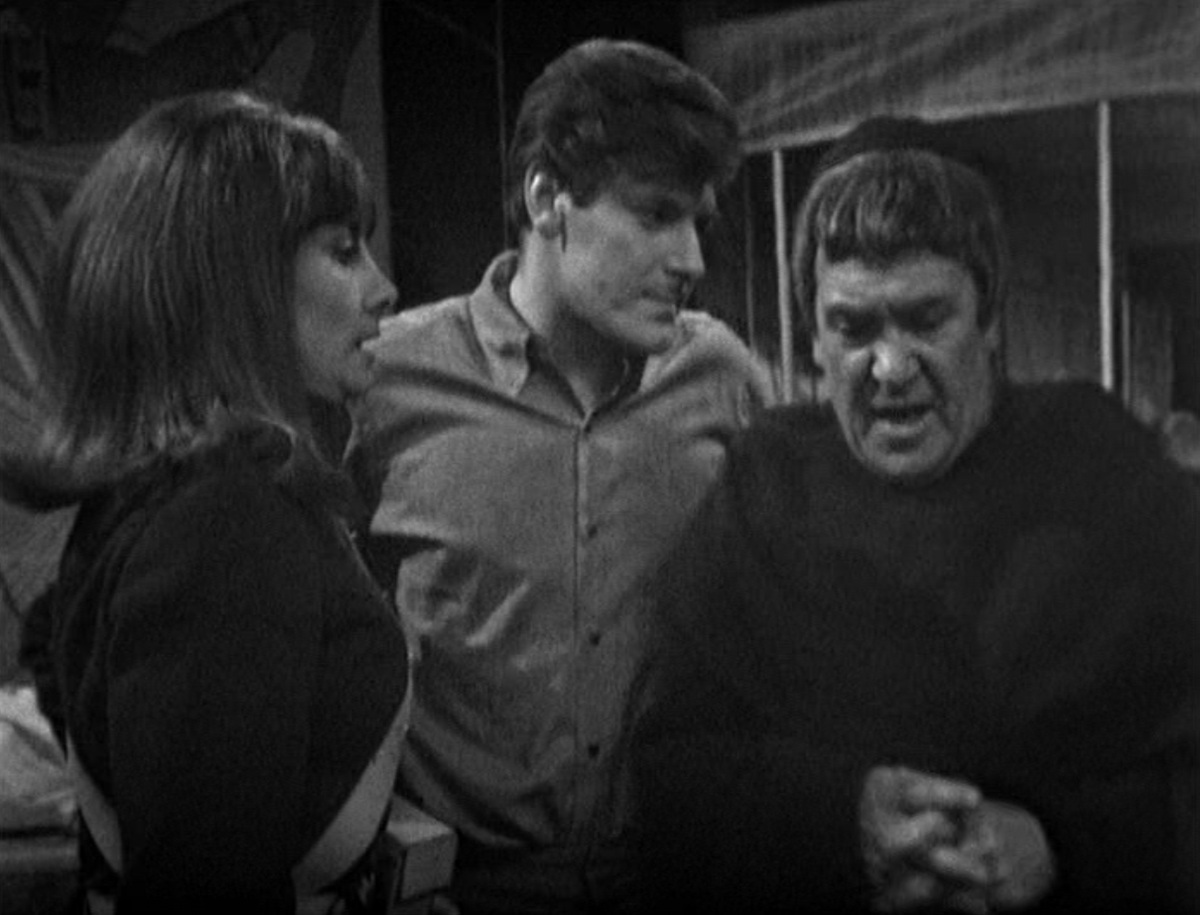
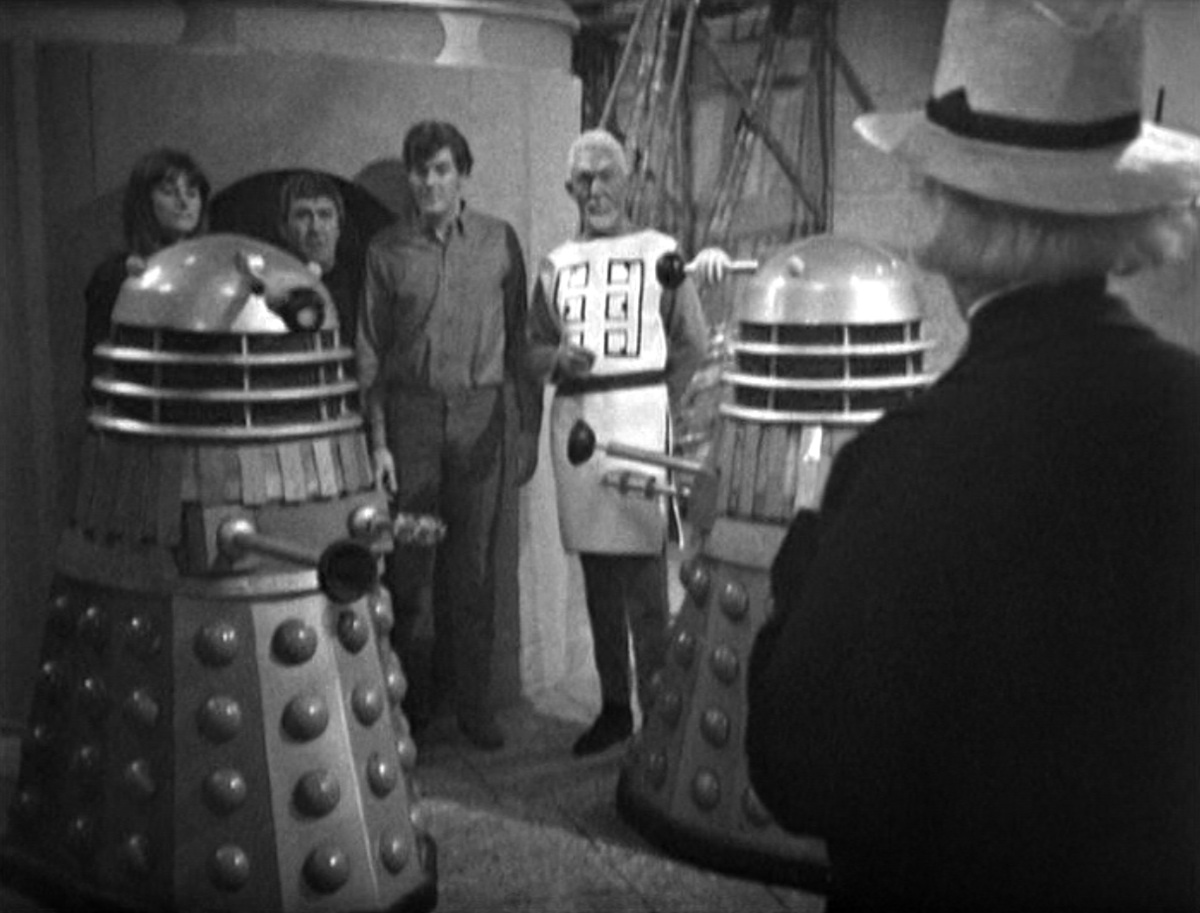
Back on Kembel, only Gearon, Sentreal, Malpha, Beaus and Celation still remain from the initial lineup of weirdos, and are engaged in a furious and passionate debate about their suspicions. They conclude by demanding the removal of Mavic Chen and, with comic inevitability, slapping the table top so vigorously that according to the script the table starts shaking. A Dalek appears and tells them to be silent, but this only makes them noisier and angrier and their Dead Poets Society-style show of defiance is only quelled when Chen himself arrives and shoots poor old Gearon, who hadn’t even said anything about him. Steven and Sara, who unsurprisingly have become separated from The Doctor as tended to happen at this point in a story, arrive at the conference centre to discover that the remaining Delegates and Chen have been rounded up and locked in a cell. They are so furious at this that they are collectively planning to round up their own galactic forces and take on the Daleks themselves, which is enough to convince Steven and Sara to release them, but while The Delegates get away in their various ships, The Spar explodes on the launch pad. Is this the Daleks’ revenge on Chen? No, it’s actually a last piece of double crossing on his part. Clearly utterly unhinged by this point, Chen is convinced that The Doctor is trying to out-Delegate The Delegates and become the Daleks’ ultimate ally, proving the extent of his plot-losing by attempting to take on the entire combined might of the Daleks with a single ray gun. You can guess what happens next.
The Doctor makes a grab for the now-activated Time Destructor – which unfortunately for The Daleks isn’t quite working as intended – and makes a run for it, hoping to use the TARDIS to neutralise its adverse effects. As the Daleks implode and mutate into some sort of humanoid octopi, the TARDIS crew begin to age rapidly; The Doctor and an increasingly bearded Steven just make it into the TARDIS in time, but Sara stumbles and falls and literally ages to death. As The Doctor and Steven ruminate bitterly on the sheer futility of the events of the previous twelve weeks, the credits promise ‘Next Episode: War Of God’, and the still-shellshocked viewers are joltingly catapulted straight into a ‘needless and nightmare-raising’ historical adventure with a conclusion that continues to baffle historians of both senses to this day. The Daleks have been defeated… but for how long?
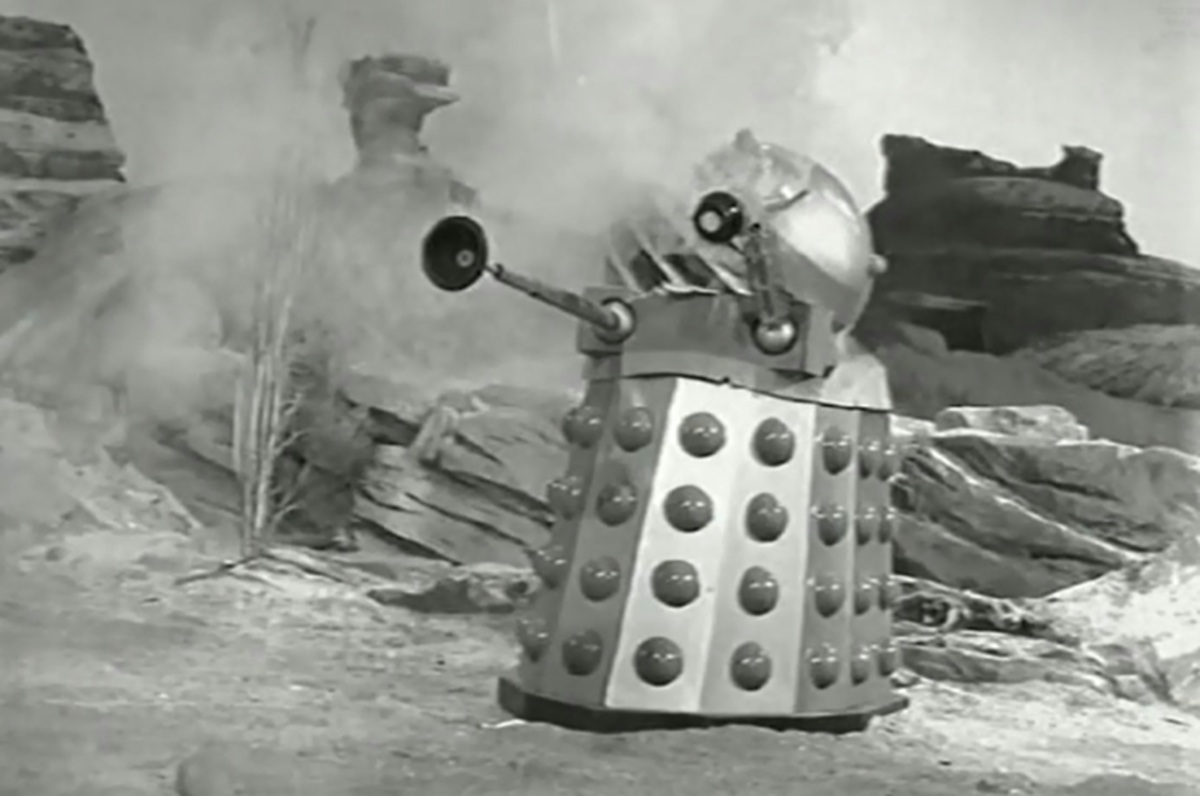
Well, for this long. A short while and a couple of superlative David Whittaker-penned Dalek stories later, Terry Nation withdrew the rights for them to be used in Doctor Who. He had his eye on a big-budget Dalek series aimed at the American networks, which would have chronicled their ongoing battle with the Space Security forces and implies that the entirety of The Daleks’ Master Plan had basically been an extended testing ground for his artistically and financially ambitious ideas. This project ultimately came to nothing and they would return in 1972, but the characters and concepts introduced in The Daleks’ Master Plan were never seen again.
Neither was The Daleks’ Master Plan ever seen again; at various points across the late sixties to early seventies, the broadcast master tape of every single episode was erased for reuse. The Feast Of Steven fared even worse; considered unsuitable for repeat or overseas sales, there is no record of any film recording ever having been made and as such it is quite possibly gone for good. The Time Destructor itself couldn’t have done a better job. Even the few film prints of the other eleven or indeed twelve instalments that were made for overseas sales – although never actually shown anywhere on account of the unusually violent content – were not intentionally retained. While a full set of off-air audio recordings made by a fan survived, for many years the only visual material known to survive was a brief clip of Katarina struggling with Kirksen in the airlock from the fourth episode The Traitors, as used in a November 1973 edition of Blue Peter. Although everything else that the production team had borrowed for that feature was returned to the Film Library – including, contrary to popular belief, the fourth episode of The Tenth Planet – The Traitors never was and is still unaccounted for. Rumours that the person responsible for its disappearance left a dummy film can in its place and is due to return it while exclaiming “I am now about to hand the fourth episode to the BBC” sadly cannot be confirmed. Later a couple of short filmed inserts from episodes one and two were discovered to have survived by chance, and episodes five (Counter-Plot) and ten (Escape Switch) were discovered in a forgotten stash of BBC films cans. In 1993, the production team of the Thirty Years In The TARDIS documentary located a lengthy clip of Kert Gantry being pursued and exterminated by the Dalek patrol, and another short clip of The Daleks in their spaceship on course for Desperus in another edition of Blue Peter. Then, a whole decade later, a former BBC employee returned the second episode Day Of Armageddon; his was one of the most significant finds since the search for missing Doctor Who very first began, as not only is it the only extant episode to feature Katarina – up until that point, the only companion not to be represented by one – but is also a superb piece of work that disproves the traditional assumptions about The Daleks’ Master Plan with a chilling, ominous atmosphere and a lot of banging on tables.
Mention should also be made of John Peel’s two-part novelisation, which stays true to the televised version of events even down to including The Feast Of Steven in the narrative – although “…and a Merry Christmas to all of you at home” was conspicuous by its absence – and Peel’s only real amendment was to insert a six month gap between the two halves of the story, primarily because he liked Sara as a character and wanted to give other writers the chance to use her in original stories. Mission To The Unknown and The Mutation Of Time, as the two volumes were subtitled, were amongst the very finest of the novelisations, as reflected by the fact that they were the first to ever be awarded the full five marks on Russell’s Rateometer, the scoring system adopted by Doctor Who Magazine’s rarely uncritical resident book reviewer Gary Russell.
This should hardly have been a surprise for The Daleks’ Master Plan in any format, though. Suspense, tension, shock plot twists, hallucinogenic sequences, alien planets by the bucketload, some very silly individuals sat around a conference table, and of course the Daleks themselves at the height of their popularity – The Daleks’ Master Plan has the lot. The reasons why it has found itself so consistently overlooked are both obvious and understandable, but it really is about time that a little more notice was taken of it because if it continues to be so widely ignored, well, that would be as big an ‘outrage’ as Zephon refusing to enter the conference room.
Buy A Book!
You can find an even longer version of Delegation’s What You Need, If You Wanna Have A Twelve-Part-Epic-Inspirin’ Blue-Peter-Episode-Stealin’ Tarranium-Core-To-Mavic-Chen-Handin’ Merry-Christmas-To-All-Of-You-At-Home-Wishin’ Time Destructor, Mmmmmm!, complete with added ‘Dalek Diversions’ in Well At Least It’s Free, a collection of some of my columns and features. Well At Least It’s Free is available in paperback here or from the Kindle Store here. There’s also a massively expanded version of my thoughts on why Katarina and Sara Kingdom ‘count’ as regular cast members regardless of what pedantic bores who don’t understand who television worked in the sixties may have to say on the matter in Keep Left, Swipe Right, available in paperback here or from the Kindle Store here.
Alternately, if you’re just feeling generous, you can buy me a coffee here. Do not bother with that coffee bar that those policemen from The Feast Of Steven are headed for in search of ‘birds’.
Further Reading
You can find a look at the entire third series of Doctor Who in It’s Still A Police Box, Why Hasn’t It Changed? Part Four: Last Train To Trantis/Sentreal here and my thoughts on why if you think Katarina and Sara don’t count then you are just plain wrong in Katarina Amongst The Pigeons here.
Further Listening
If you want to hear about my love of some of Doctor Who‘s most arcane quasi-related ephemera, then you can find just that in Doctor Who And The Looks Unfamiliar here.

© Tim Worthington.
Please don’t copy this only with more italics and exclamation marks.
 Tim Worthington