When Riverdale High School classmates Josie McCoy, Melody Valentine and Valerie Brown decided to form a feline-themed all-female rock band in 1969, they were far from the first fictional outfit created in response to the garage band boom with an eye on real-world pop stardom. From Hanna Barbera-bankrolled psychedelic popsters in huge cartoony animal costumes The Banana Splits and little-remembered part-time ineffectual animated superheroes The Impossibles to Max Frost And The Troopers, who piled youth-slanted political pressure on the establishment in 1968’s Wild In The Streets before scoring a genuine international smash with the superb Shape Of Things To Come – and there’s even a case for arguing that The Monkees at least nominally fit the bill – the television and cinema screens and record store racks, if not necessarily always the actual charts themselves, were full of almost as many non-existent Gibson ES-330-toters as they were the genuine article. Even The Pussycats’ classmates Archie Andrews, Reggie Mantle, Veronica Lodge, Betty Cooper and Jughead Jones got in on the act, courtesy of a Filmation cartoon series that recast them as a band to lend an element of variety to their small-screen adventures and inadvertently transformed them into global chart-toppers with Sugar Sugar, originally written to accompany a storyline about a school fete ‘Kissing Booth’; an unexpected turn of events that effectively spurred Archie Comics into fashioning Josie and company into a band of their own invention. Doubtless there are some, probably blokes with over-elaborate Byrds haircuts and frilly-cuffed smoking jackets, who would sneer with a worrying intensity at Sugar Sugar or indeed Jingle Jangle, Hey You (Hiddy-Hiddy-Hoo), Wait ‘Til Tomorrow, Inside Outside Upside Down, Paxton Quigley’s Had The Course and possibly even Pleasant Valley Sunday for not being as ‘authentic’ as Dark Side Of The Mushroom by The Chocolate Watchband, but when you are talking about a musical movement that was predicated on the entire notion that anyone could form a band if they could hit a basic rhythm and bash out a few chords and had enough imagination to style it out, it is unclear where the concept of authenticity might have come into proceedings in the first place.
Where Josie And The Pussycats differed from their quasi-non existent contemporaries, however, was that they endured. Doubtless at least part of the reason for this was that at the same time somehow managing to maintain their original line-up, image and basic musical style whilst also still perceptibly moving in tandem with changing fashions, their comic strip exploits also saw them react to evolving recording technology right up to the demands of the streaming age, the shifting nature of fame and the machinations of the music industry in between fretting over boyfriends, bigotry and homework. More recently, there was even a savage poke at X Factor and its progeny, with Josie getting through to the later stages of a television talent show only to unleash a volley of guitar noise somewhere between The Jesus And Mary Chain and Adrian Belew, and signing off by addressing the viewing millions with a direct to camera sarcastic paraphrasing of Back To The Future. Looming ominously in the background, however – even as far back as Josie’s earliest pre-Pussycats appearances – was a decidedly supernatural undertone. This may not have been as pronounced as it was in the escapades of their teenage wiccan classmate Sabrina Spellman – who of course wreaked hex-casting havoc at The Archies’ ‘Kissing Booth’ – but considering that Josie’s arch-rival Alexandra Cabot was continually trying to learn witchcraft via correspondence course sufficiently realistically that some earlier strips have had to be redacted for collected reprints, with the unwilling assistance of her feline familiar Sebastian who may or may not be the reincarnated spirit of an ancestral Cabot who was cast out for consorting with witches, it is safe to say that it has never exactly been far away. It is fair to say that this may all come as something of a surprise to anyone who was only ever aware of anything related to Archie Comics via Sugar Sugar; in which case we are probably better advised not informing them of Cheryl Blossom’s animal rights activism, Katy Keene’s navigation of the many and varied prejudices and manipulations of the fashion industry, and Archie’s own encounters with everything from Cold War espionage to digital identity theft and even The Max Headroom Broadcast Signal Intrusion Incident. You do have to wonder how he found time for that candy girl to get him wanting her.
What is astonishing in retrospect, however – and especially considering how little the essential format of the various Archie Comics characters and assorted titles have changed or even had cause to change – is just how much of this they were able to get away with, and that isn’t an overly dramatic manner of phrasing it, under the exceptionally watchful eye of the Comics Code Authority. Initiated in September 1954 in response to the frankly staggeringly extreme content of nonetheless hugely popular titles like EC Comics’ The Vault Of Horror and Tales From The Crypt, the Comics Code Authority’s stamp may now be such a relic of a bygone age that it served as a brilliant gag in the opening titles of Spider-Man: Into The Spider-Verse but back in the sixties – when the fledgeling Archie Comics were obliged to elevate Katy Keene’s neckline – it was a very serious matter indeed and those that did not meet the criteria to warrant displaying the stamp on their front covers would find themselves shunned by advertisers, distributors and retailers alike. It should be emphasised that there were actually some benefits to the artistic restrictions that it indirectly imposed – in the case of Marvel Comics, for example, it is clear to see how the enforced need for creative thinking played a not inconsiderable part in the evolution of characters like Iron Man, The Wasp and Galactus – but by the close of the decade it was badly out of step with changing public tastes and attitudes and when the Comics Code Authority objected to DC employing a writer named ‘Marv Wolfman’, which was of course his genuine actual name, it was evident that something would have to change. The catalyst for that change would follow in 1971, when Stan Lee wrote a three issue series of The Amazing Spider-Man built around a story examining the recreational use of hallucinogenic drugs in what he believed to be an even-handed and moral manner, and refused to pull the issues even when the Comics Code Authority refused to grant a stamp. Winning unexpected support from DC and even some corners of the right-wing press, Lee’s move more or less forced a relaxation of the code and one of Marvel’s first responses was to hire Marv Wolfman to work on titles like Tomb Of Dracula and Werewolf By Night and to create a certain vampire hunter by the name of Eric Brooks. If you are familiar with his nickname, you should have some idea of how much had changed in so short a space of time.
Riverdale’s world of good intentions, comeuppances and happy coincidences had always allowed Archie Comics to get away with skirting the edges of the Comics Code – Katy Keene’s cleavage aside, even the clause declaring that “females shall be drawn realistically without exaggeration of any physical qualities” seemed to be remarkably straightforward to surmount – but even they could not entirely pass up the opportunity to take advantage of this new-found relative freedom. Sabrina Spellman was promoted to her own headlining title at long last – she had been starring in her own animated Filmation series since 1970 – and also hosted the short-lived anthology title Chilling Adventures In Sorcery With Sabrina, while Archie, Betty, Veronica, Jughead and company were permitted to wrestle with certain of the more emotionally complicated aspects of high school romance, and Josie, Valerie and Melody were not only afforded the occasional admittedly chaste reference to the thrills and temptations of handsome young fans and free bars, but also the possibility of sporadically driving their tour van deep into full-on horror territory.
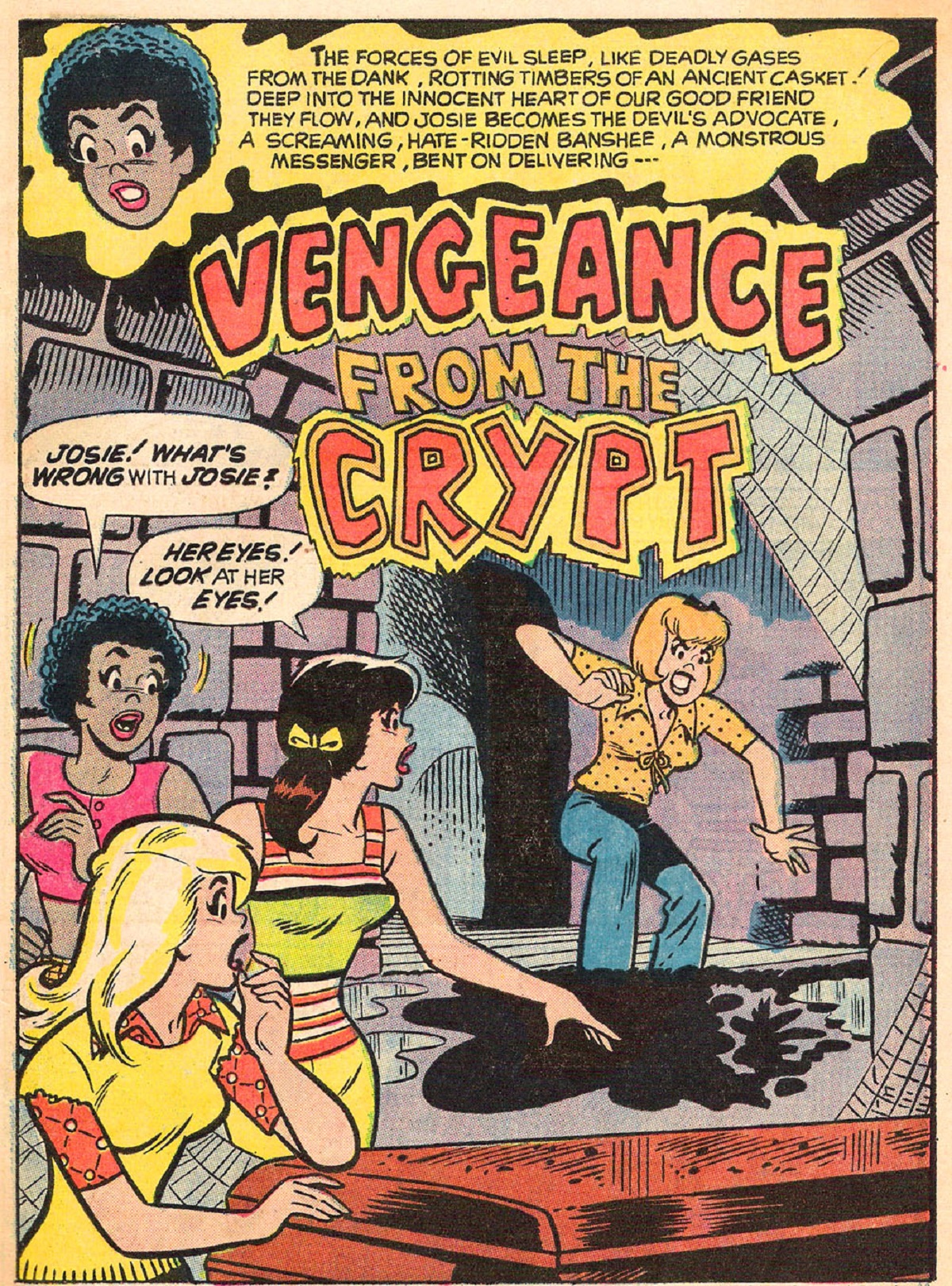
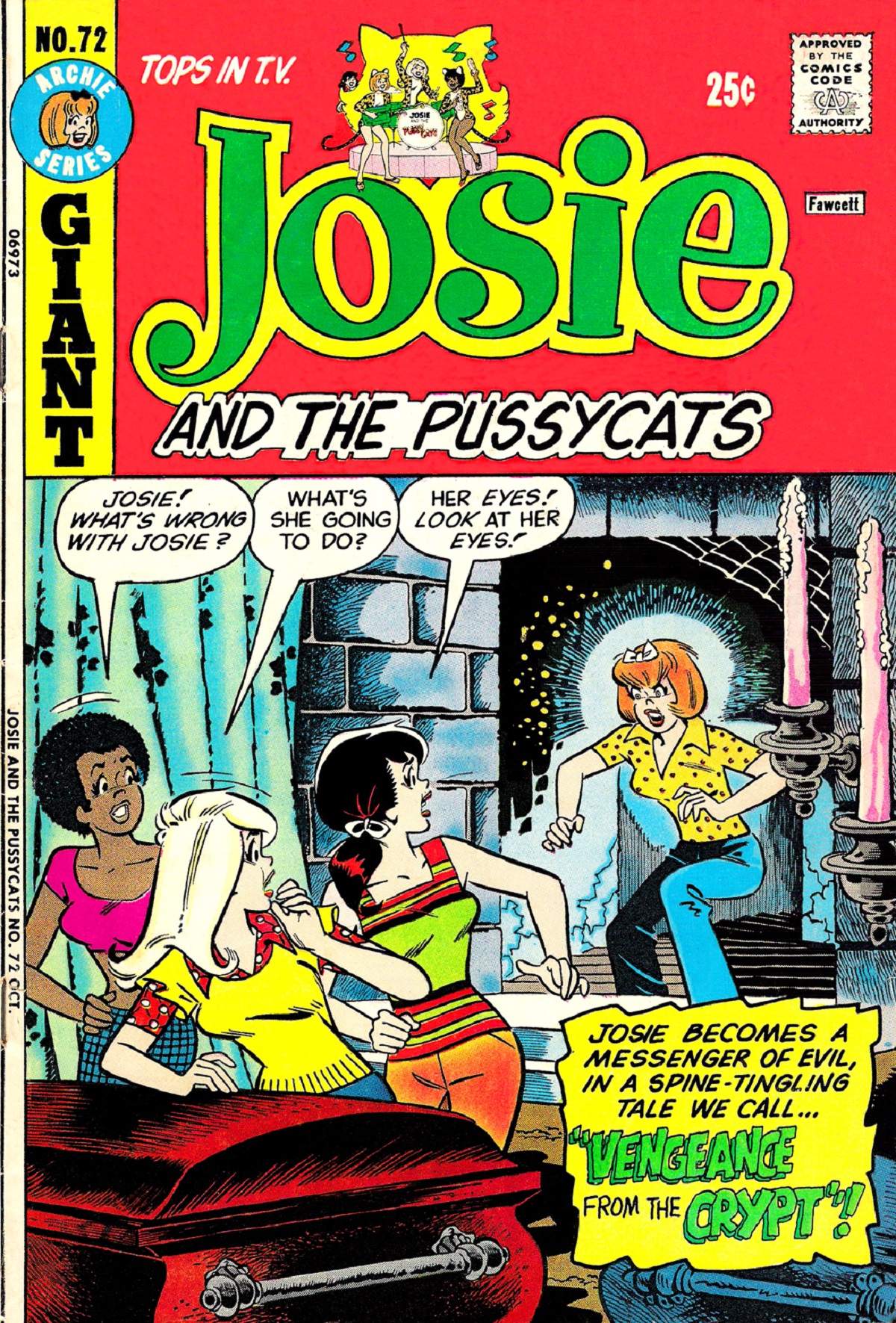
In fairness, Josie And The Pussycats had also been starring in their own Hanna Barbera comedy-adventure animated series since 1970, which brought them into conflict with the expected post-Scooby Doo assortment of mad scientists, evil hypnotists, deranged toymakers and aspirant megalomaniacs, and the attendant tie-in soundtrack album included the remarkably frank love-curse singalong Voodoo – which you can find more about here, incidentally – and that’s not even mentioning the mainstream success of Russ Meyer’s all too evidently Josie-inflected Beyond The Valley Of The Dolls, so this diversion was possibly not entirely without precedent, but even so, their small-screen exploits were essentially still just warming up for what was to come in the comics. In between the more traditional tales of television appearances, ecological protests and missed flights came the likes of haunted house saga The Ghost Of Dark Valley Manor, piratical phantom encounter The Ghostly Guardian, hallucinogenic nightmare The Falcon’s Claw, massed classic horror character skirmish What Kind Of Ghoul Am I?, mad scientist and monster thriller My Brother’s Keeper, a tussle with The Hooded Horror Of Haunted Hill, rural terror excursion The Swamp Mist Monster – complete with a cheekily unsubtle nod towards the concurrent priority dispute over DC’s Swamp Thing and Marvel’s Man-Thing – and the truly astonishing Vengeance From The Crypt, in which The Pussycats are called on to exorcise a malevolent demon in a story that would quite possibly raise a couple of eyebrows even now.

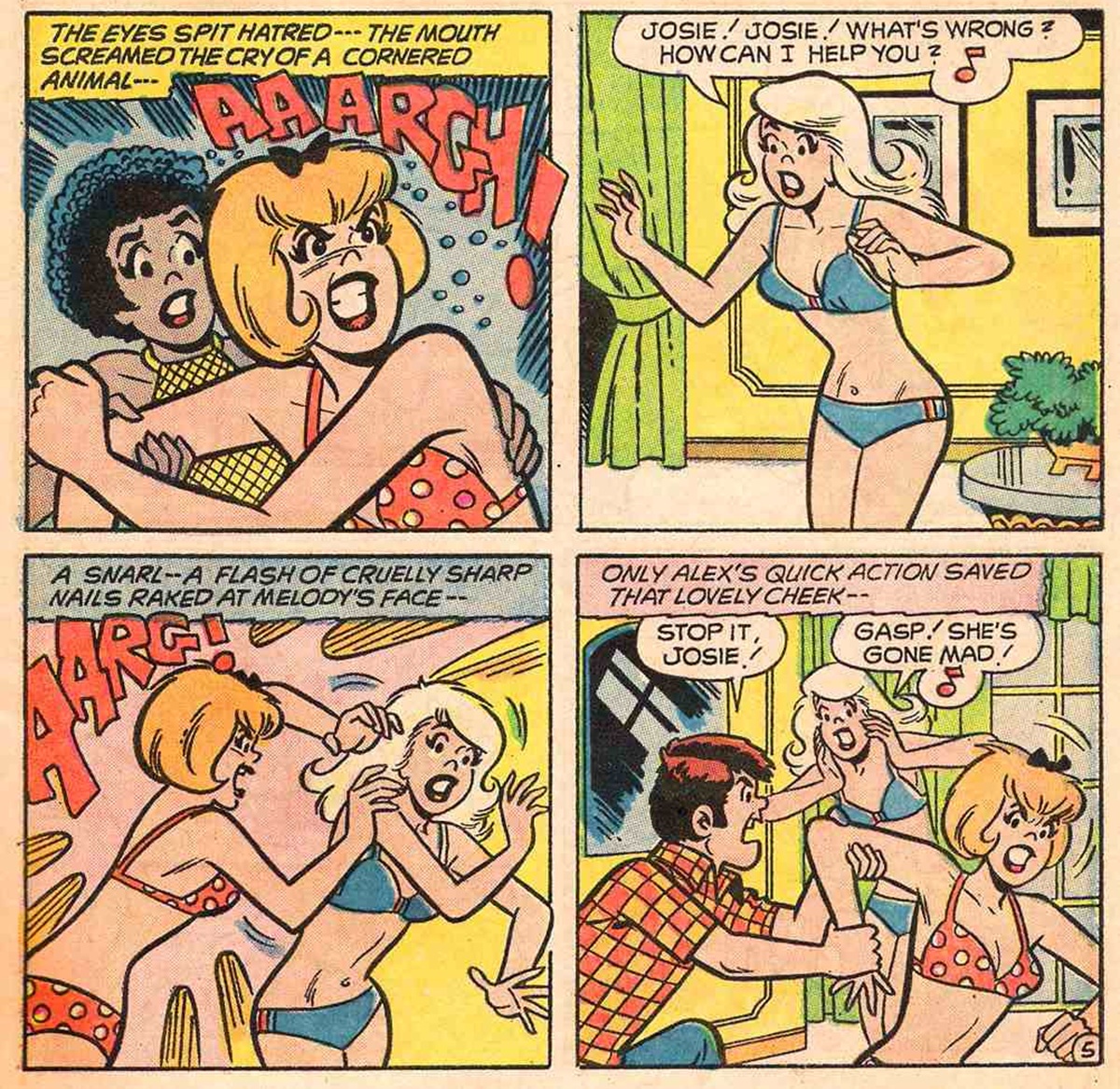
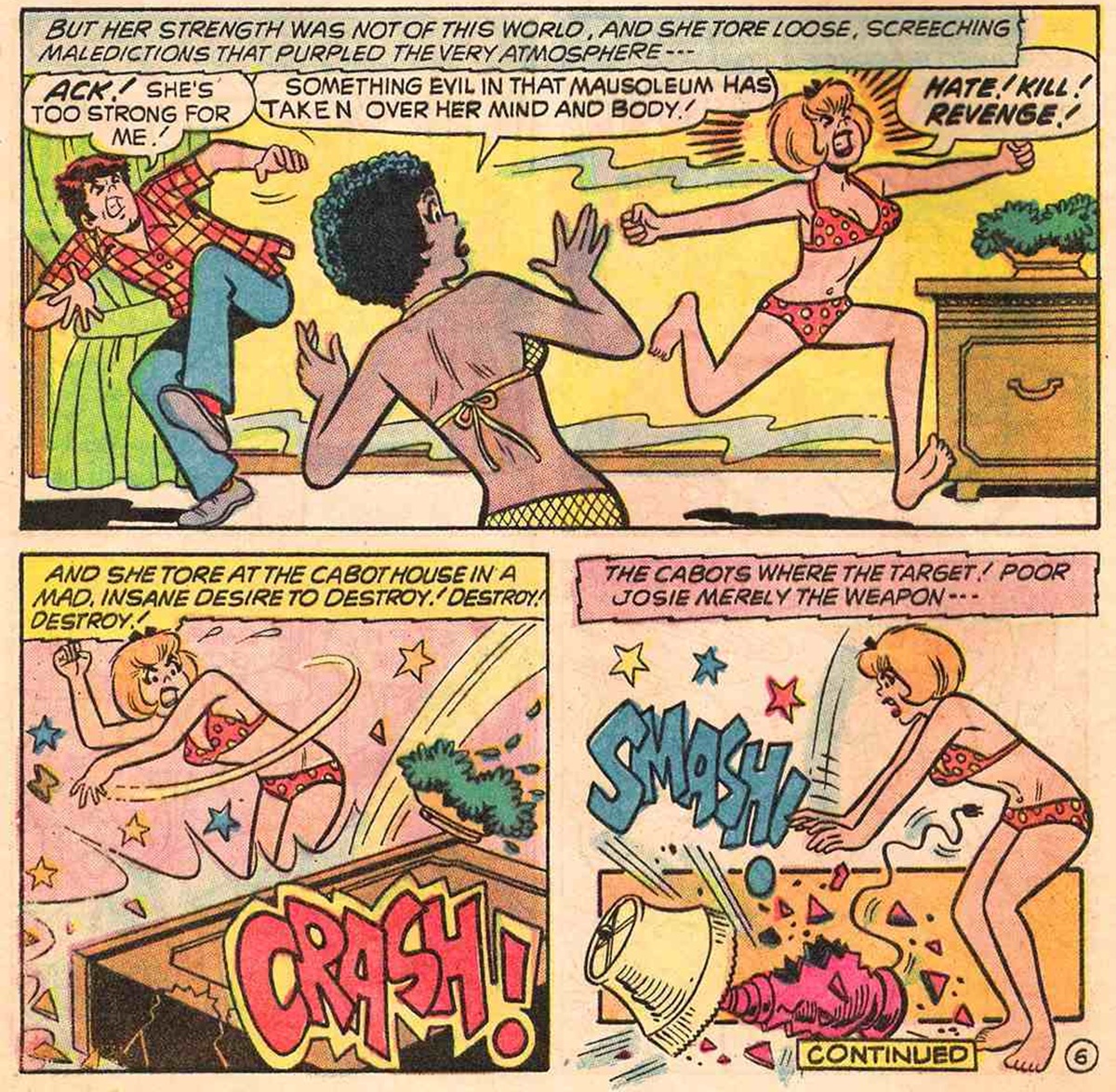
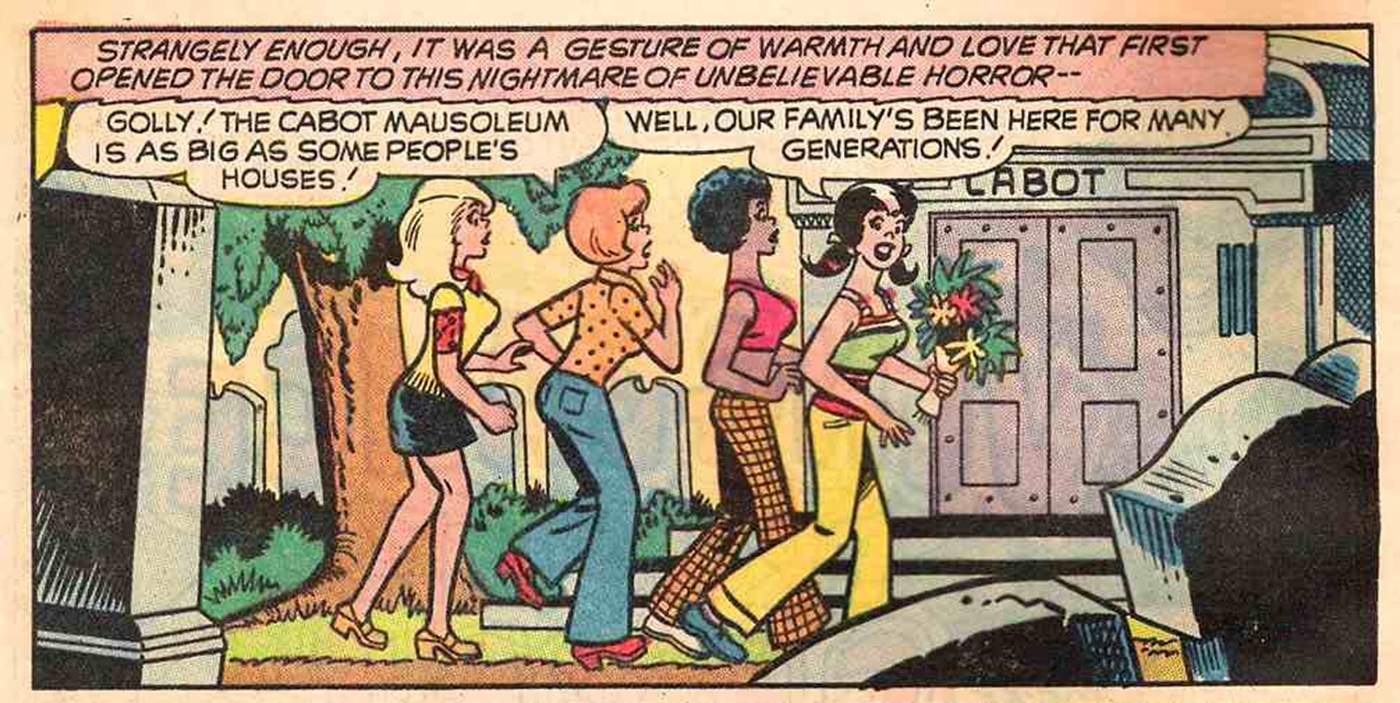
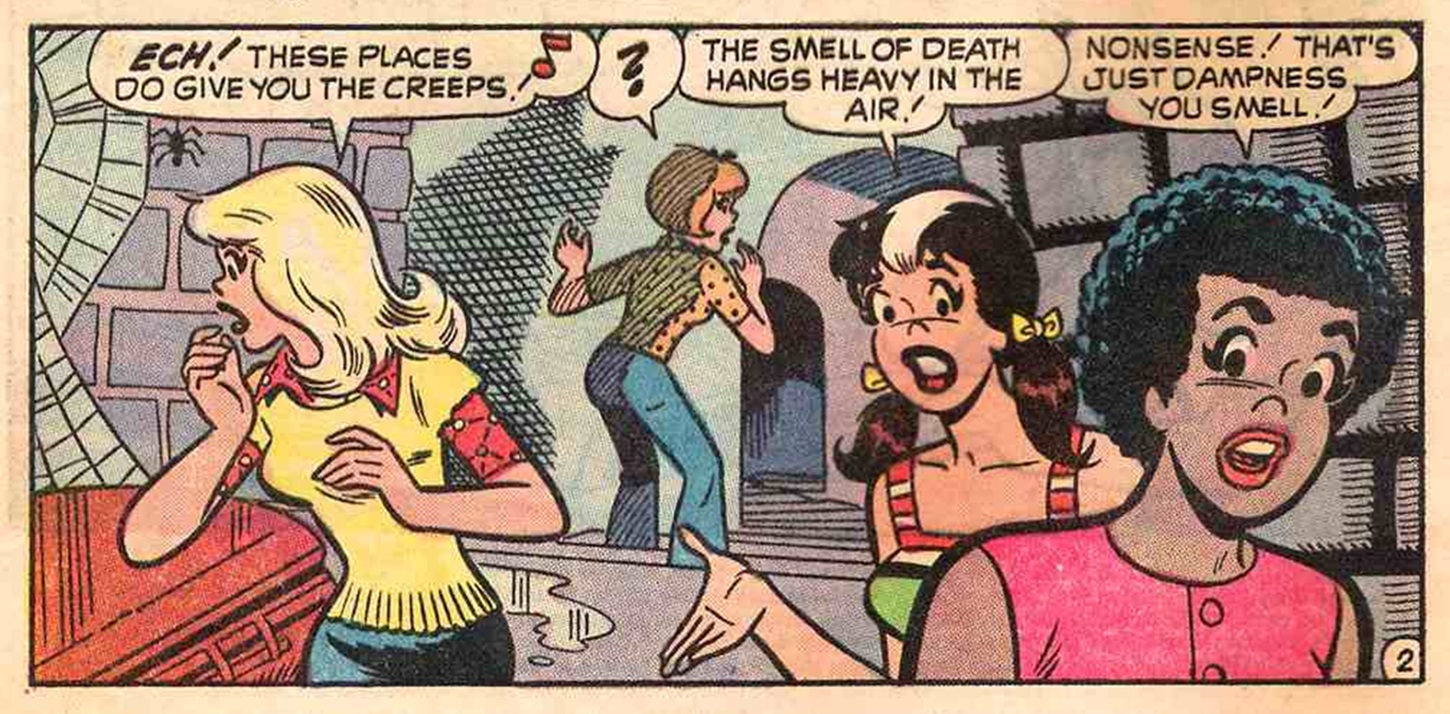
First published as issue seventy two of Josie And The Pussycats in October 1973, Vengeance From The Crypt starts off innocently enough – well, unless you count the title page with Valerie spelling out what is ahead in no uncertain terms – with the band drawing enough of a truce with Alexandra to set off with her and twin brother Alexander for a brief vacation at the Cabot family’s ancestral home. When it becomes clear that the house also houses the Cabot Family Mausoleum, however, events suddenly seem liable to take a darker turn, and while Valerie sets about disabusing the easily spooked Melody of her flights of supernatural fancy, an inevitably sceptical yet curious Josie elects to have a nose around the basement floors for herself, upon which she finds herself enveloped by and involuntarily inhaling some seemingly sentient dusty mist. Later, while everyone is relaxing around the pool – in a six-page swimwear-heavy stretch that in itself would have provoked some seriously furrowed brows at the Comics Code Authority only a couple of months earlier – Josie begins snarling incoherently, lashing out viciously and chanting ‘HATE! KILL! REVENGE!’, also taking the opportunity to destroy a couple of items of antique furniture for good measure. All attempts to restrain her are ferociously swatted away, and she screeches and recoils on coming into contact with a bible, forcing Alexandra to pivot to full tilt exorcist and ram the troublesome hardback into Josie’s hands whilst renouncing the forces of darkness until whatever has possessed her vacates her body with a crackle of lightning and a drift of foul-smelling vapour. Deducing that this must have been the lingering spirit of heartless and vindictive black magic adherent Great Aunt Julia, Alexandra leads the assembled bandmates back into the crypt, holding the bible aloft until her malevolent ancestor’s memorial crumbles into rubble. There’s a streak of sunlight, a rare moment of collective empathy for Josie’s grey-streaked tormentor, and that is essentially that. Next issue, they were off and dealing with the somewhat less than savoury management of the appropriately named ‘El Club Kreepo’, which is a different story on almost entirely every level.
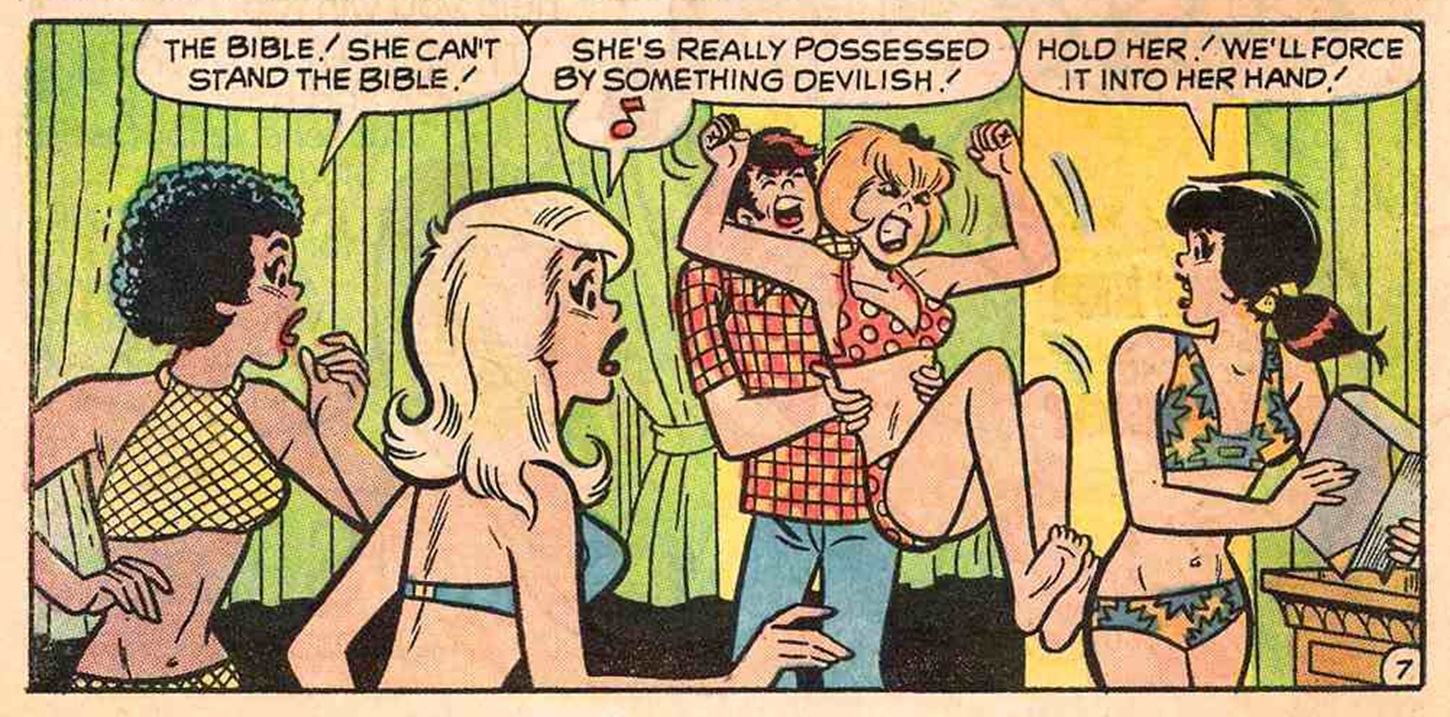
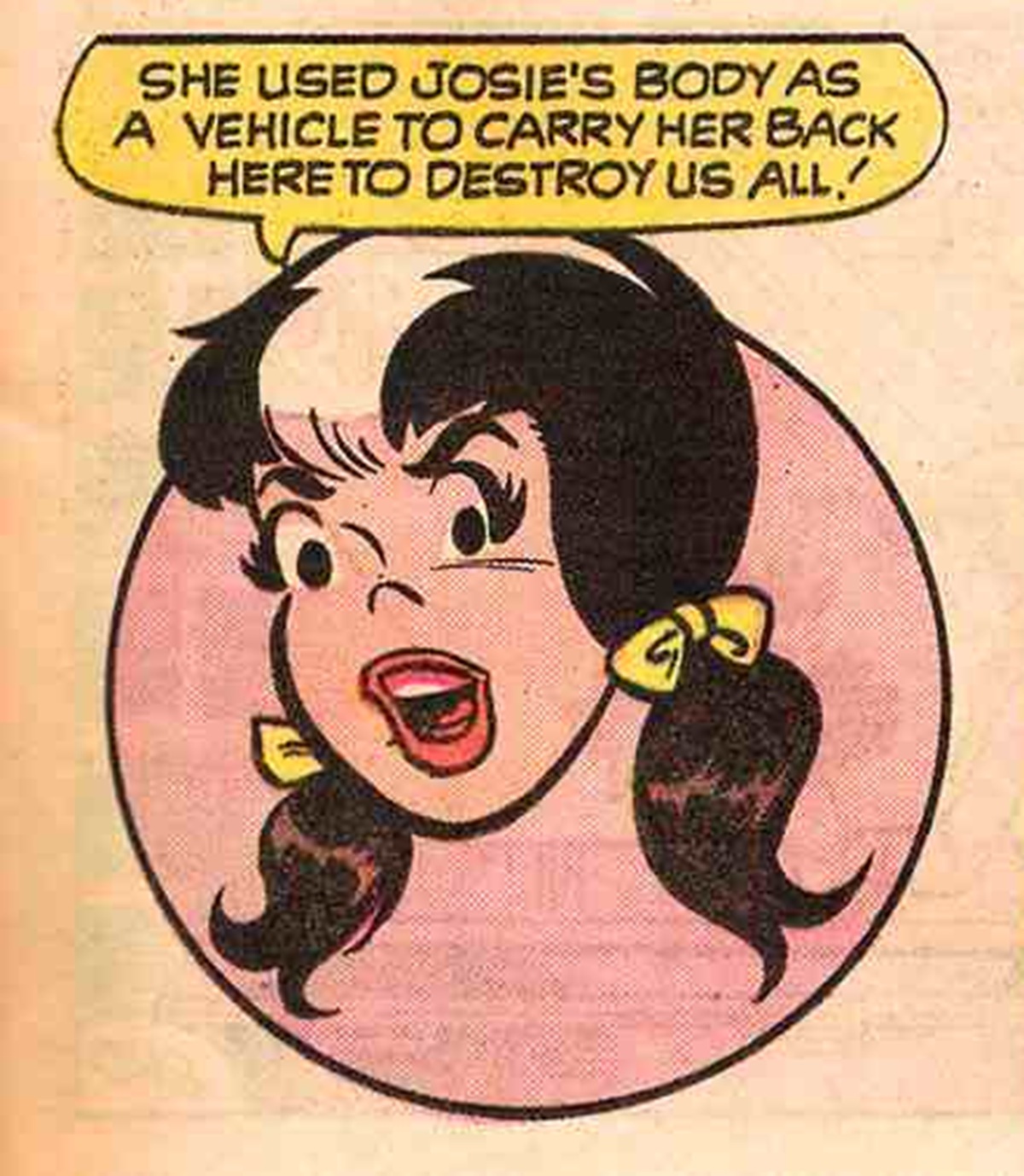
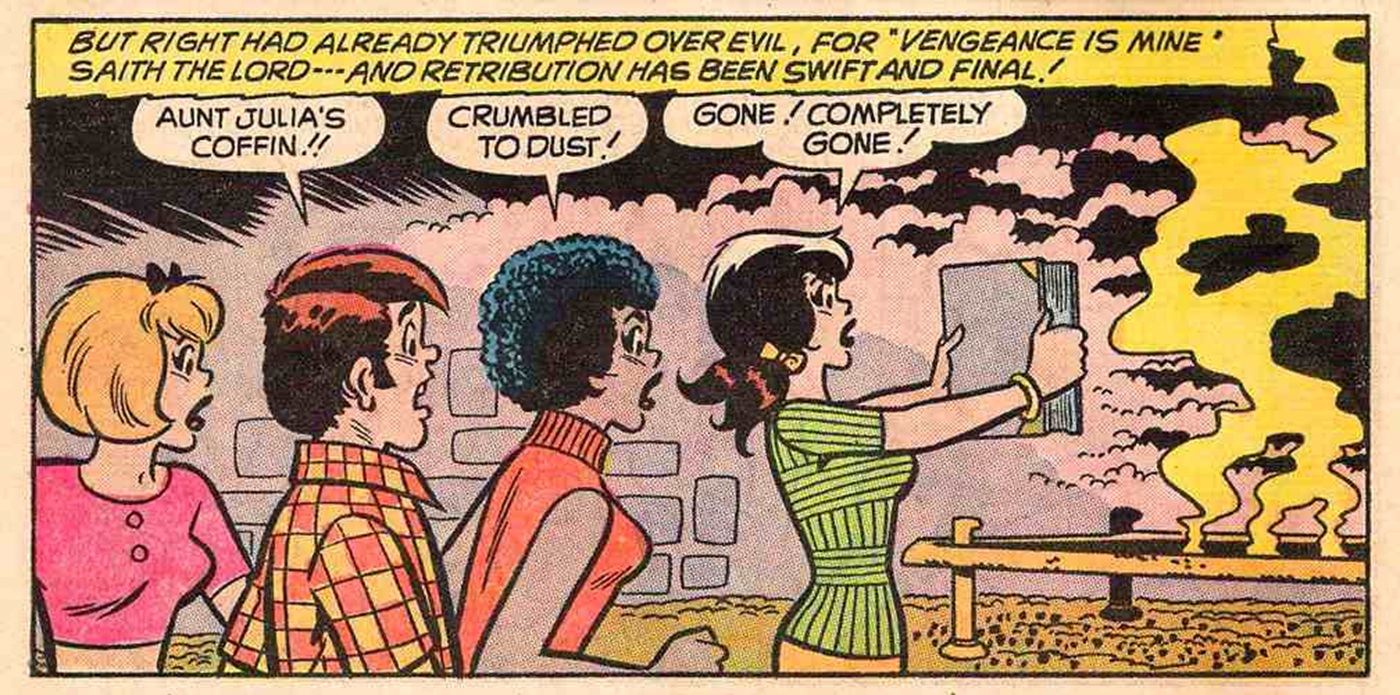
From the rise of MTV and grunge to management pressure to model for ‘lad mags’ and the risks of selling out for big budget soda adverts, Josie And The Pussycats would find themselves with plenty of further real world trends to react to – not to mention a 2001 big screen adaptation taking aim at the concept of subliminal advertising, which nobody ever seems to be able to work out whether they like it or not – but the supernatural element was never too far away, although it rarely reached such a degree of extremity again. It may not have provoked a fresh moral panic about ‘horror comics’ and a sudden reinforcement of the Comics Code, but you do have to wonder what effect it may have had on its semi-unsuspecting intended audience back in 1973. Hopefully the backup strips about Josie asking Alexander to marry her as a prank and Melody trying out new miracle washing powder ‘El Spoto Gono’ were sufficient to placate any petrified readers. Or perhaps they were secretly hoping that Josie really was gonna do some voodoo on you.
Buy A Book!
There’s lots more about Josie And The Pussycats and tons of other imported animated action-adventure favourites – not all of which featured bands in them, but let’s face it, most of them did – in The Golden Age Of Children’s TV, available in all good bookshops and from Waterstones here, Amazon here, from the Kindle Store here and directly from Black And White Publishing here.
You can also find much more about the odd preponderance of horror-tinged children’s entertainment in the seventies and eighties in Keep Left, Swipe Right here.
Alternately, if you’re just feeling generous, you can buy me a coffee here. Strong enough so that you would worry about Josie inhaling that too.
Further Reading
Why was there so much child-orientated spookiness around in the seventies and eighties in particular? Find out in I’m A Stage Illusionist, Nothing More Sinister Than That… here.
Further Listening
You can find more about the relaxation of the Comics Code – and Marvel’s response to it in particular – as It’s Good, Except It Sucks takes a look at Spider-Man: Into The Spider-Verse here, Blade here, Helstrom here and Werewolf By Night here.

© Tim Worthington.
Please don’t copy this only with more italics and exclamation marks.
 Tim Worthington