
Autumn 1965. The exact day, date, time and even month may well have depended on which ITV region they were watching in, but regardless of exactly when they saw it, a massive juvenile audience who had already thrilled to the small-screen escapades of Mike Mercury, Steve Zodiac, Tex Tucker and Aqua Marina were all glued to their television sets and all looking forward to the same programme. This was Trapped In The Sky, the heavily promoted and hugely anticipated debut episode of Gerry and Sylvia Anderson’s latest ‘Supermarionation’ series Thunderbirds. The viewing millions are introduced to the Tracy Brothers and their fleet of incredible rescue craft by a flimsy pop song that sounds about three years out of date, punctuated with even flimsier jet zoom and thunderclap effects and even flimsier still lyrics urging anyone in distress to call International Rescue ‘by sending out an S.O.S.’. Lyons Maid immediately cancel all launch plans for brand new tie-in ice lolly Fab, Dinky Toys’ FAB1 resolutely fails to find its way onto any Christmas lists whatsoever, and Gerry and Sylvia shrug and come up with yet another futuristic land, sea and air vehicle with an excitingly emphatic name whilst patiently waiting for someone to allow them to make something in live action.
Thankfully, Barry Gray woke up one morning involuntarily thinking of a rousing insistent militaristic drumbeat and Thunderbirds found the theme music we all know and love. Yet while it was very clearly composed on one of his off days, the very fact that the unused Thunderbirds theme song would have reflected the spectacle and excitement of the show so inadequately just goes to show exactly how much dynamism his music routinely brought to the already ever so slightly dynamic likes of Stingray, Fireball XL5, Captain Scarlet And The Mysterons and everything else proudly proclaiming itself to be filmed in Supermarionation; and incidentally you can find the story behind all of those shows and many thousands of others besides – including some long-forgotten would-be direct rivals that it is fair to say did not exactly have their own rival Barry Gray at their disposal – in The Golden Age Of Children’s TV here. Although Barry’s understanding of the ‘pop’ scene frequently left a little to be desired – you only have to listen to his bid for chart stardom Robot Man, credited to one ‘Mary Jane’ with doo-wop bass man vocals standing in for the mechanical paramour who “rattles when he walks and kinda echoes when he talks” and chirrupy ‘Martian’ girls and boys explaining how they fall in love just like us humans on the b-side Just The Same As I Do, which may have come out in 1963 but both sides sound like a not especially remarkable novelty disc from seven years previously, for admittedly thoroughly entertaining evidence of that – on more straightforward musical terms Gerry and Sylvia could not have wished for a more vivid and cinematic accompaniment to their deft and phenomenally popular combination of blockbusting futuristic settings, technologically sophisticated puppetry and alarmingly convincing model work explosions.
Considering Barry Gray’s way with a catchy hook and Gerry and Sylvia’s shrewd eye and indeed ear for merchandising potential, it is hardly surprising that nearly all of the Supermarionation shows enjoyed a tie-in single or three, and that some of them even made incursions into the real-life pop charts; which even in itself is something of an impressive feat when you consider that most pop-friendly radio channels at the time were operated by the BBC, who would not exactly have been affording blanket airplay to the theme from an ITV show. If you wanted to listen to them all, though, where would you start? How can you tell your Zero-X and Hijacked from your Jeremiah? Well, Stand By For Action – here’s a complete guide to all of the Supermarionation-related 45rpm releases, including a handful of notable cash-ins that did not even feature any involvement from Barry Gray, although the line is very much drawn at ‘Joe 9086 Dance Mix’ and FAB Featuring MC Parker. So if you will, take it away, The Cass Carnaby Five…
Michael Holliday – Four Feather Falls (Columbia, 1960)
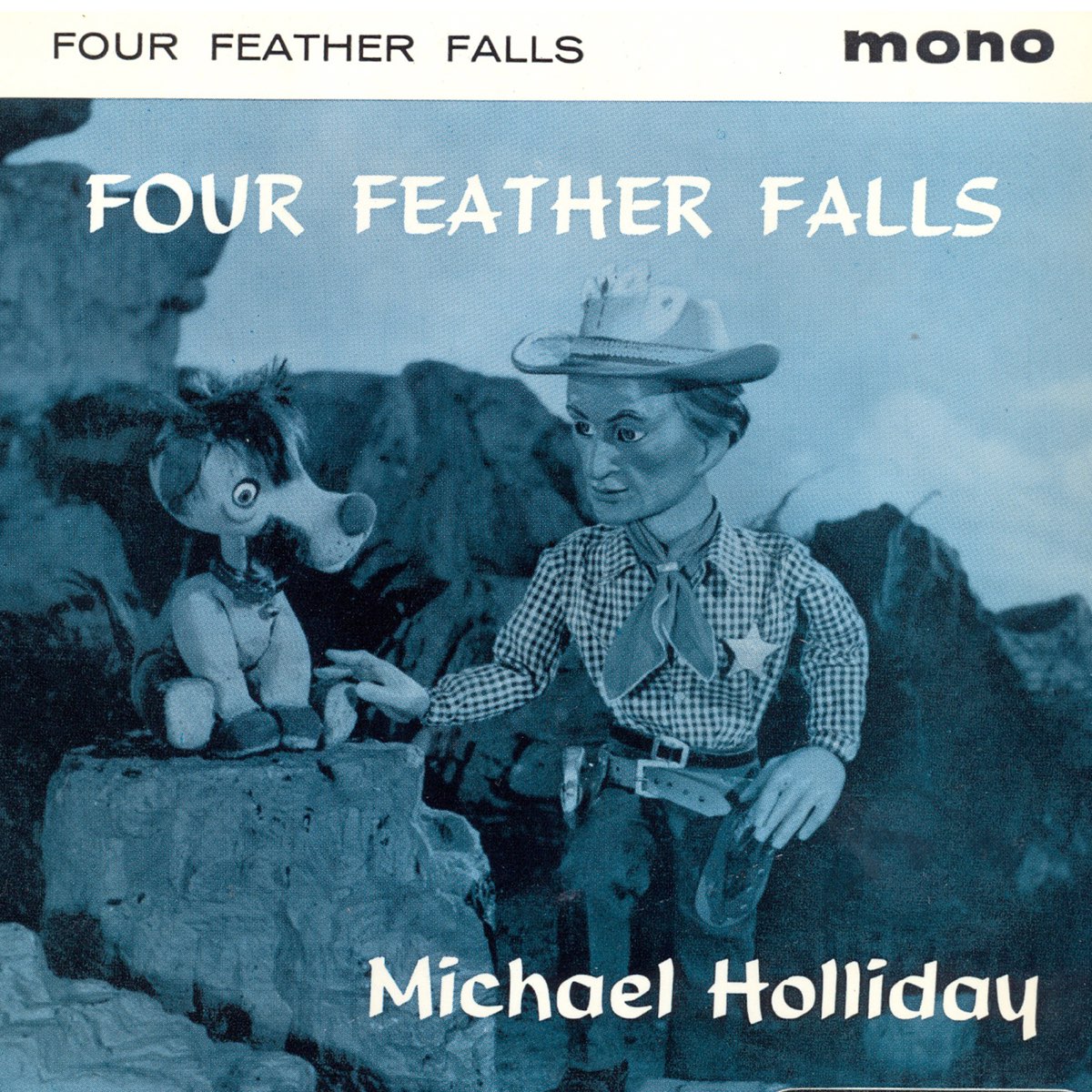
There was literally a new sheriff in town when Gerry and Sylvia scored their first big hit with the adventures of Tex Tucker, a range-riding lawman who maintained order in the Old West with the aid of four magic feathers gifted to him by a grateful Native American community, which allowed him to fire his six-guns telekinetically and also facilitated telepathic communication with his dog and horse. With Westerns still packing out cinemas and country-tinged rock’n’roll riding the trail up the hit parade – albeit usually involving less in the way of inter-species psychic contact – Barry Gray enlisted the services of real life chart-topper Michael Holliday, a square-jawed crooning frontiersman who actually hailed from the Old West of Liverpool, to furnish Two-Gun Tex with a small repertoire of appropriate pastiche campfire favourites which were duly collected on this EP. The extremely brief gallop through opening theme Kalla Makooya Kalla might lack the canyon-vaulting drama of the on-screen version, but otherwise it’s harmonica-heavy twangy clip-clopping ersatz John Wayne soundtrack thrills all the way including wistful salute to those high-falutin’ folks of great renown Happy Hearts And Friendly Faces, a whistle-hooting ride on the Rick-Rick-A-Rackety Train, the amiably spooky legend of The Phantom Rider (On The Hopi Trail), scene-setting amble around the streets of Four Feather Falls – often mistaken for the theme song – and the actual closing theme Two Gun Tex Of Texas and its somewhat over-extended warning to all lowlifes and varmints that “play it bad and he’ll get mad, so cover your treks from Two-Gun Tex, the smartest guy in town!”. Possibly an acquired taste if you’re not that taken with the oddly home on the range-fixated frontier days of pre-Beatles pop music, but a lot more enjoyable than anyone ever really gives it any credit for.
Charles Blackwell And His Orchestra – Supercar/Persian Twist (In A Persian Market) (Columbia, 1962)

Although Barry Gray appears to have made a couple of attempts at recording a full-length version of the rip-roaring beatnik-bongoed theme song from Mike Mercury and Mitch The Monkey’s rescue missions in the sort of flying subaquatic Chevrolet Bel Air dubbed ‘the marvel of the age’, he would only ever release one of them – fitted out with a whistling solo – on a promotional 7″ given away with National Petrol, where it appeared alongside a fully instrumental ‘Twist’ version of the song which, with the best will in the world, it is difficult to imagine Chubby Checker issuing a third single reminiscing about. Instead it fell to bandleader and producer Charles Blackwell to try and take the vehicle that travelled in space and under the sea and indeed can journey anywhere into that most inhospitable of environments, the top forty. Electing to dispense with the lyrics and indeed the breathlessly harmonising excitable female chorus, he opted instead to turn it into a sort of Latin ballroom shuffle which boasts some nice ‘space-age’ guitar effects but is otherwise largely staid and static and generally unremarkable. The unrelated b-side, incidentally – which has since gained a good deal more favour amongst fans of musical exotica than the a-side – is a stomping Hamburg Beatles-style arrangement of that music they always used whenever game show contestants were prevailed upon to attempt the ‘sand dance’.
Don Spencer – Fireball/I’m All Alone Again (HMV, 1962)

Better known now as a long-standing singer-songwriting presenter of the BBC’s pre-school show Play School, Don Spencer actually began his career as a semi-folky pop hopeful and early associate of The Rolling Stones and Marianne Faithfull, but his only real hit came courtesy of the end credits of Fireball XL5. Roped in to lend his vocal talents to Barry Gray’s catchy early electronic instrument-driven lament for being unable to win the heart of a lady with her mind on the solar system – which close observers, and indeed Lieutenant Ninety monitoring events back at Space City, cannot have helped but noticed bore more than a casual resemblance to Johnny Tillotson’s 1961 chart-topper Poetry In Motion – managed to climb to number thirty two; Don’s own flipside composition I’m All Alone Again, incidentally, is a fairly standard flamenco-tinged rock’n’roll ballad and not exactly one to serenade your putative Venus Of The Stars with. If you were looking instead for the Jet Harris And Tony Meehan strapped to a propulsion engine instrumental opening theme, however, then you were in luck – Zero G/Caviare (HMV, 1963) as credited to ‘The XL5’ was in fact Charles Blackwell’s distinctly Joe Meek-influenced rendition of the theme, while Caviare – written by one Charles Blackwell – starts off sounding like a light entertainment take on a Bo Diddley riff but soon turns into a faintly sinister duet between sort of amplified piano and some of those creepy female ‘a-ya-ya-yi-yi-yaaa’ vocals that you only seemed to get in 1962. It never appeared in Fireball Xl5 but it does actually sound weirdly like it should have done. Barry Gray had another go himself in cahoots with His Spacemakers on Zero-G/Fireball (Melodisc, 1964), an even more wildly effect-drenched but otherwise largely identical re-recording of the opening theme but this time equipped with a spoken introduction from Steve Zodiac, Space Doctor Venus and Robert The Robot. Fireball, meanwhile, added vocals from erstwhile chart star Gerry Grant and an abundance of literal bells and whistles. Somewhere between all of the above there’s a definitive Fireball Xl5 theme single.
The Flee-Rekkers – Fireball/Fandango (Piccadilly, 1963)

Named after saxophonist Peter Fleerakkers and discovered by legendary producer Joe Meek, The Flee-Rekkers – or The Fabulous Flee-Rekkers, depending on how swaggering they were feeling that day – had enjoyed a modicum of Hit Parade infiltration in the wake of the early sixties instrumental boom, notably with their 1960 single Green Jeans, essentially a squawking rendition of Greensleeves in the manner of Lord Rockingham’s XI. By 1963, however, the writing was on the wall – or at least someone had crossed out some graffiti saying ‘TEQUILA!’ – for instrumental combos and it was hardly surprising that they should have reached straight for the theme from a big hit television show in the hope of securing a sadly elusive last-ditch revival of fortunes. Perhaps reflecting their mood at the time, their instrumental cover of Fireball is a little more rigidly arranged with a neat and tidy tempo that takes away some of the pop dynamism of the original, but it’s an immensely likeable reworking with enjoyable swapping of lead instruments, a genuinely exciting intro that sounds as though they’d forgotten how Zero G goes and made up their own replacement on the spot and a thrillingly archaic ‘space age’ edge to the arrangement that makes it sound as though it may well have crossed orbital paths with Telstar. Meanwhile if you’ve heard the a-side, seen the producer credit and read the title, you can probably already work out how Fandango sounds.
Gary Miller – Aqua Marina/Stingray (Pye, 1964)
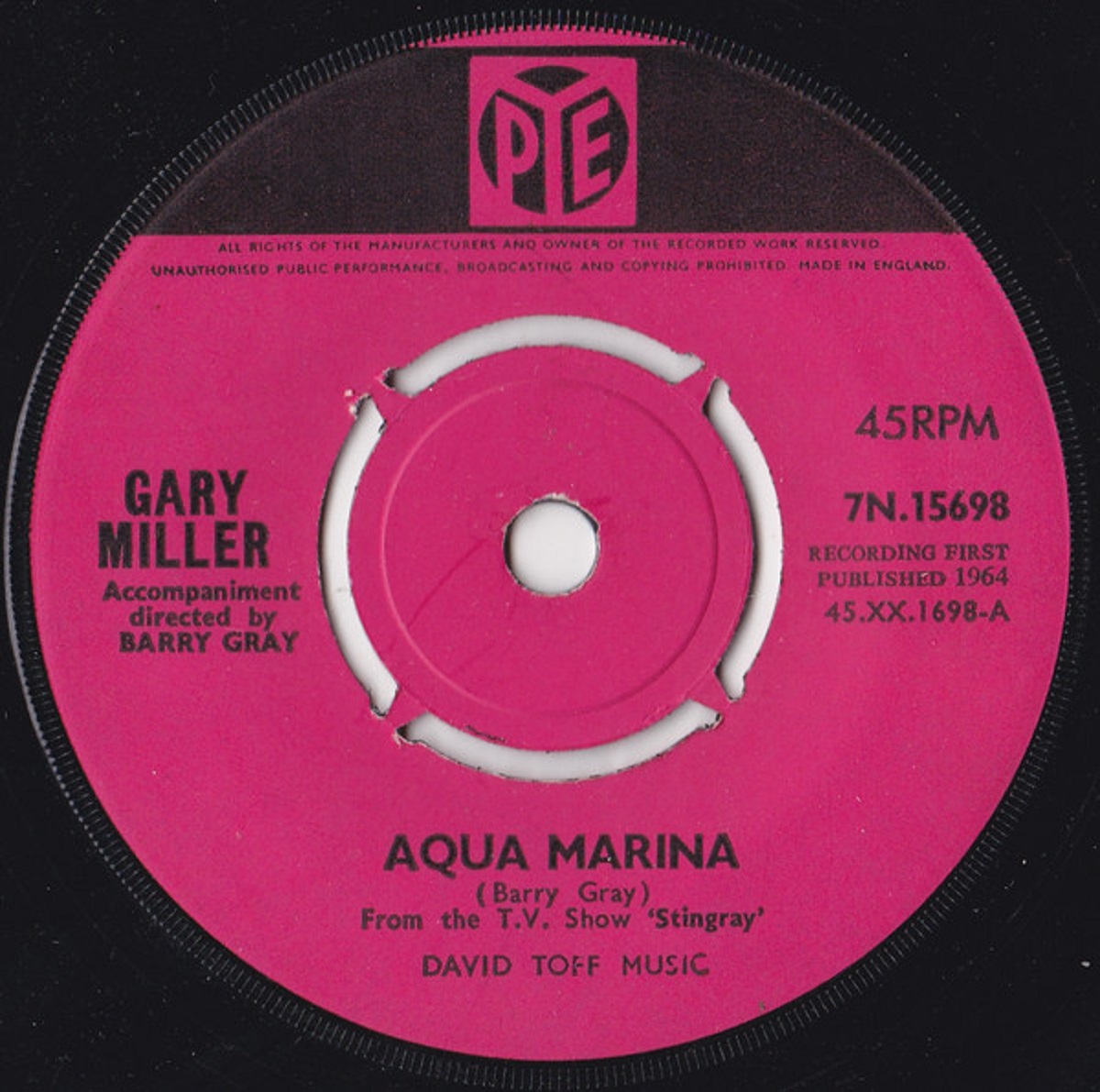
Admittedly it had been quite some time between the hitmaking, but real life hitmaker Gary Miller was engaged to provide the de facto singing voice of Captain Troy Tempest, pilot of the World Aquanaut Security Patrol’s flagship space-age submarine Stingray, so it was perhaps little surprise that Barry Gray’s opening and closing themes would appear as a single in more or less identical arrangements to the on-screen versions. Not remotely inspired by Venus by Frankie Avalon, the closing lament for underwater strange enchantments and unrequited love for a mute mermaid Aqua Marina was selected as the suitably shoal-dodging sing along-able radio listener attention-catcher, although the BBC’s reluctance to afford airtime to it did not exactly help its chart prowess, nor indeed did the fact that on record it was shorn of its accompanying hapless and hopeless love triangle-depicting visuals juxtaposing Troy and Marina at a swanky restaurant with a green-eyed seething Atlanta Shore stuck dejectedly at home – which I had plenty more to say about here, incidentally – or in all honesty the fact that it essentially just did the whole song once, threw in an instrumental verse, then repeated part of the second verse again. Over on the b-side, the action standing by-for opening riptide of a call to arms actually gets a brand new middle eight singing the praises of the Titan-trouncing submersible and an interlude where the harmonising backing chorus literally change their tune, and even if we do not actually get an intro from Commander Shore cautioning that anything can happen in the next half hour, quite a lot happens in the next two minutes and you cannot help but wonder if they actually got this single the wrong way around.
The Barry Gray Orchestra – Thunderbirds/Parker – Well Done! (Pye, 1965)
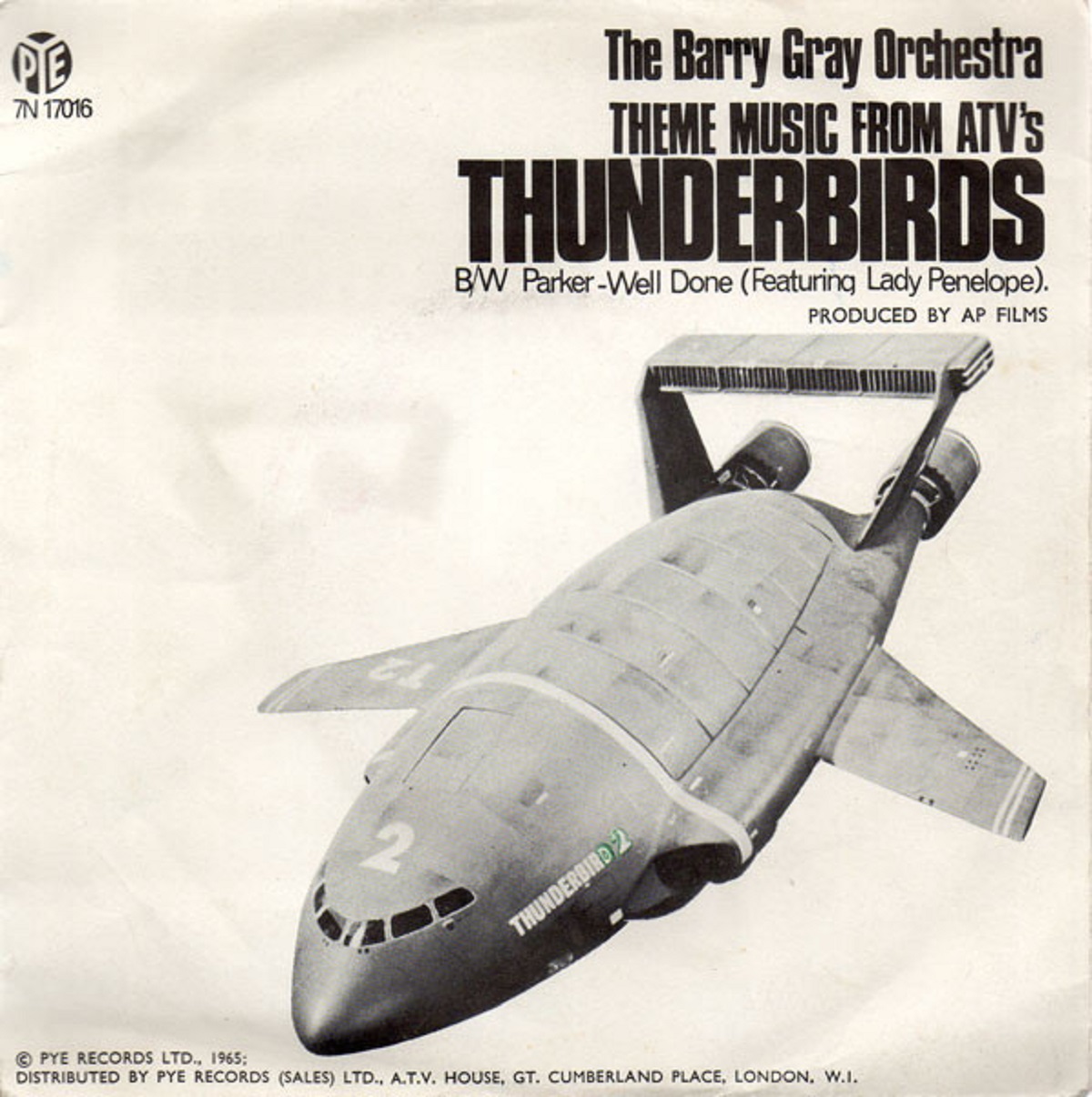
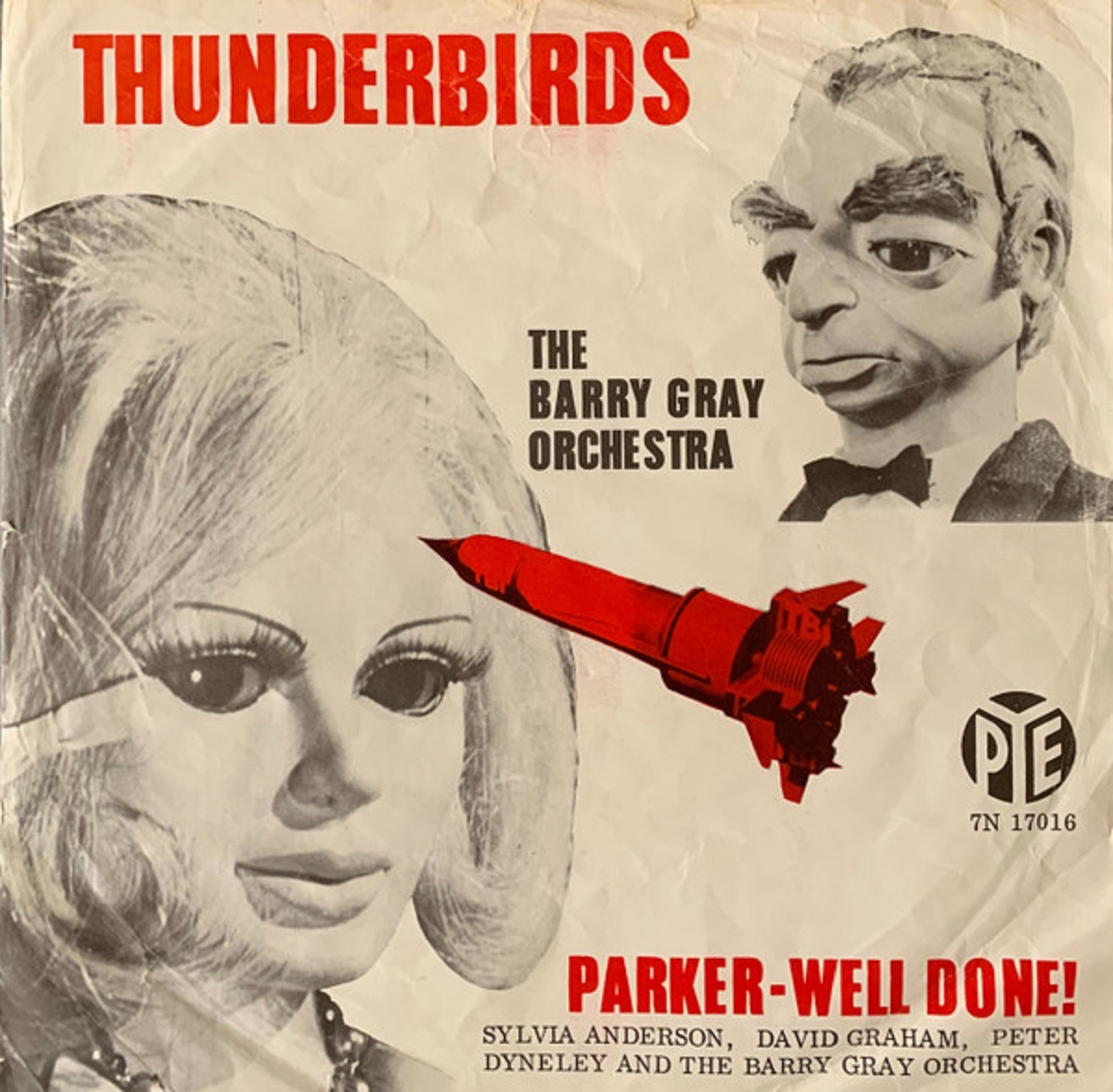
Kicking off with that same show-saving insomnia-infiltrating drum pattern that had Barry Gray up before Farming Today on the BBC Home Service, the full-length version of the Thunderbirds theme was essentially – give or take the odd arpeggiating string section – more or less identical to what was heard introducing the Tracy Brothers and their squadron of aerodynamically challenging rescue craft on screen, albeit without Jeff Tracy’s countdown or the brass section losing the plot entirely over the montage of ‘This Episode’ highlights, but if you wanted that kind of edge-of-seat excitement then you weren’t exactly out of luck. Over on the b-side, Lady Penelope Creighton-Ward and Aloysius Parker found their jaunty little duet about restocking the armaments of Thunderbird-trouncing pink Rolls Royce FAB1 interrupted by Jeff Tracy alerting them to a ‘hot one’ – in brief, a ‘foreign’ agent has stolen the small but very vital Neutronic Stabiliser from Thunderbird 2, and according to information from the FBI from your Scotland Yard, is proceeding along your motorway M4, car is black saloon, make unknown, registration HPJ 960C… repeat: HPJ 960C – obliging them to hare off into a fully Barry Gray-orchestrated car chase culminating in point-reinforcingly loud tyre-spearing and component-retrieval, and calmly heading “Home, Milady?” – “Home, Parker” to finish off their temporarily sidelined jovial musical exchange. They don’t make b-sides like that any more.
The Barry Gray Orchestra – TV21 Themes (Century 21, 1965)
Never ones to miss a shrewd marketing or merchandising opportunity, Gerry and Sylvia wasted little time in setting up TV Century 21, a phenomenally successful weekly comic featuring all of their shows and characters in strip form with mocked-up newspaper spreads almost invariably reporting on Stingray being ‘lost’, and the closely associated Century 21 records which essentially featured all of their shows and characters on vinyl in stylish EP form. The overwhelming majority of these sturdy 45rpm releases were story records like The Stately Home Robberies and Marina Speaks, but there were also occasional musical selections including this particular crammed compilation of music from the shows that you were presumably supposed to listen to whilst reading the latest issue of TV Century 21 in a sort of primitive excursion into immersive multimedia. In addition to the single versions of Stingray and Parker – Well Done!, we also get at long last an extended as-heard-on-screen version of the Supercar theme, and a re-recording of Fireball with future singing voice of Postman Pat Ken Barrie in what can only be described as an arrangement tailored to meet the requirements of Sunday Night At The London Palladium. In contrast, the Century 21 March can only be described as an amped-up and sped-up reimagining of the middle bit of the Thunderbirds theme, and thanks to a circuitous licencing arrangement that saw the Daleks invading the back page of TV Century 21 whilst their most celebrated adversary had to make do with battling enchanted storybooks and a seemingly limitless supply of alien races who all looked like parrots over at TV Comic, there’s also Eric Winstone’s unfairly maligned very much standard for its time rendition of the Doctor Who theme – released on Pye in 1964 as the very first ever commercially available item of Doctor Who-related music, and arguably the first item of Doctor Who merchandise full stop – to which Barry Gray purportedly contributed electronic effects. Incidentally the Daleks also got their own Century 21 Records EP, featuring a cut-down narrated version of Planet Of Decision, the final episode of 1965’s The Chase. It’s astonishing to think now that this was once literally all that you could own and ‘watch’ again of Doctor Who.
Barry Gray And His Music – Great Themes From Thunderbirds (Century 21, 1966)
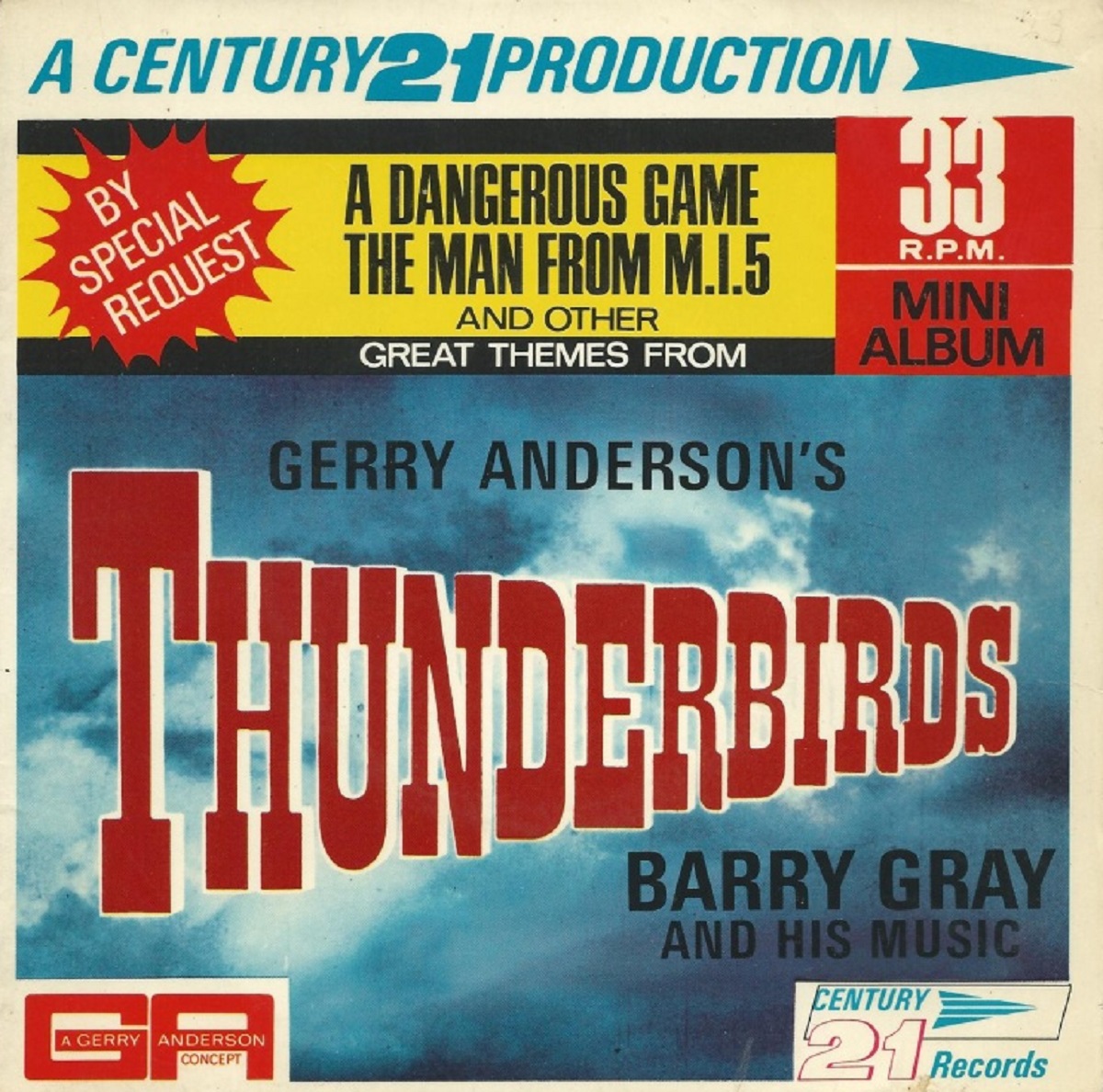
With Thunderbirds having established itself as a success on a level beyond pretty much anyone’s expectations, Century 21 Records released this EP featuring re-recorded versions of some of Barry Gray’s more memorable and noteworthy incidental cues from the series, and while there is nothing here that would especially surprise anyone who is just sort of humming invented Thunderbirds incidental music to themselves it’s still a surprisingly listenable and diverse assortment – well, ‘diverse’ in that it still all sounds recognisably by Barry Gray from an entire continent away – of instrumental emphases. That Dangerous Game is an instrumental reading of the sub-Shirley Bassey showstopper Lady Penelope belts out whilst posing as ‘Wanda Lamour’, Let’s Play Ad Lib is the polite jazzy improvisation that the band strike up in her absence, The Man From MI5 opts for Peter Gunn-esque beatnik spy jazz, San Marino shimmers along on atmospheric Mediterranean guitar, Joie De Vivre deploys an accordion with the intention of spreading just that, and Jeremiah – the signature tune of International Rescue’s little-seen cabin-dwelling Deep South operative – sound pretty much like what you would expect if someone nabbed a banjo and continued ostentatiously plucking at it whilst continually eluding comedy incompetent cops. Incidentally, this is as good a moment as any to mention Barry Gray’s own Century 21 EP Space Age Nursery Rhymes, which featured the bloopy orbiting likes of Three Refined Mice and Mary Had A Little Gram and is frankly even more deeply odd than you are imagining.
Barry Gray And His Music – Lady Penelope Themes (Century 21, 1966)

With both TV Century 21 and Thunderbirds itself enjoying overwhelming popularity, Lady Penelope also got her own equally successful comic, billed as ‘for girls who love television’ but even that is a little bit of a short sell for a title that emphatically reflected Sylvia’s insistence that girls, whether they love television or otherwise, should have assertive and capable role models who were just as equipped to take care of business as the men. Marina, ‘Girl Of The Sea’, starred in her own solo adventures as would Captain Scarlet’s high-flying associates The Angels, alongside the sadly never seen on television time traveller Jenny Ware, Cathy Thomson – presumably a descendent of the Tucker family – who could telepathically communicate with dogs, and a young nurse called Pat Langdon who worked on a ward funded by Lady Penelope, although the main attractions were always the assorted escapades of ‘Er Ladyship and Parker, and a handful of other unrelated licensed shows that were deemed to have sufficient appeal for a young female readership. Quite how many of them correspondingly invested in this peculiar EP, however, is another question. As well as the inevitable threadbare re-recording of Aqua Marina with Ken Barrie, for which the budget apparently did not extend as far as hiring backing singers, there are two brand new and frankly utterly splendid songs featuring Lady Penelope and Parker singing each other’s praises – “I know he’s spent some time in jail where a hectic life he led, they called him Nosey Parker cause his nose is large and red, and his cellmate was a gentleman they called Light-Fingered Fred” and “a secret hagent what always captivates” who has “coshed out several coppers” respectively – which sit somewhere between Parker – Well Done!, Bernard Cribbins’ sixties novelty singles and the standard wittily quoted bits of the Thunderbirds theme. Elsewhere, however, Barry and Barrie re-arrange The Man From U.N.C.L.E. for social club organ and glockenspiel, subject Bewitched to a beat boom overhaul nobody asked for, and to all intents and purposes render The Beverly Hillbillies in the style of your teacher attempting to sing it to the class long after repeats have ceased to be a going concern. Jeremiah would not have been amused.
The Shadows – Thunderbirds Are Go! (Columbia, 1966)

By 1966, International Rescue had become so inescapably massive that they were ‘go’ on the big screen too, with rebuilt and resized puppets and props and every attempt made to replicate the must-watch thrills of their small-screen adventures. However, despite the highest profile of high profile launches, Thunderbirds Are Go! remained resolutely stock still on the Thunderbird 2 launch ramp as audiences stayed away in their droves, with many reasons put forward for its lack of widespread appeal but none more compelling than Gerry’s shrugged suggestion that they probably did not feel much inclined to pay for something that they could otherwise see for free on their televisions at home. Whatever the movie’s shortcomings, you do have to admire its sense and scale of ambition, not least in an extended dream sequence in which Alan Tracy and Lady Penelope visit a sort of interplanetary restaurant for the ‘of money’ where they witness a suitably cosmologically-themed personal appearance by puppets of Cliff Richard and The Shadows. Shooting Star, the song they perform in Thunderbirds Are Go! and the lead track of this EP, is a fairly pedestrian light rocker even by Cliff’s standards of four years previously; elsewhere, however, Hank Marvin and the gang are let loose on a handful of instrumentals that frankly make you wish they had been allowed to score the entire film. As well as a string-rattling abandon-powered rampage through the Thunderbirds theme itself, there’s also an astonishing Bond Theme-adjacent effect-drenched take on the military motif deployed to accompany the unveiling of stricken deep space exploratory mega-vehicle Zero-X, and a band-penned lightly wah-wah’ed mock-Hawaiian ode to the elegance, charm and deadly danger of Lady Penelope. Just try and ignore the decidedly ropey lyrics of the song that comes with them and this is pretty much an essential listen.
The Barry Gray Orchestra – Captain Scarlet/The Mysterons Theme (Pye, 1967)

You all know the theme song from Captain Scarlet And The Mysterons, right? It’s the catchy yet ominous instrumental based around a descending motif and a bloke and a robot alternating “Cap-tain Scar-let!” – “KFMAMPTAN FCARLEF” that suddenly acquired thrillingly over-involved lyrics a couple of weeks in courtesy of real life psychedelically over-attired chart hopefuls with their own strip in Lady Penelope The Spectrum, and which every sarcastic bloke butting into a conversation sings as “Captain Scarlet, indestructible, bee ba bar be bop ba bee bo” to an entirely different tune altogether. Which is why so many successive generations of Supermarionation fans must have been so disappointed to cue this single up and discover an entirely instrumental version – all ninety seconds of it – apparently sped up and reconfigured for the benefit of this week’s competing teams on Come Dancing, as The Spectrum’s rendition sat gathering dust in a vault at RCA while their unremarkable Headin’ For A Heatwave failed to make any kind of an impression on the Hit Parade whatsoever. Fortunately, the b-side more than compensated for this by taking the eerie four-note motif that introduced the titular slighted Martian antagonists and transforming it into a sinister shimmering slow dance in a Cold War-era cocktail lounge that more or less invents Trip-Hop three decades early and sounds so menacing that the musicians appear to bring proceedings to a very hurried conclusion in the hope of getting as far away from it as possible as quickly as they can. All things consiTHIS IS THE VOICE OF THE MYSTERONS… WE KNOW THAT YOU CAN HEAR US, EARTHMEN… YOU CAN FIND MUCH MORE ABOUT JUST HOW SPECTACULARLY BRILLIANT THE MYSTERONS THEME IS HERE.
Mike Vickers – Captain Scarlet And The Mysterons/Kettles Of Fish (Columbia, 1967)

With no serviceable rendition of the theme from Captain Scarlet And The Mysterons available from your local record retailer, Manfred Mann’s guitarist thought he might as well have a go and turned in this creditable approximation of the original Spectrum-deficient robo-duet arrangement with added rough and ready lead guitar, swirly psychedelic effects and an improvised dramatically chanting male choir-led middle eight which would frankly have given The Mysterons pause for thought. Over on the b-side, however, it’s Hammond-dominated Swinging London-evoking business as usual.
The Barry Gray Orchestra – Captain Scarlet TV Themes (Century 21, 1967)
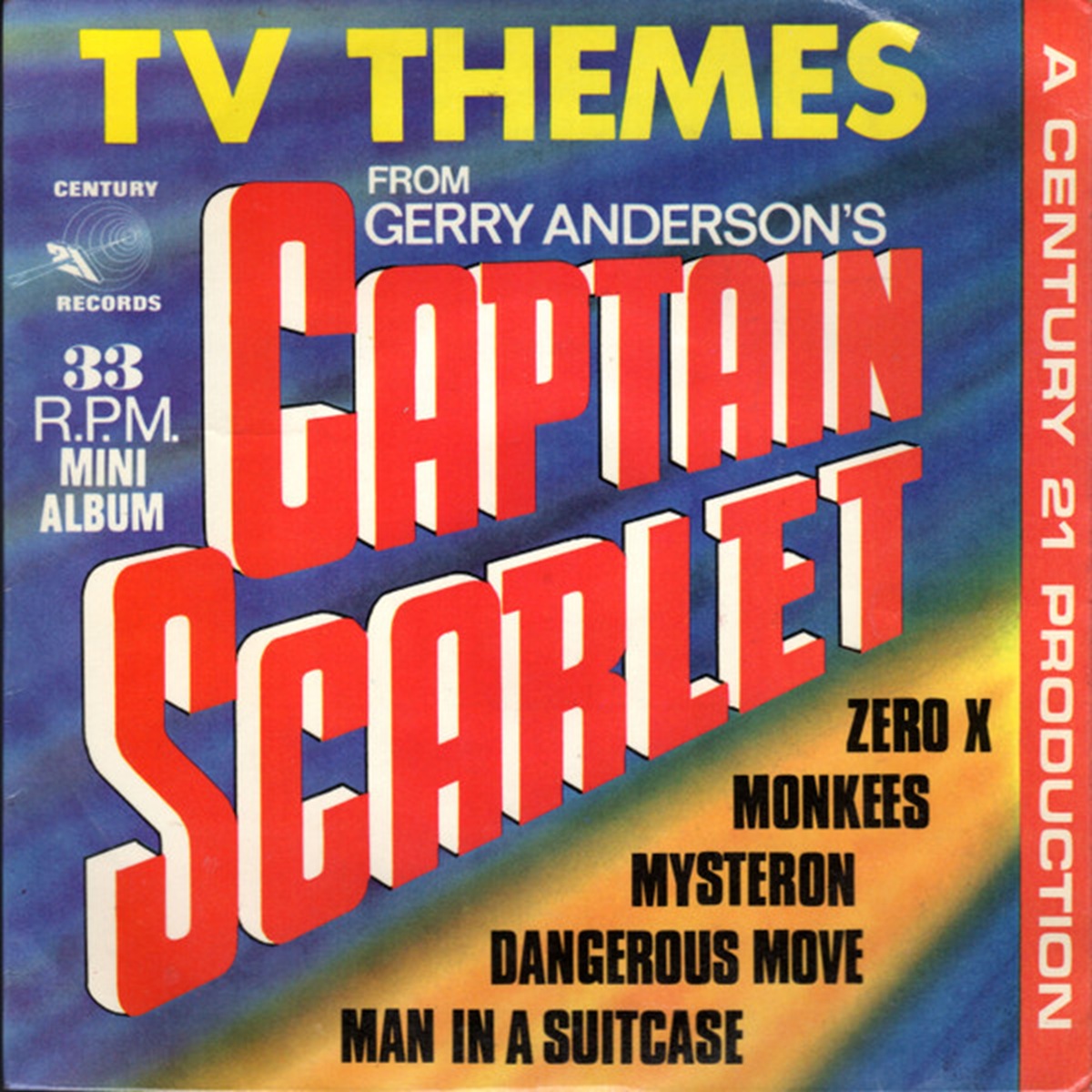
Meanwhile, Barry Gray’s original arrangement – still with The Spectrum nowhere within earshot – turned up on this shoddily-artworked Century 21 EP, alongside The Mysterons Theme and sort of mildly Mysteroned-up interpretations of Zero-X, That Dangerous Game and for no evident reason Ron Grainer’s theme from Man In A Suitcase, alongside – thanks to their appearance in comic strip form in Lady Penelope – the theme from The Monkees in a slowed-down Test Card-appropriate instrumental rendering at a pace that that suggests that ‘here they come/walking down the street’ might well involve you having to wait a while. Somehow essential yet inessential at the same time, the evident lack of enthusiasm and attention to detail in every aspect of this record – the last release on the Century 21 label – suggest all too clearly that Supermarionation was more or less gone as Gerry and Sylvia eyed up their first live action feature film. Somewhere, though, Professor Maclaine was busily cueing up the ‘having a good theme tune’ brain pattern recording…
The Barry Gray Orchestra – Joe 90/Hijacked (Pye, 1968)

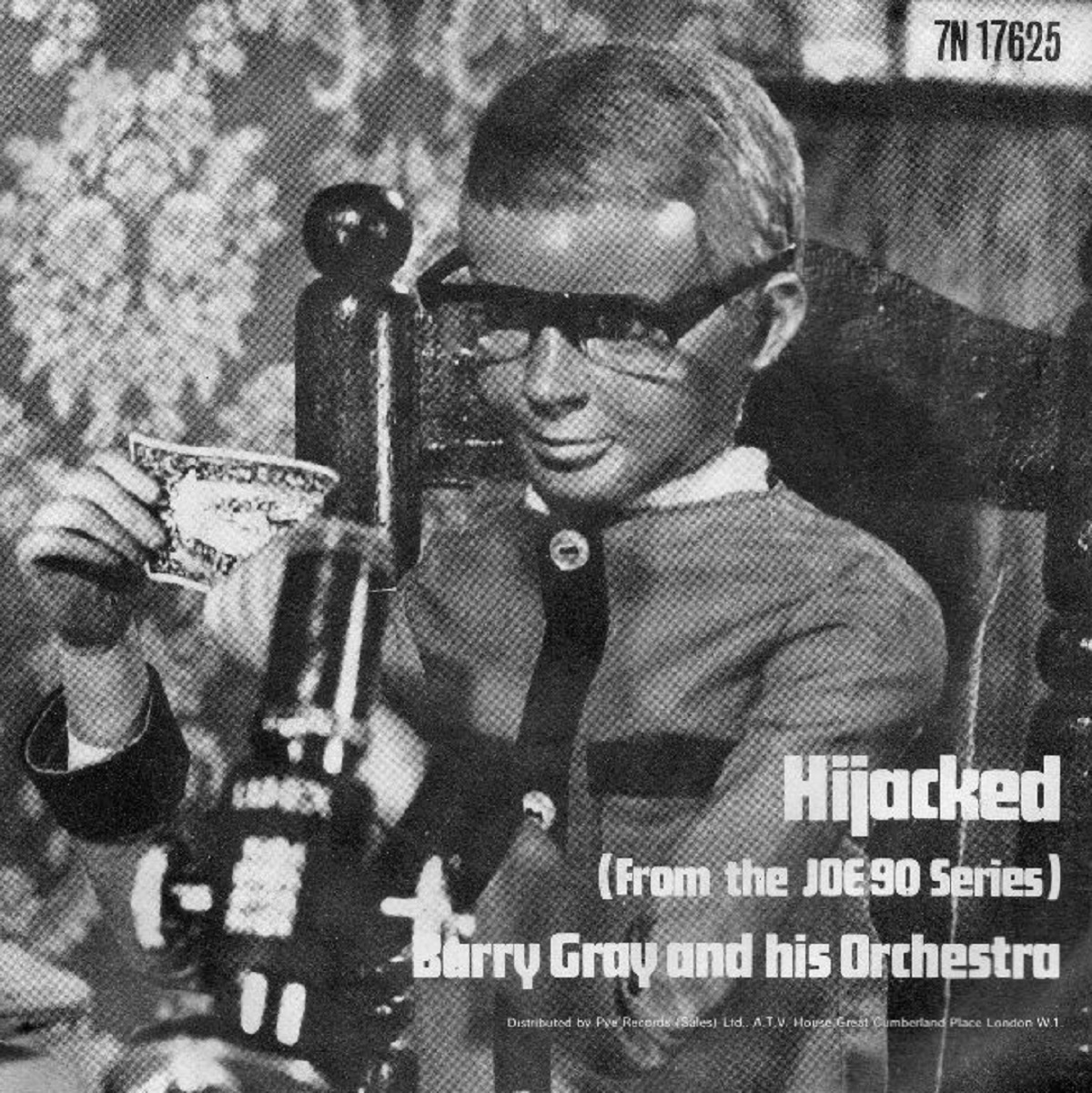
A show about a nine year old genius who gets to have moderately exciting adventures by absorbing the brain patterns of experts but at the same time can hardly realistically be placed in very much of a degree of peril was never quite going to achieve the same heights of popularity as Thunderbirds, but Joe 90 did at least score over pretty much every other Supermarionation show in one major regard – the absolutely belting theme tune. Set to an almost impossibly mechanically tight Motown beat, top session guitarist Vic Flick hammers out an instrumental duet with Barry Gray at the Farfisa organ, contrasting hilariously with the uneventful accompanying footage of a massive tape spool running for about two and a half seconds and Joe sitting absolutely motionless in the middle of BIG RAT. The version on this single is an even more polished take with an added swaggering brass section, backed with a similarly whipped-up and slightly retitled take on an incidental cue from the episode Hi-Jacked. Bizarrely and indeed brilliantly, both sides of the single later became in-demand bowling shoe-stomping instrumental floor-fillers on the early Northern Soul scene, causing miseryguts ‘purists’ to launch a campaign with the somewhat disproportionately brutal slogan ‘Bury Joe 90’ – which failed to account for the fact that he’d probably already been pre-programmed with an escapologist’s brain patterns – and they were safe from suddenly finding themselves accidentally dancing to Barry Gray straight after Frankie ‘Loveman’ Crocker once more.
The very last Supermarionation show, 1969’s Stanley Unwin-starring size-changing gobbledygook clerical espionage whimsy The Secret Service, didn’t even last long enough for a rotatey disker to find its way into record shops for the pleasure of the discerning publy and their eardrobers. Yet even if that unlikely fusion of of church organ and free-jazz vocal yodelling did not make it on to a 7″ single, it acted as a fitting conclusion to an astonishing run of theme songs that are still recognisable – and exciting – all this time later. They inspired rival cover versions, they infiltrated esoterically slanted dance music scenes, and they thundered along on lyrics like “it travels on land, or roams the skies, through the heavens’ mighty rage, it’s Mercury-manned, and everyone cries – ‘it’s the marvel of the age!'”; and that was just the ones that had lyrics. Just a few bars of any of them can make you too feel like your heart would be a fireball every time you gazed into her starry eyes. Although it’s still debatable how well that unused Thunderbirds theme would have gone down at the Wigan Casino.
Buy A Book!
There’s lots more about Four Feather Falls, Supercar, Fireball XL5, Stingray, Thunderbirds, Captain Scarlet And The Mysterons, Joe 90 and tons of other much-loved puppet favourites including some that didn’t even have a theme single in The Golden Age Of Children’s TV, available in all good bookshops and from Waterstones here, Amazon here and directly from Black And White Publishing here.
You can also find the curious story behind little-seen Supermarionation misfire The Secret Service in Well At Least It’s Free here, and more about the music from Captain Scarlet And The Mysterons and Stingray in Keep Left, Swipe Right here.
Alternately, if you’re just feeling generous, you can buy me a coffee here. You could always ask Parker to bring it. He’s got a few more jobs to do – but don’t ‘ave any fears!
Further Reading
I’m Certain To Fall I Know takes an exasperated look at the hapless, hopeless love triangle at the heart of Stingray; you can find it here. We Know That You Can Hear Us, Earthmen… takes a similar look at the thrills of first discovering Supermarionation and the chills of first discovering The Mysterons Theme and you can find it here.
Further Listening
You can find me having a bit of a chat about Gerry and Sylvia Anderson’s various shows and their significance to the story of The Golden Age Of Children’s TV in Looks Unfamiliar here.
© Tim Worthington.
Please don’t copy this only with more italics and exclamation marks.
 Tim Worthington